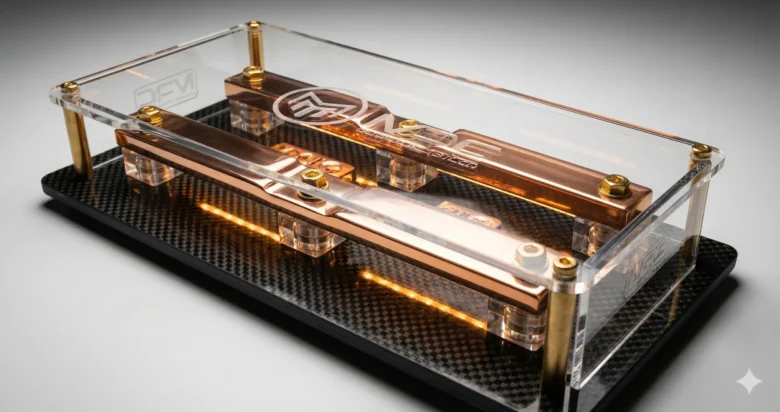
I once visited a high-stakes SQ (Sound Quality) competition in Switzerland where I saw a trunk that changed my perspective on wiring forever. There wasn’t a single wire in sight. Instead, there was a series of polished, mirror-finished copper bars flowing across the back of the car like a work of art. The owner called it his “Cathedral.” It had cost him more than most people’s entire sound systems just for the distribution blocks.
At first, I thought it was pure vanity. But then he showed me his digital readouts. While his six amplifiers were pulling nearly 800 amps of current during a peak, his voltage drop from the battery to the furthest amp was 0.01V. It was effectively a perfect circuit. In my 20 years of shop work, I had never seen such Electrical Integrity. It wasn’t just beautiful; it was the ultimate expression of power engineering.
Most installers treat power distribution as an afterthought—a cheap plastic block hidden under a seat. But in a world-class build, the distribution center is the heart of the machine. It is where raw energy is refined and delivered with surgical precision. If you are tired of “spaghetti” wiring and want the lowest resistance humanly possible, you need to step inside the cathedral of copper.
The Physics of the Solid Path: Why Bars Beat Wires
The goal of any Power Distribution system is to move current with zero interference. Every time you crimp a lug onto a wire, you create a point of resistance. In a high-power system with four batteries and four amps, you might have 20 or 30 of these “choke points.”
A solid copper busbar eliminates the crimp. By bolting your components directly to a massive, solid conductor, you are providing a path with significantly higher Electrical Conductivity.
Material Science: The Magic of C110 Copper
In Extreme Audio Engineering, not all copper is created equal. If you go to a local hardware store and buy “architectural” copper, you are getting an alloy that might only be 80% conductive. The pros use C110 ETP (Electrolytic Tough Pitch) Copper.
C110 is 99.9% pure copper. It is engineered specifically for electrical applications. It has the highest conductivity rating of any non-precious metal. When you use C110, you aren’t just buying metal; you are buying the most efficient electron highway on the planet.
Designing for Zero Voltage Drop
When designing a “Copper Cathedral,” we use the “Manifold Principle.” Think of a high-performance engine’s intake manifold—it ensures every cylinder gets the same amount of air. Our distribution center does the same for voltage.
By using a central, massive Copper Busbar as the primary rail, every amplifier “sees” the exact same electrical potential. This prevents “voltage steering,” where one amp starves while another thrives. This is critical for keeping your gains perfectly matched across multiple subwoofers.
CAD & CNC: Machining the Masterpiece
The days of cutting copper bars with a hacksaw in a garage are over. To achieve world-class results, we use CAD (Computer-Aided Design) to map out the distribution center. We account for every bolt hole, every fuse location, and every mounting point.
Once the design is perfect, it’s sent to a CNC Machining center. This allows for tolerances as tight as 0.001 inches.
- Tapped Holes: We tap threads directly into the copper, allowing you to bolt lugs down with extreme pressure for a low-resistance “cold-weld” feel.
- Beveled Edges: To prevent air turbulence and for pure aesthetic perfection.
Surface Area and Current Density
One of the reasons solid bars outperform cables is the sheer amount of surface area they provide for connections. In a high-current transient (like a heavy bass drop), the Current Density can become extreme.
Because the bar is wide and flat, it dissipates heat far better than a bundled wire. It acts as a massive heat sink for your electrical system. This keeps the temperature of your battery terminals and amp inputs low, which in turn keeps the resistance low. It is a self-reinforcing cycle of efficiency.
The Art of Plating: Nickel vs. Gold
Copper is beautiful, but it oxidizes (turns green) when exposed to air and moisture. To maintain Electrical Integrity and that “show car” look, you must plate the copper.
- Nickel Plating: The choice for a “stealth” or industrial look. It is incredibly durable and highly resistant to corrosion.
- Gold Plating: The ultimate in luxury. Gold doesn’t oxidize at all, ensuring that your contact points remain perfect for decades. Plus, the visual impact of 24k gold busbars is unbeatable.
Mounting and Structural Integrity: Safety First
A 10-pound block of copper is a dangerous object if it isn’t mounted correctly. In Extreme Audio Engineering, we use high-strength insulators (like G10 Garolite or high-density HDPE) to mount the busbars to the vehicle’s chassis.
These insulators must be able to handle the weight and the heat without deforming. Every mounting bolt is a potential short-circuit point, so we use nylon washers and recessed “counter-sunk” holes to ensure the positive bar never touches anything it shouldn’t.
Safety: The Clear Acrylic Shield
A “Copper Cathedral” is meant to be seen, but it’s too dangerous to leave exposed. A dropped wrench across a 1,200-amp busbar is an explosion, not a spark.
We always finish these builds with a custom-formed Clear Acrylic Shield.
- Visibility: You can still see the mirror-polished copper and the glowing LEDs.
- Protection: It prevents accidental contact with the live rails.
- Ventilation: We laser-cut slots into the acrylic to allow for airflow, ensuring the bars stay cool during long demo sessions.
Conclusion: Where Beauty Meets Brute Force
Building a high-end Power Distribution center is the ultimate challenge for a car audio engineer. It requires a mix of metallurgy, physics, and fine art. While a simple distribution block will “get the job done,” a Copper Cathedral ensures that your system performs at the very edge of what is physically possible.
When you invest in C110 Copper, precision CNC Machining, and proper plating, you aren’t just making your trunk look better—you are perfecting the heartbeat of your sound. You are ensuring that when the music calls for power, your system answers with zero hesitation.
FAQ:
1. Is copper better than silver for busbars? Silver is technically 5% more conductive than copper, but it is also much more expensive and oxidizes very quickly. For the cost of a silver bar, you can buy a copper bar that is 50% thicker, which will have much lower total resistance. Copper is the smarter engineering choice.
2. How do I prevent the bolts from vibrating loose in a copper bar? Copper is a soft metal. When you torque a bolt into a copper thread, it can “creep” over time. Always use stainless steel hardware with star washers or a tiny drop of conductive thread-locker to ensure the connection stays tight under 160dB of vibration.
3. Do busbars affect the sound quality, or just the volume? Both. By stabilizing the voltage, you reduce the “intermodulation distortion” in the amplifier’s power supply. This leads to a lower noise floor and a more transparent high-frequency response. Your speakers will sound more “effortless.”