I remember a client who spent six months building a world-class “wall” in his Suburban. He had the best subs, the best amps, and a custom paint job that cost more than my first car. But when we hit the first demo, his $4,000 Lithium LTO bank started to sag. Within thirty minutes of heavy playing, the voltage dropped to 12.8V and his expensive amps started getting dangerously hot. He had spent a fortune on the “best” battery tech, only to find out it couldn’t sustain the pressure he needed for an all-day demo.
He looked at me and asked the question every builder asks: “Is there anything else? Something that doesn’t cost a mortgage payment but actually stays at 14 volts?” At the time, the answer was no. But the engineering landscape has shifted. While the world was fighting over the remaining supply of Lithium, a new contender emerged from the energy storage sector that is perfectly suited for the violent demands of Extreme Audio Engineering: the Sodium-Ion Battery.
Sodium-Ion isn’t just a “budget” alternative; it’s a chemical breakthrough that solves the two biggest problems in car audio—cost and cold-weather performance. If you want a rock-solid 14.8V rail that refuses to budge during a 30Hz bass drop, and you want it for half the price of high-end Lithium, you need to understand the science of the Sodium Ion.
What Exactly is Sodium-Ion Chemistry?
To understand the hype, we have to look at the periodic table. Sodium (Na) sits right below Lithium (Li). They are “chemical cousins.” Both work by moving ions between a cathode and an anode to store and release energy. However, Sodium is essentially everywhere—it’s the “salt” of the earth.
For the Car Audio world, this abundance is the “New Opportunity.” Because we don’t have to mine rare minerals like Cobalt or Lithium to make these cells, the production cost is 30% to 50% lower. But the real magic isn’t in the price—it’s in the Voltage Curve.
The 14.8V Sweet Spot: Why Amplifiers Love Sodium
Most high-performance amplifiers are designed to perform their best at 14.4V to 14.8V.
- Lead Acid/AGM: Rests at 12.6V. Under load, it crashes to 11V.
- LiFePO4 Lithium: Rests at 13.2V. Good, but still requires a lot of help to stay above 14V.
- Sodium-Ion: Many Sodium cells are engineered to have a nominal voltage that aligns perfectly with a High-Output Alternator charging at 14.8V.
This stability means your “headroom” increases. You get tighter, more controlled bass because the amplifier’s power supply isn’t gasping for air every time the subwoofers move.
Performance in Extreme Temperatures: The Lithium Killer
If you live in a climate where it snows, you know that Lithium is a nightmare. Most Lithium batteries cannot be charged below freezing without being destroyed. They also lose massive discharge capacity when the mercury drops.
Sodium-Ion Batteries are different. They maintain over 90% of their discharge capacity at -20°C (-4°F). For a daily driver in the Midwest or Northern Europe, this is a game-changer. You get the same violent bass in January that you get in July. This Thermal Stability is one of the primary reasons the “Old School” crowd is starting to switch.
Safety and Non-Flammability: The Peace of Mind Factor
We’ve all seen the videos of Lithium batteries entering Thermal Runaway—a self-sustaining fire that burns at 1,000 degrees. While rare in car audio, the risk is real when you have 50lbs of Lithium bolted into a vibrating trunk.
Sodium-Ion is chemically much more stable.
- No Thermal Runaway: It is nearly impossible to make a Sodium cell catch fire through overcharging or physical damage.
- 0V Discharge: You can discharge a Sodium battery to zero volts for safe shipping or storage without damaging the chemistry. If you do that to Lithium, the battery is dead.
Cycle Life: Is it Really a 10-Year Battery?
In the world of Extreme Audio Engineering, we abuse our gear. We charge and discharge our batteries hundreds of times a month.
- AGM: Lucky to survive 300-500 deep cycles.
- Sodium-Ion: Rated for 2,000 to 4,000 full cycles.
Even if you demo your system every single day, a Sodium bank will likely outlast the vehicle it is installed in. This longevity makes the “Cost per Amp-Hour” over the life of the system much lower than any other technology on the market.
Building the Sodium Bank: Installation Basics
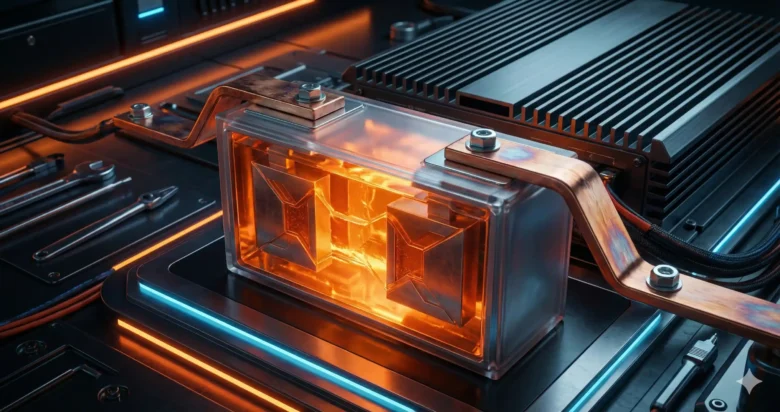
You don’t install a Sodium bank like a standard battery. To handle the massive current these cells can dump, you need a professional infrastructure.
- Copper Busbars: Do not use wires to link cells. Use C110 Copper Busbars to ensure the lowest internal resistance.
- Compression: Like many prismatic cells, Sodium cells should be mounted in a rigid frame to prevent expansion during high-current charging.
- Active Balancing: Use a high-quality BMS (Battery Management System) to ensure every cell in the bank stays at the same voltage.
Alternator Integration: Feeding the Beast
To get the most out of a Sodium bank, you need a High-Output Alternator with an adjustable External Voltage Regulator.
You want to set your charging voltage to the exact peak recommended by the cell manufacturer—usually around 14.8V to 15.0V. This keeps the Sodium cells in their “Peak Discharge” zone, ensuring that when you turn the volume up, the voltage stays pinned.
Conclusion: The Final Verdict on Sodium-Ion
We are witnessing the end of the Lithium monopoly. Sodium-Ion Batteries offer the high-voltage stability of LTO, the safety of LiFePO4, and a price point that makes Extreme Audio Engineering accessible to everyone.
If you are building a new system today, the smart money is on Sodium. It’s safer, it’s cheaper, and it loves the cold. Most importantly, it keeps your voltage at 14.8V, giving your amplifiers the “clean fuel” they need to dominate the lanes.
FAQ:
1. Can I use my standard Lithium charger for Sodium-Ion? No. Sodium-Ion has a slightly different charging profile. Using a Lithium-specific charger might undercharge the cells or trigger a safety shut-off. Always use a charger that has a dedicated “Sodium” or “User-Defined” voltage setting.
2. Are Sodium batteries heavier than Lithium? Slightly. Sodium-Ion is about 20% less energy-dense than high-end Lithium, meaning a battery of the same capacity will be a bit larger and heavier. However, in a car audio build, the weight difference is negligible compared to the massive subwoofers and enclosures already in the trunk.
3. Is Sodium-Ion available for retail purchase yet? It is starting to flood the market via specialized energy storage distributors. While you might not find them at your local big-box store yet, they are becoming the “secret weapon” for pro installers who source their own cells for custom banks.