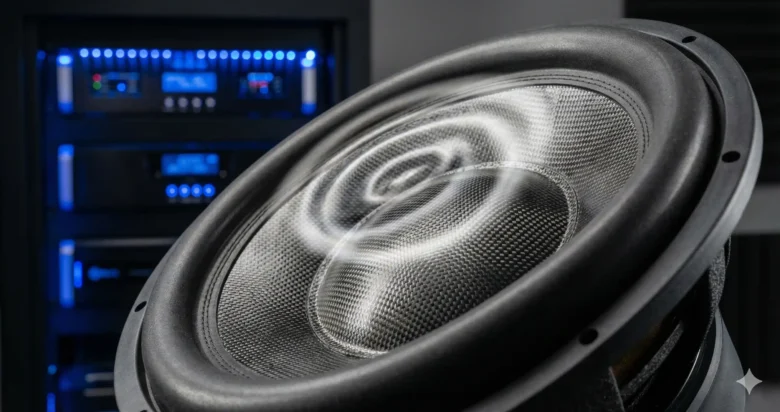
I remember a “Bass Boxing” competition in Vegas where a guy brought out a single 18-inch sub that had nearly 4 inches of peak-to-peak travel. Watching that cone move was like watching a living, breathing creature. It was beautiful, but every time the track dipped into the 20Hz range, you could hear a faint “clack” sound. The owner was grinning, but I knew that sound—it was the voice coil former literally hammering against the backplate of the motor.
Three minutes later, the music stopped. The “clack” had turned into a “crunch,” and the sub was seized solid. He had chased the visual “flex” but ignored the mechanical limits of his gear. He pushed for 100% excursion but didn’t have the engineering foundation to prevent Bottoming Out. He didn’t just lose the round; he turned a $1,200 driver into a paperweight.
Excursion is the lifeblood of deep bass. If you want to move the air in a large cabin, your cones have to travel. But there is a razor-thin line between “maximum output” and “mechanical suicide.” In this guide, I’m going to show you how to find that line, stay on it, and ensure your subs survive the most violent tracks in your library.
Xmax vs. Xmech: The Red Line of Engineering
In Extreme Audio Engineering, we deal with two types of limits. If you don’t know the difference, you’re gambling with your gear.
- Xmax (Linear Excursion): This is how far the cone can move while the voice coil is still 100% controlled by the motor’s magnetic field. Once you go past Xmax, distortion sky-rockets and the amp loses control.
- Xmech (Mechanical Limit): This is the absolute “physical” limit. This is how far the cone can move before the spider snaps, the surround tears, or the coil hits the backplate.
Your goal is to play as close to Xmax as possible without ever touching Xmech. When you hear that “pop” or “clack,” you have officially hit Xmech.
The Suspension: The Spider and Surround Physics
The “brakes” of your subwoofer are the Surround (the rubber ring on the outside) and the Spider (the fabric disc behind the cone).
- The Surround: Its job is to keep the cone centered and provide a seal. In high-excursion subs, these are massive and “high-roll” to allow for deep travel.
- The Spider: This is the most critical part. It acts as a spring. As the cone moves further out, the spider pulls back harder.
If you push a sub too hard, the spider can undergo “fatigue,” losing its stiffness. This is why a brand-new sub feels “stiff” and an old, abused sub feels “floppy.” Once the spider loses its spring, the sub will over-excursion even at low power.
Motor Force (BL) and Cone Control
Why do some subs look like they are “vibrating” out of control while others look precise? It comes down to Motor Force, often called the BL Factor. This is the strength of the magnet and the amount of wire in the gap.
A high-BL motor acts like a high-performance brake system. It can “stop” the cone and reverse its direction instantly. If you have a weak motor but high power, the cone will “overshoot” its target, leading to Mechanical Failure.
The Enclosure as a Brake: Back Pressure Matters
Your Subwoofer Enclosure isn’t just a box; it’s a tuned acoustic spring.
- Sealed Boxes: Provide the most “air spring” pressure, making it very hard to bottom out the sub.
- Ported Boxes: At the tuning frequency, the port does all the work and the cone barely moves. But below the tuning frequency, the box loses all pressure. The sub acts as if it’s in “free air.”
This is the danger zone. If your box is tuned to 35Hz and you play a 20Hz track at full volume, the cone will go into uncontrolled over-excursion and likely destroy itself.
The DSP Shield: Subsonic Filters are Mandatory
In the world of Extreme Audio Engineering, we don’t rely on luck; we rely on DSP Tuning. The most important tool in your arsenal is the Subsonic Filter (High-Pass Filter).
You should set your subsonic filter roughly 1/2 octave below your box’s tuning frequency.
- Example: If your box is tuned to 32Hz, set your subsonic filter to 25Hz-28Hz with a steep 24dB/octave slope. This “cuts” the ultra-low frequencies that the box can’t control, protecting your driver from flying apart while keeping the “usable” bass loud and clean.
The Sound of “Bottoming Out”
You need to train your ears to hear mechanical distress before the smoke starts.
- The “Clack”: This is the voice coil former hitting the back of the motor. It sounds like a hammer hitting a block of wood. If you hear this, TURN IT DOWN IMMEDIATELY.
- The “Flutter”: This happens when the spider is reaching its limit. It sounds like a flapping or a rapid vibration that isn’t part of the music.
- The “Pop”: Usually the sound of the spider tearing or the lead wires snapping. At this point, the damage is done.
Clipping: The Thermal Assassin of Excursion
Most people think Clipping only burns voice coils. While that’s true (thermal failure), clipping also affects excursion. A clipped signal is a “square wave.” A square wave tells the cone to move to a position and hold it for a millisecond. This stops the cone’s natural momentum abruptly, putting massive stress on the glue joints and the spider. This is how you “blow” a sub even if you aren’t at the mechanical limit.
Pro Diagnostic: Measuring the Throw
The pros use laser distance sensors to measure real-time excursion. By plotting the cone’s movement against the input voltage, we can find exactly where the Linear Excursion ends and the mechanical danger begins.
If you don’t have a laser, you can use the “Slow Motion” feature on your smartphone. Record the cone at 240fps and play it back. You can often see the moment the cone starts to “wobble” or lose its straight path—that is the limit of your suspension.
Conclusion: Mastering the Dance of the Cone
Subwoofer Excursion is a balancing act. You want the visual “flex” and the massive air movement, but you must respect the mechanical limits of the materials. By using a high-quality OFC Wiring setup for a clean signal, a perfectly tuned enclosure for back pressure, and a strict Subsonic Filter, you can push your gear to the edge without falling off.
Engineering is about control. Don’t let your subwoofers be “floppy” and uncontrolled. Give them the power they need, but keep them on a digital leash. That’s how you win in the lanes and keep your system playing for years.
FAQ:
1. Does a “stiff” sub play lower than a “soft” sub? Not necessarily. Stiffness (Compliance) affects the resonant frequency (Fs). A stiff sub might handle more power, but a “softer” sub often has a lower Fs, meaning it can play deeper notes with less power, though it is easier to over-excursion.
2. Can I increase my sub’s excursion by cutting the spider? Absolutely not. This is a “death sentence” for a subwoofer. The spider is a calculated spring rate. Altering it will cause the voice coil to tilt in the gap, leading to an immediate “coil rub” and a short circuit.
3. Why does my sub move more when I open my car doors? When you open a door, you are changing the “cabin gain” and the pressure inside the car. This reduces the back-pressure on the cone, allowing it to move more freely. Many people blow their subs by “demoing” with the doors open at full tilt.