Picture the final moments in a world-class recording studio. The mixing engineer sits at an enormous console, the artist is listening intently on the couch behind them. They are listening to the “Master Tape”—the definitive, unadulterated version of the song. In this moment, the music contains immense amounts of data: the subtle decay of a cymbal crash, the intake of breath before a vocal line, the textured friction of fingers sliding down a guitar string. This is the emotional DNA of the music, captured with absolute fidelity.
Now, fast forward to your morning commute. You get into your car, your phone automatically connects via Bluetooth, and you hit play on a standard streaming service. What you hear is no longer that Master Tape. It is a ghost of the original. To save data and storage space, the file has been ruthlessly compressed, stripped of up to 80% of the information that made it feel “real” in the studio. You have spent thousands on amplifiers, speakers, and perhaps even a DSP, but you are feeding this high-performance machine a starved, corrupted signal.
This is the most common tragedy in car audio. Beginners build incredible hardware systems only to cripple them at the very source. If you consider yourself an aspiring audiophile, you must understand that your system is only as good as its weakest link. And right now, that link is likely the file format you are listening to. It is time to stop choking your system and open the floodgates to the true potential of your music.
The Studio Master: Where the Art Tells the Truth
To understand what you are missing, you must understand what was there to begin with. In the studio, digital audio is usually recorded at astonishingly high resolutions—typically 24-bit depth and sample rates ranging from 96kHz to 192kHz.
Without getting lost in the technical weeds, think of it this way: The bit depth dictates the dynamic range (the difference between the quietest whisper and the loudest explosion), and the sample rate dictates how accurately the complex waveforms of analog sound are captured digitally. A 24-bit/192kHz studio master is like a photograph taken with a 100-megapixel camera. You can zoom in endlessly and see perfect, sharp details in the shadows and highlights.
The Great Data Heist: Understanding Audio Compression
When that studio master is prepared for standard streaming services (like the free tier of Spotify or standard YouTube music) or converted to a basic MP3, it undergoes “lossy compression.” The algorithms look for sounds that the human ear theoretically shouldn’t miss and simply delete them to make the file smaller.
For the casual listener with basic earbuds, this is fine. But for the purist with a high-end car system, it is vandalism. The algorithm throws away the “air” in the recording—the sense of space around the instruments. It flattens the dynamic range, making the drums sound cardboard and the vocals sound congested. You aren’t hearing the music; you are hearing a sketch of the music.
The Bluetooth Betrayal: Convenience Over Quality
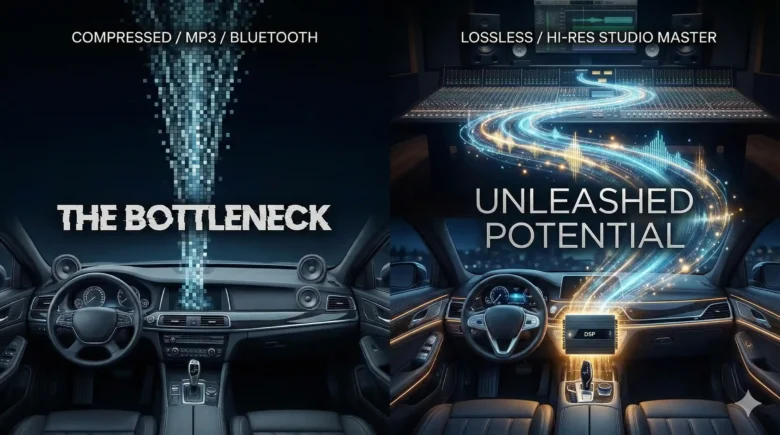
Even if you have higher quality files on your phone, your connection method might be betraying you. Standard Bluetooth codecs act like a narrow funnel. They cannot transmit the massive amounts of data required for true high-fidelity sound in real-time.
To fit the music through the “Bluetooth pipe,” your phone compresses the audio again right before sending it to your car stereo. This double compression is the death knell for critical listening. It’s the equivalent of buying a 4K television and only watching old VHS tapes on it. It works, but it misses the entire point of the investment.
Defining the Gold Standard: What is High-Resolution Audio?
High-Resolution (Hi-Res) Audio is generally defined as anything better than CD Quality (which is 16-bit/44.1kHz). Hi-Res aims to deliver the sound exactly as it was on that final studio master tape.
When you listen to a Lossless format like FLAC or ALAC, or stream from a Hi-Res tier service like Qobuz or Tidal HiFi, no data is thrown away. The file is larger, yes, but it contains every nuance the artist intended. For the beginner audióphile, moving from MP3 to Hi-Res is often a more dramatic upgrade than buying new speakers.
The Hardware Reality: Bypassing the Factory Source Unit
Here is the hard truth for car audio enthusiasts: your car’s factory head unit (radio) is likely incapable of processing true Hi-Res audio. Even if you feed it a high-quality signal, its internal internal Digital-to-Analog Converter (DAC) is cheap and noisy.
To truly unlock Hi-Res in a vehicle, purists often bypass the factory radio entirely.
- Digital Audio Players (DAPs): These are dedicated, high-end portable music players designed specifically to play massive Hi-Res files with pristine internal components.
- USB DACs: Feeding a digital signal directly from a phone or DAP into a high-quality standalone DAC or a DSP with digital inputs ensures the signal remains pure until the very last moment.
The “Veil Lifted” Moment: Hearing the Difference
The first time you hear a true 24-bit Hi-Res track on a capable car audio system, the reaction is almost always the same: “I’ve heard this song a thousand times, but I’ve never heard it like this.”
It’s often described as a “veil being lifted” from the speakers. Suddenly, the bass isn’t just a “thump”; it has texture and tone. You can hear the breath of the saxophone player. The soundstage widens beyond the physical boundaries of the car doors. The emotional connection to the music, which was severed by compression, is instantly restored.
Conclusion: Respect the Chain of Sound
Building a high-performance car audio system is an exercise in respect. Respect for the engineering of your equipment, and ultimately, respect for the art you are listening to.
Don’t insult your expensive amplifiers and precision speakers with garbage data. If you demand the best performance from your hardware, you must demand the best performance from your source material. Upgrade your files, upgrade your connection, and finally give your system the fuel it deserves.
Frequently Asked Questions (FAQ)
1. Is Spotify “High Quality” considered Hi-Res? No. As of 2026, Spotify’s standard “Very High” setting is still a compressed format (typically Ogg Vorbis at 320kbps). While it sounds better than low-bitrate MP3s, it is not “lossless” and certainly not High-Resolution. It still discards data from the original studio master.
2. What streaming services actually offer true Hi-Res Audio? The current leaders in the audiophile space are Qobuz and Tidal. Both offer tiers that stream truly lossless, high-resolution audio (often up to 24-bit/192kHz). Apple Music and Amazon Music HD also offer lossless tiers that are vastly superior to standard compressed streaming.
3. Can I hear the difference between Hi-Res and MP3 while driving on a noisy highway? This is a common debate. While road noise does mask some subtle details, the core benefits of Hi-Res—better dynamic range, tighter bass response, and less listener fatigue—are noticeable even at speed. However, the true magic of Hi-Res is best appreciated when stopped or cruising on smooth pavement.
4. How do I connect my phone to my car to get Hi-Res audio if Bluetooth is bad? The best way is a wired digital connection. If your car’s head unit or your aftermarket DSP supports it, use USB Audio. This sends the raw digital data from your phone to be processed by the superior DAC in your car equipment, bypassing the phone’s weaker internal audio hardware and avoiding Bluetooth compression.
5. Are Hi-Res music files huge? Yes. Because they contain all the original data, Hi-Res albums can take up significant storage space (a single album can be over 1GB). If you are streaming, they also use enormous amounts of mobile data. This is the price of purity—high performance requires high bandwidth.