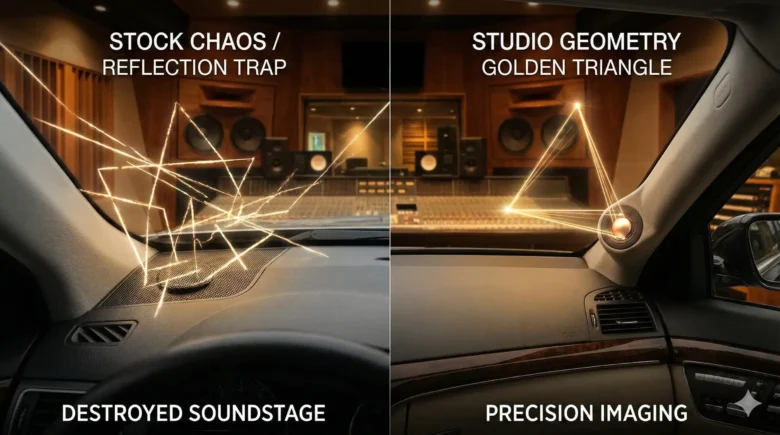
In the controlled environment of a professional mixing suite, the position of the studio monitors is never an accident. Engineers spend days, sometimes weeks, calculating the “Golden Triangle”—the precise distance between the speakers and the listener’s ears—to ensure that every frequency arrives with perfect phase and timing. They treat the high-frequency drivers as laser beams of information, capable of painting a 3D image of the music in thin air.
But in the automotive world, the “factory” approach is usually a compromise of convenience. Tweeters are often tucked into corners, fired into windshields, or hidden behind thick plastic grilles. This neglect creates a sonic “smearing” that no amount of volume can fix. To the purist, this isn’t just a loss of clarity; it is the destruction of the artist’s spatial vision. If the high frequencies aren’t positioned correctly, the singer isn’t standing on your dashboard—they are trapped in your glovebox.
True high-fidelity audio requires us to stop thinking about “installing speakers” and start thinking about “engineering an environment.” The geometry of your tweeters determines the width, height, and depth of your soundstage. It is the final frontier in your quest for studio-grade sound behind the wheel. To understand how to manipulate the physics of sound and reclaim the clarity that your high-end equipment is capable of delivering, continue reading below.
The Golden Triangle: How Studio Precision Informs Your Dashboard
When you sit in front of a pair of high-end studio monitors, they are angled slightly inward to point directly at your ears. This is because high frequencies (the notes handled by your tweeters) are incredibly directional. Unlike low-frequency bass notes that move through the car like a slow tide, high-frequency waves are tight, fast, and unforgiving.
In a car, the “Golden Triangle” is physically impossible because you are always sitting off-center. However, through the clever use of geometry, we can trick the brain. By rethinking where and how our tweeters are mounted, we can reconstruct the “phantom center” that makes a recording feel like a live performance. We aren’t just placing drivers; we are aiming the soul of the music.
The Physics of Directionality: Why High Frequencies Demand Respect
The smaller the sound wave, the more it behaves like a beam of light. A bass wave can be 50 feet long, easily bending around seats and passengers. A high-frequency note at 15kHz, however, is less than an inch long. It travels in a straight line. If that “line” is blocked by a dashboard or pointed at your knees, the most delicate details of the music—the shimmer of a cymbal or the breath of a flute—are lost forever.
For the audióphile, this directionality is a double-edged sword. It means that small errors in placement lead to massive losses in quality. But it also means that with precise angling, we can control exactly how the music interacts with the cabin, bypassing obstacles and delivering a “pure” signal directly to the listener’s ear.
On-Axis vs. Off-Axis: Navigating the Purist’s Perspective
In the world of extreme audio engineering, we talk about On-Axis and Off-Axis response.
- On-Axis: The tweeter is pointed directly at your face. This provides the most detail and energy but can sometimes be “bright” or harsh in the small confines of a car.
- Off-Axis: The tweeter is angled away from the listener, perhaps pointed at the center rearview mirror. This uses the natural roll-off of the speaker to create a smoother, wider soundstage.
Neither is inherently “better,” but for the purist, the choice is artistic. On-axis aiming provides the clinical precision of a studio monitor, while off-axis aiming can create a more “atmospheric” and natural sense of space. The key is to test both before permanently mounting your hardware.
The Reflection Trap: Glass as the Ultimate Acoustic Saboteur
The biggest enemy of a tweeter in a car is the windshield. Glass is an acoustic mirror. When you fire a tweeter into the windshield (as many factory systems do), the sound bounces off the glass and hits your ears at a slightly different time than the direct sound. This causes Comb Filtering—a phenomenon where certain frequencies cancel each other out, leaving the music sounding hollow and artificial.
To reclaim the artistic integrity of the track, we must minimize these reflections. This often means moving the tweeters away from the corners where the dashboard meets the glass and mounting them in a way that prioritizes “direct” sound over “reflected” sound.
A-Pillars vs. Sail Panels: Choosing the Foundation of Your Stage
The two most popular locations for high-end tweeter mounting are the A-Pillars (the vertical bars on either side of the windshield) and the Sail Panels (the plastic triangular area near your side mirrors).
- A-Pillars: These are the favorite of competition-grade builds. Mounting tweeters here places them at ear level, maximizing the “height” of the soundstage. It feels as though the singer is standing tall in front of you.
- Sail Panels: This location offers excellent “width.” By pushing the tweeters further apart, the soundstage feels like it extends beyond the physical width of the car doors, creating a truly immersive experience.
For the beginner, the Sail Panel is often the easiest entry point for a DIY upgrade, but the A-Pillar remains the “Holy Grail” for those seeking the ultimate studio reproduction.
The Path-Length Dilemma: Correcting Physics with Geometry
The fundamental problem in car audio is that the left speaker is closer to you than the right one. This is known as the Path-Length Difference. If the left tweeter is 2 feet away and the right one is 4 feet away, the left sound arrives first, dragging the “center” of the music to your left shoulder.
While a Digital Signal Processor (DSP) can fix this using digital delay, a true engineer starts with geometry. By angling the tweeters across the car—aiming the left tweeter at the passenger and the right tweeter at the driver—we can physically balance the intensity of the sound. This “Cross-Firing” technique uses the speaker’s off-axis behavior to naturally center the image, making the DSP’s job much easier.
Micro-Adjustments, Macro Impact: The Art of the Precision Aim
In a high-end build, the difference between “good” and “sublime” is often measured in millimeters. Professional installers often use temporary “clay” or “blue tack” to move tweeters around while listening to a reference track.
Moving a tweeter just half an inch or changing its angle by 5 degrees can suddenly make the soundstage “snap” into focus. It’s like turning the lens on a camera; suddenly, the blurred edges of the music become sharp and defined. This is the moment where the car disappears, and only the art remains.
The ROI of Labor: Why Positioning Beats Buying More Hardware
From an investment standpoint, the time spent on positioning offers a higher Return on Investment than any other upgrade. You can spend $2,000 on “Diamond” tweeters, but if they are aimed at your gear shifter, they will sound worse than a $200 set properly aimed at your ears.
Positioning is the “labor of love” that protects your financial investment in hardware. It ensures that every dollar you spent on high-fidelity components is actually being translated into audible performance. In the world of extreme audio engineering, the brain always beats the wallet.
Conclusion: Honoring the Verticality of the Performance
When you get the geometry right, the interior of your vehicle undergoes a metaphysical transformation. The ceiling of the car seems to vanish, and the dashboard becomes a stage where artists perform with lifelike presence. You aren’t just “listening to the radio” anymore; you are attending a private session in a world-class studio.
Respect the directionality of the highs. Fight the reflections of the glass. And most importantly, take the time to aim your drivers with the same precision an engineer uses to set up a mastering room. Your music—and your ears—will thank you for the effort.
Frequently Asked Questions (FAQ)
1. Is it better to put my tweeters on the dashboard or in the doors? For soundstage height and clarity, the dashboard or A-pillars are generally superior. Mounting tweeters low in the doors often results in the sound being blocked by your legs or the seats, which “muffles” the high frequencies. Keeping them at or near ear level ensures the most direct path for the sound to reach you.
2. Can I use the factory tweeter locations with my high-end speakers? You can, but it is rarely optimal. Factory locations are designed for ease of assembly, not acoustic perfection. They are often behind restrictive plastic grilles or pointed in directions that cause heavy reflections. Moving your tweeters to a custom A-pillar or sail panel mount is usually the single biggest improvement you can make to a system’s clarity.
3. What is “Phase” and why does it matter for tweeters? Phase refers to the timing of the sound waves. If your left and right tweeters are “out of phase,” they are pushing and pulling air at different times, which causes certain frequencies to cancel out. This makes the music sound thin and “hollow.” Proper geometry and wiring ensure that your tweeters work in harmony to create a full, rich sound.
4. Do I need a professional to build custom A-pillars? While many DIY enthusiasts use fiberglass to build their own pods, it is a highly technical skill. Professional A-pillar pods are designed not just for aesthetics, but for the specific volume and angle required by your tweeters. If you are a beginner, look for “Plug & Play” pods or sail panel mounts designed for your specific vehicle model to get a professional result without the learning curve of fiberglass.
5. Why do some tweeters come with different mounting “cups”? High-end tweeter kits often include “Flush Mount,” “Surface Mount,” and “Angled” cups. These are provided to give you the flexibility to aim the tweeters correctly regardless of your car’s interior shape. The angled cup is particularly useful for achieving the “Cross-Firing” geometry needed to balance the soundstage for the driver.