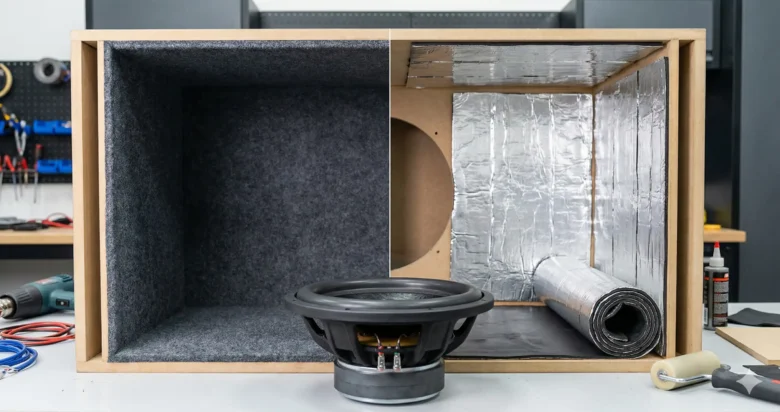
If you spend five minutes in any car audio forum, you will see it: a heated argument about what to put inside your subwoofer box. Some guys swear by asphalt manta (sound deadener), while others say cheap carpet felt is the only way to go. For a DIYer on a budget, this is confusing. Are you supposed to stop the wood from vibrating, or are you trying to make the box “act” bigger than it is? Most of the advice you find online is a mix of half-truths and outdated myths. (98 words)
The reality is that felt and asphalt manta are two completely different tools for two completely different problems. One is designed to add mass and stop resonance, while the other is designed to manipulate sound waves and air temperature. Using the wrong one won’t just waste your money; it could actually make your 12-inch sub sound worse. As we dive into the science of internal coatings, we are going to strip away the “forum lore” and give you the facts you need to build a better-sounding system for less than $20. (98 words)
You don’t need expensive, “audiophile-grade” foam to get professional results in your own garage. By understanding how common materials like felt and asphalt manta interact with sound, you can tune your enclosure to match your music perfectly. Whether you are trying to tighten up a muddy sealed box or kill the “ringing” in a budget ported enclosure, the solution is simpler than you think. Let’s look at what actually happens inside that wooden box when the bass hits and which material deserves your hard-earned cash. Check the details.
Internal Acoustic Coating: Felt or Asphalt Manta in the Box?
We have all seen it—the guy who lines the inside of his subwoofer box with egg-crate foam, carpet scraps, or even old pillows, claiming it made his bass “twice as loud.” In the DIY world, internal coatings are often treated like magic, but they are actually governed by simple physics.
If you are confused between using Asphalt Manta (Sound Deadener) or Acoustic Felt, you are not alone. Let’s break down the myths and see which one actually belongs in your build.
Absorption vs. Damping: The Technical Difference
To choose the right material, you first need to understand what problem you are trying to fix.
- Damping (Asphalt Manta): This is about stopping the wood from vibrating. It adds mass to the panels so they don’t “ring” like a bell.
- Absorption (Felt/Poly-fill): This is about sound waves and air. It absorbs high-frequency reflections and changes how air moves inside the box.
Asphalt Manta: The Vibration Killer
Asphalt manta (or its modern, non-smelly cousin, Butyl) is a heavy, sticky sheet. In the car audio world, it’s mostly used on door panels to stop rattles. Inside a box, its only job is to stop Box Flex.
The Myth: “Lining my box with manta will make the bass deeper.”
The Truth: Manta does not change the tuning of the box. However, if your box is made of thin wood (like 1/2″ MDF) and it is vibrating, that vibration is “stealing” energy from the sub. By applying manta, you stop the wood from moving, which makes the bass feel tighter and cleaner.
Budget Tip: If your box is already built with 3/4″ MDF and is well-braced, you likely don’t need asphalt manta inside. Save your money.
Acoustic Felt: The “Virtual Volume” Cheat Code
Felt or Poly-fill (the fluffy stuff inside pillows) serves a very different purpose. When sound waves travel through these fibers, they convert kinetic energy into a tiny amount of heat.
The Magic Trick: This process makes the air inside the box more “compliant.” To the subwoofer, the air feels less stiff, making the speaker behave as if it is in a box that is 10% to 20% larger than it actually is.
When to use it: * If your sealed box is slightly too small for your 12-inch sub.
- If your sub sounds “hollow” or “boomy” in the upper-bass frequencies.
[Internal Link: How to calculate if your box is too small for your sub]
Comparing the Budget Options
| Material | Primary Goal | Cost (approx.) | Best For |
| Asphalt Manta | Stop wood vibration | High | Thin-walled or unbraced boxes |
| Carpet Felt | Absorb mid-bass echoes | Low | Ported boxes (mid-range cleanup) |
| Poly-fill | Increase virtual volume | Very Low | Small sealed boxes |
The Big Forum Myth: “Manta makes it louder”
I hear this one all the time: “I put manta in my box and gained 2 decibels!”
In 99% of cases, this is a placebo effect. Asphalt manta actually decreases internal volume slightly because it takes up physical space. Unless your box was vibrating so badly that it was literally falling apart, adding manta won’t increase your peak SPL. It just cleans up the sound.
The “Smell” Factor (Safety First)
This is the “Brotherly” advice you won’t get on a sales page. Cheap Asphalt-based mantas smell like a road construction site. In the summer, your car’s trunk can reach 140°F (60°C). That heat causes the asphalt to “off-gas” toxic fumes.
If you must use a vibration damper inside your box, spend the extra $10 and get Butyl-based sheets. They don’t smell and they don’t melt off the walls when the sun hits the trunk.
How to Apply Them Correctly
If you’ve decided to use these materials, don’t just throw them in there.
- Felt: Only line the back wall and the sides. Do not block the back of the subwoofer magnet (it needs air to cool) and never put felt or poly-fill near the opening of a port, as it will cause turbulence.
- Manta: Apply it to the center of the largest, flattest panels. These are the parts that vibrate the most. You don’t need 100% coverage; 50% coverage in the center of a panel is usually enough to kill the resonance.
[Image: Proper placement of felt vs manta inside a subwoofer box]
The Veredict: Which one is for you?
- If you listen to Rock/Classical: Use Acoustic Felt. It smooths out the “honky” frequencies and makes the bass sound more natural and musical.
- If you have a cheap, thin box: Use Asphalt/Butyl Manta. It will make that $30 pre-fab box feel like a $100 custom enclosure by stopping the wood rattles.
- If you are a Bass Head: You probably don’t need either. A properly built, thick-walled ported box is already rigid enough, and felt won’t help you win an SPL competition.
Conclusion
Don’t let forum myths dictate your build. Asphalt manta and felt are tools, not magic charms. If your box is vibrating, dampen it. If your box is too small or sounds “hollow,” absorb it. By choosing the right material for the right job, you can save your budget for what really matters: better speakers and more power. Keep it simple, keep it logical, and your ears will tell you the truth.
5 Unique FAQs
1. Can I use a real pillow instead of buying Poly-fill?
Yes! The stuffing inside a standard polyester pillow is essentially the same as “Acoustic Poly-fill” sold in audio shops. Just don’t put the whole pillow in—take the stuffing out and spread it loosely.
2. Will felt help with “Port Noise”?
No. Port noise is caused by air moving too fast. Felt will actually make it worse by creating more friction. To fix port noise, you need a larger port or rounded (flared) edges.
3. Does lining the box change the tuning frequency (Fb)?
Felt/Poly-fill can lower the tuning slightly by making the box act larger. Asphalt manta can raise it slightly by decreasing the physical volume. However, the change is usually so small (1-2Hz) that you won’t hear the difference.
4. Can I use spray-on undercoating instead of asphalt manta?
You can, but it’s messy and doesn’t add as much mass as a solid sheet. It also takes a long time to dry and can have a very strong chemical smell for weeks.
5. Should I glue felt to the walls or let it sit loosely?
For felt, always glue it to the walls using a spray adhesive. For poly-fill, you can let it sit loosely, but make sure it’s not so loose that it gets sucked into the subwoofer’s cooling vent or blocks the port.