In the professional world of car audio installation, we don’t just “install” gear; we engineer environments. As we move through 2026, the technological landscape has shifted. The once-clear divide between the “musical” Class AB and the “efficient” Class D has become a battleground of high-speed semiconductors and advanced filtering. For the high-performance installer, choosing the right topology is a decision that affects power delivery, heat management, and, ultimately, the soul of the sound.
The Legacy of Linearity: Inside Class AB Enclosure
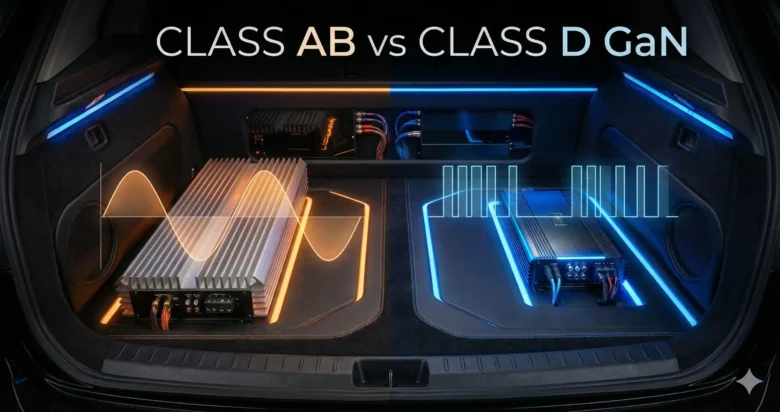
To understand where we are going, we must respect where we started. Class AB has been the gold standard for high-fidelity audio for decades. It is a hybrid of Class A (where transistors are always “on”) and Class B (where they switch between positive and negative cycles).
The Bias Current and Tonal Warmth
The “secret sauce” of Class AB is the bias current. By keeping a small amount of current flowing through the transistors even when no signal is present, Class AB avoids the “Crossover Distortion” that plagued early Class B designs.
- The Result: A smooth, linear transition between the positive and negative halves of the audio wave.
- The Sound: Installers often describe Class AB as having a “natural,” “warm,” or “airy” top end. This is because Class AB is inherently free of high-frequency switching noise.
However, linearity comes at a cost. Class AB amplifiers are notoriously inefficient. On average, only $50\%$ to $60\%$ of the power taken from the battery reaches the speakers. The rest? It is converted into heat. For a high-performance installer, this means massive heatsinks, large footprints, and the constant threat of thermal shutdown in tight trunk spaces.
The Efficiency Revolution: The Mechanics of Class D
Class D is often mistakenly called “Digital,” but it is actually a Switching Amplifier. Instead of a linear transition, the transistors (MOSFETs) act as high-speed switches. They are either fully “On” (saturated) or fully “Off” (cutoff).
Pulse Width Modulation (PWM)
In a Class D circuit, the incoming audio signal is compared to a high-frequency triangle wave to create a Pulse Width Modulated signal. The “information” of the music is stored in the width of the pulses.
- Saturation: When the transistor is “On,” there is zero resistance.
- Cutoff: When the transistor is “Off,” there is zero current.
Mathematically, the efficiency ($\eta$) of a Class D amplifier can be represented as:
$$\eta = \frac{P_{out}}{P_{in}} \approx 90\% – 95\%$$
For the installer, this is a miracle. You can pull 2000W RMS from a chassis the size of a cigar box without melting the carpet. This efficiency allows for smaller power cables and less strain on the vehicle’s alternator.
Thermal Management: The Installer’s True Enemy
One of the most critical aspects of high-performance installation is Thermal Dissipation.
Let’s look at a real-world scenario: An amplifier producing 1000W RMS.
- Class AB (60% Efficient): It pulls $1666W$ from the battery and generates $666W$ of heat. That is equivalent to a medium-sized space heater inside your trunk!
- Class D (90% Efficient): It pulls $1111W$ from the battery and generates only $111W$ of heat.
Pro Installer Note: If you are building a “stealth” rack under a false floor or behind a side panel, Class AB is a liability. Without active cooling (fans), the heat will soak into the MDF and eventually cause the amplifier to clip or fail. Class D is the only logical choice for high-power, hidden installations.
The Fidelity Gap: THD and Signal Purity
Historically, Class D was ridiculed for its “harsh” high frequencies. This was caused by the Output Filter. Because Class D switches at high frequencies (usually $400kHz$ to $1MHz$), it requires a Low-Pass Filter (an inductor and capacitor) to remove the switching noise before it reaches the speakers.
High-Frequency Aliasing
If the switching frequency is too low, it can interact with the audio signal, creating “aliasing” or “beating” tones. Furthermore, the output filter’s performance can change depending on the speaker’s impedance. This is why some old Class D amps sounded “bright” with 4-ohm speakers and “dull” with 2-ohm speakers.
Total Harmonic Distortion (THD)
Modern Class AB amps still hold a slight edge in THD figures, often reaching as low as $0.001\%$. High-end Class D is catching up, but the “floor” of noise in a switching environment is inherently higher. For a customer who wants to hear the “breath” of a vocalist in a $24$-bit/$192kHz$ FLAC track, a high-bias Class AB amp is still the weapon of choice for the front stage (tweeters and midranges).
2026 Tech Upgrade: Gallium Nitride (GaN)
The year 2026 has brought us the widespread adoption of GaN FETs in car audio. Gallium Nitride is a “Wide Bandgap” material that allows transistors to switch much faster than traditional Silicon.
- Higher Switching Frequency: GaN amps can switch at over $2MHz$. This moves the “noise” so far beyond the range of human hearing that the output filter can be smaller and much more precise.
- Lower Distortion: Faster switching means the pulses are “sharper,” resulting in a signal that is nearly identical to Class AB in terms of linear response.
As an installer, when you see “GaN Technology” on an amp’s spec sheet, you are looking at a Class D that finally rivals Class AB in audiophile fidelity.
Damping Factor: Controlling the Cone
The Damping Factor is the amplifier’s ability to control the movement of the speaker cone, especially after the signal stops. A high damping factor means “tighter” bass and more controlled mid-bass transients.
- Class AB: Generally has a high damping factor because there is no filter between the transistors and the speaker.
- Class D: The output filter (the inductor) adds a small amount of resistance and phase shift, which can slightly lower the damping factor.
However, for subwoofers, Class D’s raw power and efficiency usually outweigh the minor loss in damping factor. The massive “grip” provided by $2000W$ of Class D power will almost always outperform $500W$ of Class AB on a heavy 12-inch sub.
EMI and RFI: The Modern Vehicle Challenge
Modern electric and hybrid vehicles are “noisy” environments. They are filled with sensors, computers, and high-voltage cables.
- Class AB is relatively immune to generating interference, but its large power supply can be sensitive to incoming noise.
- Class D is a radio-frequency interference (RFI) factory. If not properly shielded, a Class D amp can kill FM radio reception or interfere with keyless entry systems.
Installer Tip: When installing high-power Class D, always use high-quality, double-shielded RCA cables and ensure your ground point is a “star ground” to minimize ground loops and RFI pickup.
The Decision Matrix: Choosing Your Weapon
| Requirement | Preferred Topology | Why? |
| Tweeters / High-End SQ | Class AB | Zero switching noise, natural transients, airy highs. |
| Hidden / Stealth Install | Class D | Low heat, small footprint, high power density. |
| High-Power Subwoofers | Class D | Massive current delivery, high efficiency, less battery drain. |
| Electric Vehicles (EV) | Class D | Preserves battery range, handles voltage fluctuations better. |
| Budget Performance | Class D | More “Watts per Dollar” in the modern market. |
The “Golden Setup”: The Hybrid Strategy
The most successful high-performance installers in 2026 don’t choose one or the other—they use both.
- Class AB for the Front Stage: Use a high-quality 4-channel Class AB amp for your component speakers (Tweeters/Mid-bass). This ensures the “vocal” range and high frequencies remain sweet and transparent.
- Class D for the Sub-Stage: Use a dedicated Class D Monoblock for the subwoofers. It provides the raw, efficient muscle needed to move air without taxing the car’s electrical system or generating excessive heat.
Conclusion
In 2026, the question of “best fidelity” is no longer a simple one. If you have the space and the electrical capacity, Class AB remains the king of pure, uncolored musicality. However, for the modern installer facing limited space, electrical constraints, and high-power demands, the Class D (especially with GaN tech) is a marvel of engineering that offers $98\%$ of the fidelity with $200\%$ of the practicality.
Understand your client’s goals. If they want to “see” the music in a laboratory, go Class AB. If they want to “feel” the music in a modern daily driver, Class D is your champion.
5 Unique FAQs for High-Performance Installers
1. Can I mix Class AB and Class D on the same battery/ground?
Yes, but be careful with EMI. Keep the Class D power cables away from the Class AB signal (RCA) cables. Also, ensure your battery can handle the peak current of the Class D and the constant current of the Class AB simultaneously.
2. Does Class D “clip” harder than Class AB?
Yes. Class AB tends to have a “soft” clipping characteristic because of its linear nature. Class D, being a switching system, has a very “hard” clipping point. When a Class D amp runs out of headroom, the distortion is immediate and very aggressive, which is dangerous for tweeters.
3. Why are high-end home theater amps still Class AB?
In a home environment, space and electricity are plentiful. Engineers don’t have to worry about a 12V alternator or a small trunk. They prioritize the zero-noise floor and linear perfection of Class AB because the trade-offs (size/heat) don’t matter as much.
4. Will GaN amplifiers completely replace Class AB?
It’s likely. As GaN prices drop and switching frequencies reach the $5MHz$ to $10MHz$ range, the technical advantages of Class AB will disappear. We are in the “transition era” where both are still relevant.
5. How do I explain the price difference of a Class D GaN amp to a customer?
Tell them they are paying for “Intelligence and Space.” A GaN amp is like a modern smartphone—smaller, faster, and more efficient than the bulky computers of the past. It provides audiophile sound in a chassis that fits under a seat.