I still remember the 2004 Chevy Tahoe that rolled into my shop about six years ago. The owner was frustrated. He had spent thousands on a high-end DC Power alternator and a pair of Sundown amplifiers, but his voltage was dropping into the 11s at idle. He couldn’t figure it out. He’d done the “Big 3” upgrade himself and used what looked like massive 0-gauge wiring.
When I pulled the fuse holder near the battery, I didn’t see shiny metal. I saw a fine, white, chalky powder. The wire had literally disintegrated inside the jacket. He had used Copper-Clad Aluminum (CCA), and in our humid climate, the galvanic corrosion had turned his “powerhouse” into a resistor. That Tahoe is the reason I tell every “Old School” reliability hunter: If you buy cheap wire, you pay for it twice.
The Fundamental Difference: Pure Copper vs. The Imposter
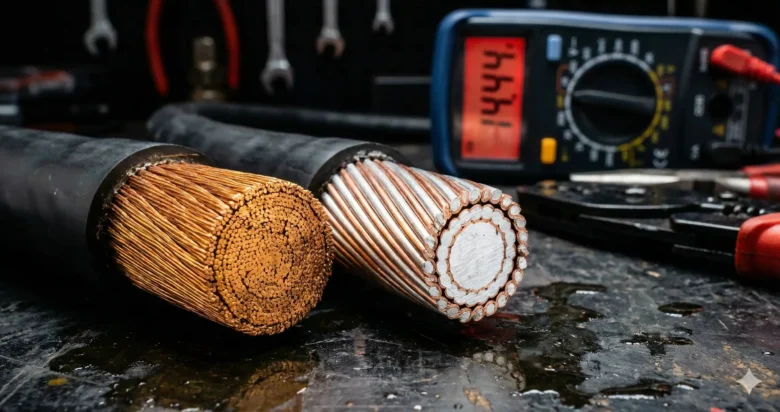
In the car audio world, we primarily deal with two types of wire: Oxygen-Free Copper (OFC) and Copper-Clad Aluminum (CCA).
OFC is exactly what it sounds like. It is refined copper with the oxygen removed to prevent internal oxidation. It’s heavy, it’s expensive, and it’s the best conductor we have for mobile electronics.
CCA, on the other hand, is an aluminum core with a thin “skin” of copper bonded to the outside. Manufacturers do this to make the wire look like copper while keeping the price low. Aluminum is significantly cheaper than copper, but it comes with a heavy performance tax.
The Physics of Resistance and Voltage Drop
As an installer, I don’t care about marketing fluff; I care about the Resistance (R) of the circuit. In a DC system, the goal is to get power from the battery to the amp with as little loss as possible.
Aluminum has about 61% of the conductivity of copper. This means that for the same thickness (gauge), an aluminum wire will have much higher resistance. Higher resistance leads to a Voltage Drop.
To calculate the resistance of a wire, we use the following formula:
R = ρ * (L / A)
Where:
R = Resistance in Ohms (Ω)
ρ (Rho) = Resistivity of the material (OFC ≈ 1.68 x 10^-8, Aluminum ≈ 2.65 x 10^-8)
L = Length of the wire in meters
A = Cross-sectional area in square meters
When you look at that formula, you realize that if you use CCA (which has a higher ρ), you must significantly increase the Area (A) of the wire to keep the Resistance (R) low. In practical terms, a 4-gauge OFC wire often outperforms a 1/0-gauge CCA wire.
The “White Powder” Nightmare: Corrosion and Longevity
This is where the “Old School” guys get protective. Car audio is a harsh environment. We deal with heat cycles, vibration, and moisture.
Aluminum is highly reactive. When it is exposed to air, it forms aluminum oxide. Unlike copper oxide, which is still somewhat conductive, aluminum oxide acts as an insulator. Even worse, when you join two dissimilar metals (like the copper skin and aluminum core of CCA) in the presence of moisture, you create a tiny battery. This is called galvanic corrosion.
Over time, the aluminum core eats itself. This increases the resistance at the termination points (terminals and fuse holders), which creates heat. I have seen CCA wire get hot enough to melt its own insulation because the resistance at the crimp became so high. With OFC, the terminations stay clean and conductive for decades.
Debunking the “Skin Effect” Myth
You’ll often hear salespeople say, “Audio signals travel on the skin of the wire, so CCA is just as good.”
Stop right there. The “Skin Effect” is a real phenomenon in high-frequency AC (Alternative Current). However, in car audio power wiring, we are dealing with DC (Direct Current). In a DC circuit, the current flows through the entire cross-section of the conductor. The aluminum core isn’t just “filler”; it is part of the path, and because it’s a poor conductor, it hinders the flow of electricity. Don’t let a “big box” store salesman use a misinterpreted physics concept to sell you inferior cable.
ROI: The Real Cost of Cheap Wire
Let’s talk numbers. Let’s say you’re building a 1,500-watt RMS system.
- CCA Setup: You buy 1/0-gauge CCA for $60. Two years later, your amp starts clipping because of voltage drop caused by terminal oxidation. You spend $40 on new terminals and eventually $150 on OFC wire to fix it correctly. Total: **$250 + wasted time.**
- OFC Setup: You buy 4-gauge OFC (which has similar performance to that CCA) or 1/0 OFC for $130. It lasts the life of the vehicle. Total: **$130.**
The Return on Investment (ROI) for OFC is undeniable. It protects your expensive amplifiers from low-voltage damage and ensures you are actually getting the wattage you paid for.
How to Spot the Difference
If you have a wire and aren’t sure what it is, here are my three “Shop Tricks”:
- The Weight Test: Pick up a roll of 1/0 OFC. It feels like a lead pipe. Pick up 1/0 CCA. It feels like a toy. Copper is roughly 3x denser than aluminum.
- The Scrape Test: Take a knife and scrape the side of one of the tiny strands. If it stays gold/orange, it’s copper. If it reveals a silver/white center, it’s CCA.
- The Flame Test: Hold a lighter to the end of the wire. Copper will get hot and discolored but stay intact. Aluminum will often melt or “droop” almost instantly.
Conclusion
In my 20 years behind the dash, I’ve learned that the electrical foundation is the most important part of the build. You can have the most expensive DSP and the most beautiful subwoofers, but if your power delivery is choked by high-resistance, corrosion-prone aluminum wire, you’re building on sand.
My Professional Advice: If your budget is tight, go with a thinner gauge of pure OFC rather than a thicker gauge of CCA. Your amplifiers, your battery, and your ears will thank you five years down the line. Keep it copper, keep it clean, and keep the voltage high.
FAQs
1. Can I mix OFC and CCA in the same system? I strongly advise against it. Mixing materials can accelerate galvanic corrosion at the connection points where they meet. Furthermore, calculating voltage drop becomes a nightmare because you have different resistance levels across the run. Stick to one material for the entire power and ground path.
2. Is silver-tinned copper the same as CCA? No. Silver-tinned copper is high-quality OFC copper strands coated in a thin layer of tin. This is actually the “Gold Standard” for marine environments because the tin adds an extra layer of protection against corrosion. It looks silver like aluminum, but it’s 100% copper underneath and performs beautifully.
3. Does CCA have any legitimate use in car audio? If you are building a “demo” car that will be torn down and rebuilt in six months, or if you are on an extremely tight budget for a low-power system (under 500W), CCA can work. However, you must use an anti-corrosion paste (like Noalox) at every connection point to slow down the inevitable oxidation.
4. Why does CCA wire feel more flexible than OFC? Aluminum is naturally more “floppy” and less dense than copper. While this makes it easy to route through tight corners, don’t confuse flexibility with quality. Quality OFC uses a high strand count (thousands of tiny hair-like wires) to achieve flexibility without sacrificing conductivity.
5. Will using CCA void my amplifier’s warranty? While the wire itself won’t void the warranty, the damage caused by it might. Many high-end amplifiers have “Low Voltage Protection,” but if the CCA wire causes a massive voltage dip that damages the power supply FETs, the manufacturer might deny the claim due to “insufficient power supply.”