A Lesson Learned in the Heat of the Shop
I remember a Saturday back in July; it was 104 degrees in the shade, and a customer rolled in with a “wall of sound” that was supposed to be the talk of the block. He was running eight high-end titanium drivers, but he had them crossed over way too low, trying to force them to do a job they weren’t built for. Ten minutes into his demo, the high-end just… vanished. It wasn’t a blown fuse or a dead amp; he had literally shattered the diaphragms because he didn’t understand the physics of the material he was using.
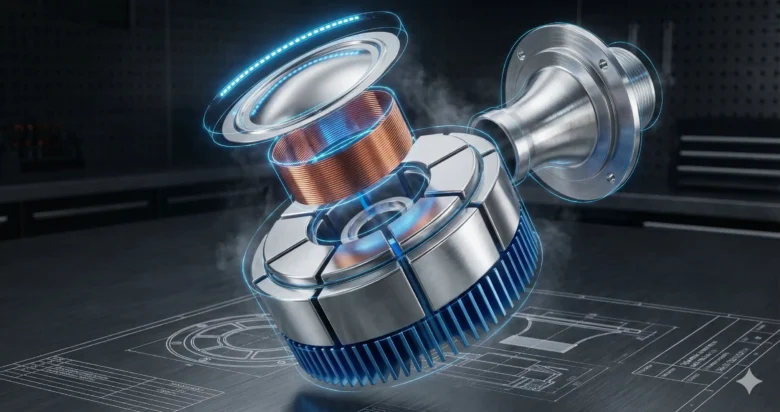
In the world of professional Car Audio Engineering, choosing between a titanium and a phenolic compression driver isn’t just about brand names or price tags. It’s about understanding how sound waves interact with physical matter. If you want a system that doesn’t just play loud but plays right for years, you need to know exactly what is happening inside that magnet assembly.
Whether you are building an SPL competition monster or a high-fidelity daily driver, the material of your driver’s diaphragm will dictate your crossover points, your amplifier choice, and ultimately, your ROI on the entire build. Let’s dive deep into the engineering specs so you never have to smell a burnt voice coil again.
1. The Material Science: Molecular Rigidity vs. Internal Damping
To understand why these drivers sound different, we have to look at their DNA. A compression driver is essentially a high-pressure piston. It moves air through a small throat and expands it through a horn.
Phenolic diaphragms are made of layers of fabric (linen or cotton) bonded with phenolic resin. This creates a material that is relatively heavy but incredibly “lossy.” In engineering terms, high internal damping means that when the material stops receiving a signal, it stops vibrating almost instantly. This prevents the “metallic ringing” that some people find annoying.
Titanium diaphragms, on the other hand, are ultra-thin sheets of metal. Titanium has a phenomenal stiffness-to-mass ratio. It is incredibly light, allowing it to vibrate at extremely high frequencies (up to 20,000 times per second). However, because it is so rigid, it has very low internal damping. If not controlled, it can ring like a bell at certain frequencies, often referred to as “breakup modes.”
2. The Phenolic Driver: The Midrange Powerhouse
If your goal is “vocal authority” and “bulletproof reliability,” phenolic is your best friend. In the Professional Car Audio scene, phenolic drivers are the backbone of systems that need to project sound over long distances (Outdoor/Trio style).
Why Phenolic Wins in the Midrange:
- Vocal Warmth: Because the material is non-metallic, voices sound natural and “thick.” It covers the 500Hz to 5,000Hz range with a smoothness that titanium struggles to replicate.
- Thermal Resilience: The resin-impregnated fabric can handle massive amounts of heat. When your Car Audio Amplifier is pushing 200W RMS into a driver for four hours straight, phenolic won’t warp or lose its shape.
- Mechanical Strength: It is much harder to “shatter” a phenolic diaphragm. It can handle lower crossover points, making it the perfect bridge between your mid-bass woofers and your high-frequency tweeters.
The Trade-off: Mass is the enemy of high frequencies. Because phenolic is heavier, it simply cannot move fast enough to produce crisp treble (highs) above 6kHz or 7kHz. If you use phenolic, you must use a super tweeter to fill in the top end.
3. The Titanium Driver: The High-Frequency Scalpel
For the audiophile who wants a 2-way system that does it all, titanium is the undisputed king. A high-quality titanium driver can often replace both a midrange driver and a tweeter, simplifying your Car Audio System and reducing phase issues.
The Titanium Advantage:
- Frequency Extension: A well-engineered titanium driver can play from 1,200Hz all the way to 20,000Hz. This “full-range” high-frequency response creates a seamless soundstage.
- Transient Response: Because the diaphragm is so light, it responds to the music’s “attacks” instantly. Snare drums, symbols, and acoustic guitar strings have a “bite” that sounds incredibly realistic.
- Efficiency: Titanium drivers usually have higher Sensitivity (dB) ratings. You get more sound for every watt of power, which is great for preserving your Car Battery life during long sessions.
The Risk Factor: Titanium is brittle. If you clip your amplifier or experience a massive Voltage Drop, the resulting distortion can cause the metal to fatigue and crack. It requires a disciplined hand on the DSP Tuning software.
4. Electrical Integration: Voltage, OFC, and Impedance
Your drivers are only as good as the power they receive. Many installers spend thousands on drivers but use cheap CCA (Copper Clad Aluminum) wire. In a high-performance build, Oxygen-Free Copper (OFC) Cable is non-negotiable.
Why it matters for Drivers: Compression drivers have complex impedance curves. As the voice coil heats up, its resistance increases—this is called Power Compression. If your wiring is thin, you’ll experience a Voltage Drop that limits the driver’s ability to reproduce peaks.
Using a high-quality AGM Battery or a Lithium (LiFePO4) bank ensures that when the kick drum hits, your titanium drivers have the instantaneous current they need to move that piston without distorting.
5. Crossover Engineering: The Line Between Life and Death
This is the most critical part of the build. If you cross a titanium driver at 800Hz with a shallow slope, you are essentially signing its death warrant.
Standard Recommendations:
- Phenolic Drivers: 12dB/octave or 24dB/octave High Pass at 500Hz to 800Hz. You can let them play up to 6,000Hz before they naturally roll off.
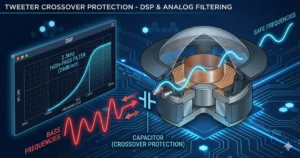
- Titanium Drivers: Minimum 24dB/octave High Pass at 1,500Hz. If you want them to last, 2,000Hz is even safer.
Using a Digital Signal Processor (DSP) allows you to set “Butterworth” or “Linkwitz-Riley” filters. I always suggest a 24dB/oct Linkwitz-Riley; it provides a smooth phase transition and protects the driver from over-excursion.
6. Horn Geometry: Controlling the Wavefront
The driver produces the sound, but the Horn (Waveguide) shapes it.
- Exponential Horns: Great for “throw.” If you want your sound to reach the end of the street, use an exponential horn with a phenolic driver.
- Tractrix or Bi-Radial Horns: These offer better “dispersion.” They spread the sound wide, making them ideal for titanium drivers in a daily driver where you want a wide sweet spot for both the driver and passenger.
7. Phase Alignment: The “Secret Sauce” of the Pros
Have you ever heard a car that was loud but made your ears “confused”? That’s a phase issue. Because phenolic and titanium diaphragms have different weights, they move at different speeds.
If you have a mid-bass woofer in the door and a titanium driver on the dash, the sound from the woofer might arrive at your ear 2 milliseconds after the sound from the driver. This causes Phase Cancellation.
The Fix: Use your DSP’s Time Alignment feature.
- Measure the distance from each driver to the headrest.
- Input those values into the DSP.
- Now, the “kick” of the drum and the “snap” of the snare arrive at your ear at the exact same microsecond. That is high-performance audio.
8. Maintenance: How to Save Your Reparo (Voice Coil)
Eventually, every pro has to change a repair (Diaphragm Replacement). Whether it was a mistake in the gain setting or just years of use, here is my shop protocol:
- Clean the Gap: Use masking tape to pull out any metallic dust from the magnet gap. Even a tiny grain of sand will destroy a new coil.
- Check the Gasket: A leak in the horn-to-driver seal will kill your low-end response. Use a rubber gasket or high-quality silicone.
- Center the Coil: Don’t just tighten the screws. Play a low-volume 1,000Hz sine wave while tightening to ensure the coil is perfectly centered and not rubbing.
9. Conclusion: The Specialist’s Verdict
So, which one should you choose for your next project?
- Choose Phenolic if: You want a “party” car. You want to play music for hours at a BBQ, you love heavy vocals, and you don’t want to worry about blowing a driver every time someone else touches the volume knob.
- Choose Titanium if: You are an audiophile. You want your car to sound like a concert hall, you crave high-frequency detail, and you have the DSP and Amplifier quality to control the beast.
At the end of the day, your Car Audio Build is a reflection of your goals. Don’t build for the internet; build for your ears. But whatever you do, use OFC wire, keep your voltage stable, and respect the crossover points.
FAQ:
1. Can I mix Phenolic and Titanium? Yes, and many “Pro Audio” home speakers do this. You use a phenolic for the “lower-mid” and a titanium for the “highs.” It’s an expensive way to build, but it results in a massive, effortless soundstage.
2. Why do titanium drivers sound “harsh” sometimes? This is usually due to “ringing” at the 12kHz-15kHz range. A simple -3dB “High Shelf” or a narrow “PEQ (Parametric EQ)” cut in your DSP can fix this in seconds.
3. Does the magnet size matter? Absolutely. A larger Ferrite or Neodymium magnet provides a stronger Motor Strength (BL). This gives you better control over the diaphragm, leading to less distortion and higher SPL.