The “Disco Lights” Mystery at the Shop
I remember a guy named Mike who pulled into my shop about ten years ago in a custom Tahoe. He had four 15-inch subs and about 5,000 watts of raw power, but every time the bass dropped, his headlights dimmed so hard it looked like a disco ball was stuck under his hood. He handed me a 2-Farad “Mega Capacitor” he bought online, convinced it was the “magic bullet” that would fix his electrical woes. He thought he was adding a tiny nuclear reactor to his trunk.
I had to break the news to him the hard way: a capacitor is not a battery. It doesn’t create energy; it just borrows it and gives it back very, very quickly. After we installed it, his lights still dimmed, and his Amplifier eventually went into protect mode. Why? Because Mike was trying to treat a broken leg with a band-aid. He had a stock 80-amp Alternator trying to feed a 500-amp beast.
If you are tired of watching your voltmeter dance every time the kick drum hits, you need to understand the cold, hard physics of power delivery. In this deep dive, I’m going to pull back the curtain on the Car Audio Capacitor myth and show you exactly what works, what doesn’t, and why your Power Wire might be more important than that shiny chrome cylinder in your trunk.
1. The Physics of the “Stiffening Cap”
To understand a capacitor, stop thinking about it as a bucket of electricity. Think of it as a spring. A Car Battery is like a massive water tank with a small faucet; it holds a lot of water (energy), but it comes out slowly because of the chemical reaction inside. A capacitor is like a small balloon that you can pop. It doesn’t hold much, but what it does hold, it lets go of instantly.
In technical terms, a capacitor stores energy in an electrostatic field. When your Monoblock Amplifier demands a massive burst of current for a 40Hz bass note, it needs that energy in milliseconds. The battery is often too slow to “prime the pump,” and that delay causes a momentary Voltage Drop. The capacitor sits right next to the amp, ready to dump its tiny reserve to “stiffen” the voltage for that split second.
Notice that energy is proportional to the square of the voltage. If your voltage drops from 14.4V to 12V, your capacitor loses almost 30% of its stored energy. This is why a capacitor cannot fix a failing Charging System.
2. The ESR Factor: The Silent Performance Killer
The most important spec you’ve probably never heard of is ESR (Equivalent Series Resistance). This is the internal resistance of the capacitor. If a capacitor has high ESR, it’s like trying to pour water through a coffee stirrer—it doesn’t matter how much is in the tank if you can’t get it out fast enough.
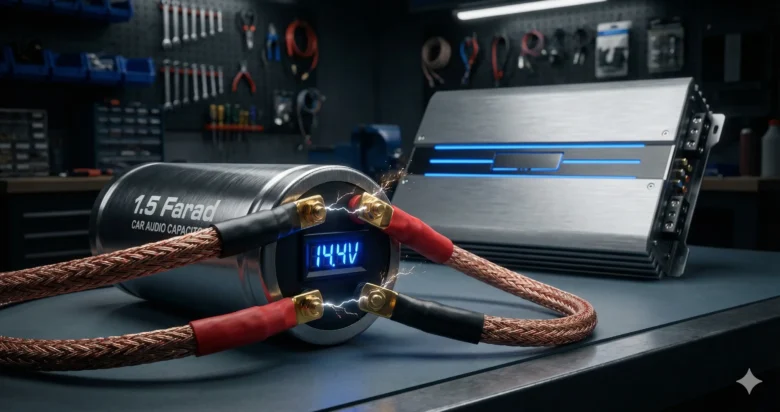
Many cheap “Mega Capacitors” on the market are actually low-quality components with high ESR. They look cool with their LED voltmeters, but they are too slow to actually help the amplifier. A high-quality Car Audio Capacitor will have an ESR so low that it can deliver hundreds of amps in a heartbeat.
If you want real results, you need to look for capacitors with “Low ESR” ratings. Without it, the capacitor is just another load for your Alternator to charge, actually making your voltage problems worse instead of better.
3. Why Your Lights are Still Dimming
Here is the truth that manufacturers won’t tell you: dimming lights are a sign of a capacity issue, not a speed issue. If your lights stay dim for the entire duration of a bass note, a capacitor will do absolutely nothing for you.
A 1-Farad capacitor stores enough energy to run a 1,000-watt amp for about 0.05 seconds. That’s it. If the bass note lasts 1 second, the capacitor is empty in the first 5% of the note. For the remaining 95%, your Alternator and Battery are doing all the work—plus they now have to recharge that empty capacitor.
The Hierarchy of Power Fixes:
- High Output Alternator: This is the only way to create more current.
- The Big 3 Upgrade: Replacing factory wires with 1/0 AWG OFC Cable to reduce resistance.
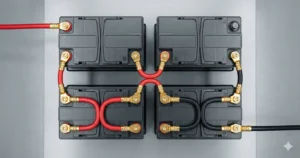
- Secondary AGM or Lithium Battery: To provide a larger reserve of energy.
- Capacitors: To filter high-frequency noise and provide micro-second “stiffening.”
4. The “Big 3” Upgrade: The Foundation
Before you spend a dime on a capacitor, you must perform the “Big 3.” I’ve seen 2,000-watt systems stabilize just by doing this. The factory wiring in most cars is designed for a 60-amp load, not a massive Car Audio System.
What is the Big 3?
- Alternator Positive to Battery Positive: Helps current flow from the source to the reserve.
- Battery Negative to Chassis Ground: The most common bottleneck in any car.
- Engine Block to Chassis Ground: Ensures the alternator has a solid path back to the battery.
Always use OFC (Oxygen-Free Copper). Avoid CCA (Copper Clad Aluminum) like the plague. CCA has higher resistance and will cause the very Voltage Drop you are trying to prevent.
5. Supercapacitors: The New Industry Standard
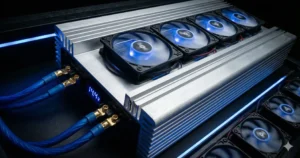
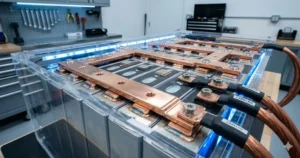
In the last few years, we’ve seen a shift from traditional “soda can” capacitors to Supercapacitor Banks (using Maxwell cells or LTO technology). Unlike the old 1-Farad units, these banks offer 500, 1,000, or even 3,000 Farads of capacitance.
These aren’t just for “stiffening”; they can actually act as a hybrid between a battery and a capacitor. They have incredibly low ESR and can hold enough charge to support multiple bass hits without breaking a sweat. If you are running a 5,000W+ system, a Supercapacitor Bank is a much more effective tool than ten traditional capacitors wired in parallel.
6. When Should You Actually Use a Capacitor?
Am I saying capacitors are useless? Not at all. They have a specific place in High-End Sound Quality (SQ) builds.
- Filtering Alternator Whine: Capacitors are excellent at filtering out the AC ripple voltage produced by the alternator, which can lead to a cleaner signal.
- Reducing Stress on the Battery: By taking the “hit” of the initial transient, they can slightly extend the life of your AGM Battery.
- Small Systems: On a system under 500W RMS, a capacitor can provide just enough “oomph” to keep the dash lights from flickering slightly.
7. Installation Protocol: Don’t Blow Yourself Up
A capacitor is a dormant bomb if handled incorrectly. If you connect a completely empty 1-Farad cap directly to a Car Battery, it will try to charge instantly, creating a massive spark that can weld tools or explode the capacitor’s internal foil.
How to Charge a Capacitor:
- Place a resistor (usually included) or a 12V test light between the battery positive and the capacitor positive.
- Wait for the LED voltmeter on the cap to reach 12V-14V or for the test light to go out.
- Once charged, you can safely make the direct connection.
Placement: A capacitor must be within 18 inches of the Amplifier. If you put it in the front of the car, the resistance of the long cable run will negate any speed benefit the capacitor provides.
8. Voltage Drop vs. Clipping: Protecting Your Gear
The real danger of a Voltage Drop isn’t the dimming lights—it’s Clipping. When an amplifier’s input voltage drops, it can no longer produce a clean sine wave. It begins to “square off” the wave, which sends massive amounts of heat into your subwoofer’s voice coil.
If you don’t have a Volt Meter installed on your dash, you are flying blind. A capacitor might hide the dimming lights, but if your voltage is still dropping to 11.5V, your amplifier is clipping, and your subs are on borrowed time.
9. The Final Verdict: Band-aid or Cure?
Do mega capacitors prevent voltage drops? Only the micro-drops. They cannot fix a system where the total current draw exceeds the alternator’s output.
If you want a rock-solid electrical system:
- Calculate your Amperage: (Total RMS Watts / 10). If you have 2,000W, you need roughly 200 amps of current.
- Upgrade your Alternator: If your stock alt is 90 amps, you are 110 amps short. No capacitor will fix that.
- Use a Secondary Battery: An AGM or Lithium battery in the trunk will provide the sustained capacity you need.
- Add a Capacitor last: Use it as the “cherry on top” to clean up the signal and provide that final bit of speed for the high-frequency transients.
FAQ:
1. Does a capacitor drain my battery when the car is off? Most modern capacitors have an auto-turn-on circuit that senses voltage ripple. However, cheap ones or ones with a constant LED display can pull a small “parasitic draw.” If your car sits for weeks, it might weaken a small battery.
2. Can I use a capacitor with a Lithium (LTO) battery? You can, but it’s often redundant. Lithium batteries already have a much lower internal resistance and faster discharge rate than AGM batteries. Adding a traditional 1-Farad cap to a Lithium bank is like adding a cup of water to a swimming pool.
3. Why do some capacitors have three terminals? The third terminal is usually a Remote Turn-on lead, just like your amplifier. This ensures the voltmeter display only turns on when the radio is on.