The Day the Tahoe Melted
I’ll never forget a guy named “Big Al” who rolled into my shop with a 2015 Tahoe. He had just finished installing two 15-inch subs and a massive monoblock rated at 3,500W RMS. He was proud of the build, but he was still running the factory 130-amp alternator. “I’ve got three extra batteries in the back,” he told me, thinking he had solved the power problem. Within ten minutes of a “decaf” bass demo, we smelled it: that unmistakable scent of burning copper and ozone.
The factory alternator had literally given up the ghost, its internal diodes frying as it desperately tried to feed a beast it was never designed to handle. Big Al made the classic mistake of thinking batteries create power—they don’t. Batteries are just reservoirs. The alternator is the faucet. If your faucet only drips, your reservoir will eventually run dry, and your Car Audio System will suffer.
If you’re stepping into the 3000W+ realm, you aren’t just playing with sound anymore; you’re managing a small power plant. In this guide, I’m going to show you the exact engineering math I use to size alternators for world-class builds, ensuring your Voltage Drop stays low and your music stays loud.
1. The Harsh Reality of 3000W RMS
When we talk about 3,000 Watts RMS, we are talking about a continuous flow of energy. Many people see “3000W” and think of it as a peak number. In the world of high-performance audio, we calculate for the worst-case scenario.
A 3000W amplifier doesn’t just pull 3000W from the electrical system. Because of the laws of physics, every amplifier loses energy in the form of heat. This is known as Efficiency. If you don’t account for this loss, you will undersize your alternator every single time.
2. The Engineering Math: Calculating the Real Draw
To size your alternator correctly, you need to know how many Amps your system is actually demanding. This isn’t a guess; it’s a calculation.
The standard formula is:
Let’s look at a real-world example. You have a 3,000W Class D monoblock and a 4-channel amp doing 600W for your mids and highs. Total: 3,600W RMS.
- System Voltage: We calculate at 13.8V (average charging voltage under load).
- Efficiency: Most Class D amps are around 80% (0.80) efficient.
- Calculation: (3,600 / 13.8) / 0.80 = 326 Amps.
That’s right. A 3,600W system can demand over 300 Amps of current. If you have a 150-amp factory alternator, you are over 170 Amps short. That deficit is being pulled from your Car Battery, which will eventually lead to a massive Voltage Drop and clipping.
3. The “Idle Output” Trap
This is where most enthusiasts get burned by marketing. You see an alternator labeled as “320 Amps” and think you’re safe. But you need to read the fine print: at what RPM?
Most alternators are rated at “Cruise RPM” (usually around 2,000 engine RPM). However, when you’re at a stoplight or at a car show, your engine is at Idle (600-800 RPM). A standard 320A alternator might only produce 140A at idle.
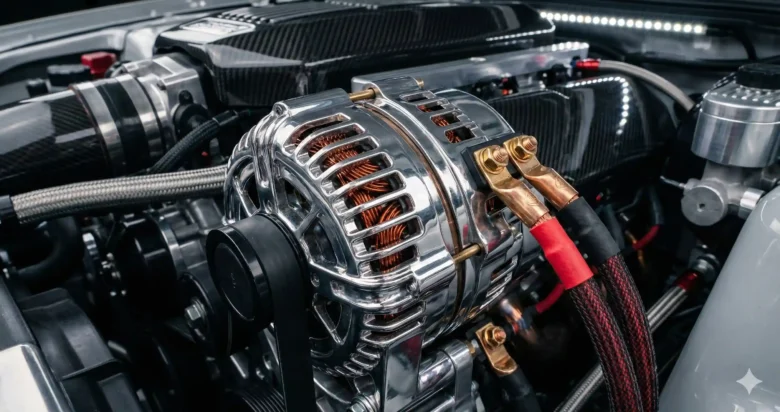
The Pro Tip: When sizing for 3000W+, always look for the Idle Output rating. If you play your music while parked, you need an alternator designed for high low-end current. This usually involves a High Output Alternator with a “Hairpin” stator design, which packs more copper into the same space for better low-RPM induction.
4. Class D vs. Class AB: Topology Matters
The type of amplifier you use dictates how much stress you put on the crank.
- Class D: Highly efficient (75-85%). Most of the power goes to the speakers.
- Class AB: Lower efficiency (50-60%). Almost half of the energy is wasted as heat.
If you are running old-school Class AB “Cheater Amps,” your current demand will be nearly double that of a modern Class D build. This is why many high-wattage builds have transitioned almost exclusively to Class D for subwoofers—it’s easier on the Charging System.
5. High Output (HO) Technology: Hairpin vs. S-Series
When you shop for an upgrade, you’ll see two main technologies.
- S-Series (6-Phase): These are great for daily drivers. They offer excellent efficiency and a very clean DC signal with low ripple.
- Hairpin (Elite) Stators: These are the heavy hitters. They use square copper wire instead of round wire, allowing for a much denser winding. This translates to more Amps at lower RPMs—perfect for those heavy 30Hz bass notes while idling.
6. The Foundation: “The Big 3” and 0 Gauge Infrastructure
You can have a 400-amp alternator, but if you’re trying to push that current through the factory 4-gauge wire, you’re in trouble. Resistance creates heat, and heat creates Voltage Drop.
To support 3000W+, the Big 3 Upgrade is mandatory:
- Alt Pos to Battery Pos: Use 0 Gauge OFC Power Cable.
- Battery Neg to Chassis: Ensure a clean, paint-free contact point.
- Engine Block to Chassis: Essential for the alternator’s return path.
7. External Regulators: The Secret of the Pros
Standard alternators have an internal regulator that drops voltage as the engine gets hot. For a 3000W+ system, you want a steady voltage.
An External Regulator (like the Mechman or Wakespeed units) allows you to manually set your charging voltage. If you are running Lithium (LTO) batteries, you might want to charge at 14.8V or even 15.2V to maximize the discharge rate of your bank. Internal regulators simply can’t offer this level of control.
8. Battery Synergy: The Buffer Zone
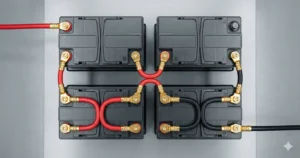
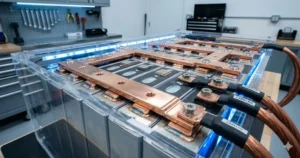
Even with a massive alternator, you need a buffer. Music is dynamic—it has peaks and valleys. A High Output Alternator provides the constant “base” of current, but a fast-discharging battery like an AGM Battery or a Lithium LTO Bank handles the micro-second peaks.
For a 3000W system, I recommend:
- Minimum: One high-quality AGM under the hood and one in the back.
- Optimal: A small bank of LTO cells. LTO can absorb current as fast as the alternator can produce it, making them the perfect pair for high-wattage audio.
9. Conclusion: The Final Spec
To size an alternator for 3000W RMS correctly, don’t just look at the total power. Look at your RPM habits, your wiring gauge, and your battery chemistry.
If you calculate 320 Amps of total demand, buy a 370-amp or 400-amp alternator. That extra 20% of “Headroom” ensures that the alternator isn’t running at 100% capacity all the time, which drastically extends the life of the bearings and the stator.
Stop asking your stock alternator to do a pro’s job. Upgrade the faucet, and your reservoir will never run dry.
FAQ:
1. Will a high-output alternator hurt my car’s computer? No, as long as the voltage is regulated. Your car’s electronics only “take” the amperage they need. The alternator doesn’t “push” Amps into the ECU; it simply makes them available.
2. Why do I hear a “whining” noise after my alternator upgrade? This is often Alternator Whine caused by a ground loop or an AC ripple. Ensure your “Big 3” grounds are perfect. If it persists, you may need a noise filter on your RCA lines.
3. Do I need a smaller belt with a high-output alternator? Usually, yes. HO alternators use a smaller pulley to spin faster at idle. You will likely need a belt that is 0.5 to 1 inch shorter than the factory belt to prevent Belt Slip.