I remember a custom Jeep Wrangler that came into my shop mid-July. The owner was furious. He had just spent three grand on a “top-of-the-line” 3,000-watt monoblock, but every time he drove for more than 20 minutes, the music would cut out. “The amp is a piece of junk,” he shouted. “It’s burning hot to the touch!”
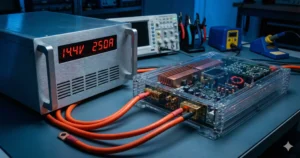
I didn’t even look at the amp first. I grabbed my multimeter and checked his battery terminals while the system was playing. His voltage was crashing to 10.8V on every bass hit. He was trying to draw massive current through a factory alternator and a thin, 4-gauge aluminum wire.
The amp wasn’t “junk”—it was starving. It was working so hard to produce power from almost nothing that it was literally cooking itself from the inside out. Once we did the Big 3 Upgrade and swapped his wire for 0-Gauge OFC, the amp ran cool as a cucumber. If you want to stop the “Protect Mode” cycle, you have to stop starving your gear.
The Physics of Heat: Why Does Starvation Create Fire?
Every Car Amplifier has an internal power supply. Its job is to take the 12V-14V from your car and “step it up” to a much higher voltage (sometimes 60V or 100V) to drive your speakers. This process is governed by the Law of Conservation of Energy.
If the input voltage drops, the amplifier doesn’t just give up. It tries to maintain its power output. To do that, it has to pull more Amperage.
If Watts stay the same, but Volts go down, Amps must go up. High amperage creates friction at the molecular level in your wires and transistors. That friction is heat. When you starve an amp of voltage, you are essentially forcing it to run a marathon while holding its breath. It will overheat.
The Amperage Death Spiral
When an amplifier starts to get hot due to high amperage draw, its internal resistance increases. This is a “Death Spiral.”
- Low Voltage leads to higher current draw.
- Higher Current leads to more heat.
- More Heat increases resistance.
- Increased Resistance requires even more current to overcome.
Eventually, the thermal sensors hit their limit (usually around 170°F – 190°F) and the amp goes into Protect Mode to save itself from a meltdown. If you don’t have a Digital Voltmeter on your dash, you are flying blind into this spiral every time you turn the knob.
Class D vs. Class AB: The Efficiency Factor
Your choice of amplifier architecture dictates how much heat you should expect.
- Class AB Amplifiers: These are known for great sound quality but poor efficiency (around 50-60%). Half of the power they pull is wasted as heat immediately. These must have massive heat sinks and perfect voltage.
- Class D Amplifiers: These are high-efficiency (80-90%). They run much cooler because they use high-speed switching. However, if you starve a Class D Amp, the switching transistors (MOSFETs) stay “open” longer to compensate, which generates heat that these compact amps aren’t always designed to dissipate.
Wire Gauge: The Silent Arsonist
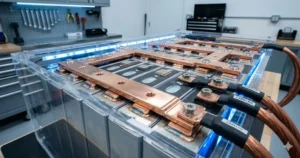
The most common cause of power starvation is the wire itself. I see people using “0-Gauge” kits that are actually CCA (Copper Clad Aluminum). Aluminum has higher resistance than copper.
Think of it as a water pipe. A CCA wire is like a pipe full of rust; you can’t get the flow you need. You MUST use OFC (Oxygen-Free Copper).
- 0-Gauge OFC: Essential for any amp over 1,500W RMS.
- Resistance: Low resistance means the voltage stays high at the amp terminals, keeping the current (and heat) down.
The Role of the High-Output Alternator
If you are running 2,000+ watts on a stock 80-amp alternator, you are asking for trouble. Your car’s electronics take about 40-50 amps just to keep the engine running. That leaves only 30 amps for your sound system.
A high-performance system needs a High-Output Alternator. By providing a consistent 14.4V rail, the alternator ensures the amplifier never has to “struggle” for current. This is the single best way to keep your system cool during long drives.
Clipping: When Square Waves Burn
Power starvation often leads to the user “cranking the gain” to get more volume. This leads to Clipping. When a signal clips, the smooth sine wave becomes a “square wave.” A square wave is essentially DC voltage for a split second.
- For the Amp: The transistors stay “on” with no rest, generating massive heat.
- For the Sub: The voice coil stays stationary while receiving power, which means it can’t move air to cool itself.
Always set your gains using an oscilloscope or a specialized tool like a DD-1 to ensure a clean signal.
Installation & Airflow Engineering
Sometimes the electrical is perfect, but the “house” is bad. If you mount your Car Amplifier under a seat or in a sealed trunk corner with no airflow, it’s going to overheat regardless of voltage.
Pro-Tips for Cooling:
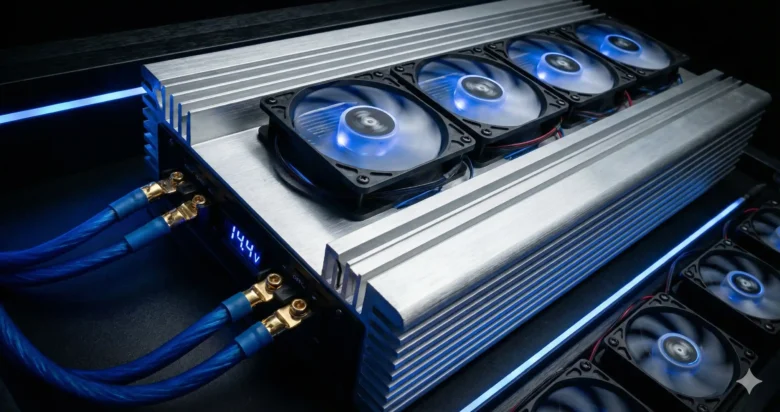
- Vertical Mounting: Mount the amp so the heat sink fins are vertical. Heat rises; this creates a “chimney effect” that pulls cool air up through the fins.
- Cooling Fans: Use 12V computer fans to create a “push-pull” airflow system in your amp rack.
- Don’t Carpet the Amp: Never let the carpet touch the heat sink. It acts as an insulator, trapping the heat inside the board.
The Big 3 & Grounding: The Return Path
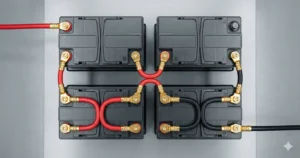
Electricity is a loop. If your Grounding is weak, the power can’t get back to the battery, creating a “backup” that increases resistance and heat. The Big 3 Upgrade (Battery to Chassis, Engine to Chassis, Alternator to Battery) is non-negotiable. It ensures that the path of least resistance is wide open, keeping your voltage stable and your temperature low.
Conclusion: Protect the Power, Protect the Sound
Preventing an amplifier from Overheating is about 10% airflow and 90% electrical integrity. If you provide your gear with a rock-solid 14.4V supply through high-quality OFC Wire, you eliminate the root cause of thermal failure.
Don’t wait for the smell of burning plastic to take action. Invest in your charging system, monitor your volts, and keep the air moving. Your ears—and your wallet—will thank you.
FAQ:
1. Is it normal for my amp to be hot to the touch? It is normal for an amp to be warm (up to 120°F-140°F). However, if you cannot keep your hand on the heat sink for more than 3 seconds, it is likely over 150°F and is approaching the danger zone.
2. Does a lower impedance (like 1-ohm) make the amp hotter? Yes. Running an amp at 1-ohm instead of 4-ohms allows more current to flow, which generates significantly more heat. If you run at low impedance, your electrical system must be twice as strong to prevent starvation.
3. Will adding a second battery stop my amp from overheating? A second Car Battery provides more reserve, but it doesn’t “create” power. If your alternator can’t keep both batteries charged, you’ll eventually hit the same voltage drop and starvation issues. Fix the alternator first.