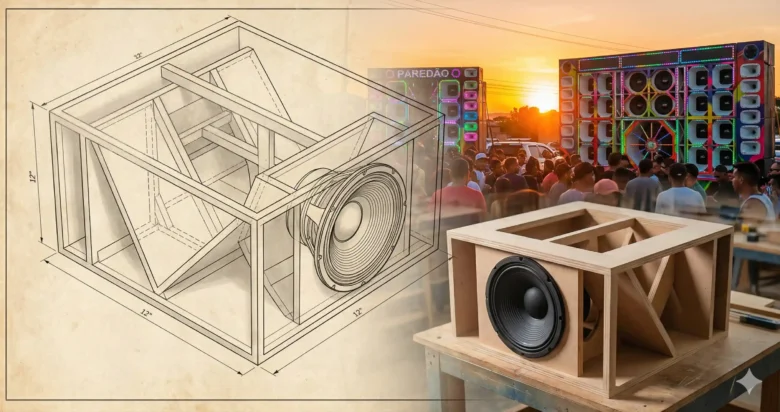
I still remember that afternoon at the regional “Paredão” meet. The air was thick with heat, and dozens of systems were competing for attention. But there was one truck that stood out—not because it was the loudest, but because you could feel its “punch” in your chest from across the parking lot. While others had bass that washed out, this one had a tight, aggressive mid-bass that cut through the noise like a knife. That was my first encounter with the Euclides design, the legendary Brazilian manifold box. (97 words)
The “Euclides” isn’t just a wooden box; it’s an acoustic weapon designed for one thing: long-range impact. In the world of outdoor sound (Paredão), your biggest enemy is open space. A standard box loses energy quickly, but the Euclides uses a manifold design to compress the air waves before they even leave the enclosure. This creates a “horn” effect that shoots the mid-bass further than you ever thought possible. If you want your system to be heard and felt blocks away, you need to understand the magic of this hybrid design. (99 words)
Building a Euclides-style box is a rite of passage for any serious DIYer who wants to dominate the streets. It requires precision, a bit of bravery with a table saw, and an understanding of how air behaves under pressure. We’ve taken the technical secrets from the best builders in the industry and condensed them into this step-by-step guide. By the time you’re done, you’ll have the blueprint to build a mid-bass powerhouse that doesn’t just play music—it commands authority. Let’s get our hands dirty and start the build. (98 words)
Euclides-Style Manifold Boxes: Technical Guide for High-Impact Mid-Bass
Every builder has that moment when they realize their standard enclosures just aren’t cutting it for outdoor events. You turn up the volume, the woofers are jumping out of their frames, but the sound just disappears ten feet away. This is exactly where I was before I discovered the Euclides-style Manifold.
Originating from the high-stakes world of Brazilian “Paredão” (Speaker Walls), the Euclides design is a hybrid between a sealed chamber and a manifold horn. It’s designed specifically to maximize the Mid-Bass (60Hz to 250Hz)—that “pancadão” kick that you feel in your soul. Here is how you build one.
Understanding the Manifold Effect
In a Euclides box, the woofer is mounted facing into a V-shaped or U-shaped internal chamber (the manifold). Instead of the sound wave escaping directly into the air, it is compressed within this small space.
This compression increases the acoustic loading on the cone. Think of it like putting your finger over the end of a garden hose; the pressure increases, and the water (or in this case, the sound) shoots out much further. This is what gives the Euclides its legendary “throw” at outdoor parties.
The Gear: Selecting the Right Woofer
You can’t just throw any subwoofer into a Euclides box. You need a Woofer, not a Subwoofer.
- FS (Resonant Frequency): Look for something between 45Hz and 60Hz.
- Qts: High-efficiency drivers with a strong motor structure work best.
- Size: While 15-inch models are popular, the 12-inch Euclides is the king of the fast, dry “pancadão” kick.
[Internal Link: Subwoofer vs. Woofer: Which one do you need?]
Step 1: Preparing the Armor (The Material)
Outdoor sound is brutal on wood. Between the humidity and the extreme vibrations of a 1000W+ mid-bass driver, MDF often fails. The Pro Choice: 18mm (3/4″) Marine Plywood. It is lighter than MDF and can handle the stress of the manifold compression without cracking.
Step 2: Cutting the Critical Angles
The secret of the Euclides is in the internal “V” or “U” shape. This requires precise angled cuts.
- The Rear Chamber: This is usually a sealed section that controls the cone’s excursion.
- The Manifold Panels: These are the two boards that form the throat of the box. You’ll typically need to cut these at a 15 to 22.5-degree angle depending on your specific blueprint.
- The Mouth: The opening must be wide enough to let the sound escape but tight enough to maintain compression.
Step 3: Sealing and Bracing
A Euclides box with an air leak is just a heavy piece of trash. Because the internal pressure is so high, you must use heavy-duty wood glue and screws every 2 inches.
- Pro Tip: Apply a layer of fiberglass resin inside the manifold area. This makes the wood surface incredibly hard and smooth, allowing the air to slide out with zero turbulence.
Step 4: Mounting the Driver
In a Euclides build, the driver is often mounted “inverted” or facing into the manifold.
- Ensure you use heavy-duty bolts and T-nuts.
- Make sure the wiring is secure and sealed. A leak through the wire terminal hole will ruin the pressure in the rear chamber.
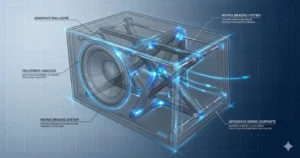
[Image: Technical cross-section of a Euclides Manifold box]
Step 5: The “Throw” Tuning
Unlike a ported box where you tune with a pipe, you tune a Euclides by adjusting the volume of the manifold and the depth of the throat.
- Short Manifold: More “dry” and aggressive punch (perfect for 120Hz hits).
- Deep Manifold: More “weight” and rumble in the lower mid-bass (better for 60Hz-80Hz).
Finishing for the Street
Since this box is going to be seen at meets, the finish matters. Line-X or Duratex (Truck Bed Liner) is the industry standard. It protects the wood from the sun and rain and adds a layer of structural integrity. Plus, it looks aggressive—exactly how a Euclides box should look.
The Moment of Truth
Once the glue has cured and the driver is mounted, it’s time for the first test. When you play a high-quality “Pancadão” track, you’ll notice something immediately: the woofer isn’t moving as much as it would in a ported box, but the sound is twice as intense. That is the Acoustic Loading at work.
Conclusion
The Euclides-style manifold is the ultimate expression of acoustic engineering for outdoor sound. It takes the energy of your woofer and focuses it into a beam of high-pressure mid-bass that can dominate any environment. It’s a challenging build for a DIYer, but the reward—that legendary, long-range “pancadão”—is worth every cut. Build it right, and you won’t just be part of the show; you will be the show.
5 Unique FAQs
1. Can I use a Euclides box for a 12-inch subwoofer? You can, but the results won’t be the same. Subwoofers are designed for low-end rumble (below 60Hz). The Euclides is optimized for the “kick” above 60Hz. If you put a heavy sub in it, you might lose the very punch you are looking for.
2. Why is it called “Euclides”? The name comes from the Brazilian designer (Euclides) who popularized this specific hybrid manifold/horn geometry for the “Som Automotivo” scene.
3. Does a Euclides box work inside a closed car trunk? Not very well. The Euclides needs space to “throw” its sound. In a small car trunk, the waves will bounce back too quickly, causing cancellation. This is a design built for “open-trunk” or wall-style systems.
4. How do I calculate the volume for a Euclides box? It is a complex calculation involving the rear sealed chamber and the manifold’s air volume. Most builders use specialized software like Hornresp or follow proven blueprints from the “Paredão” community.
5. Do I need a different amplifier for this box? Not necessarily, but you need an amp with a high Damping Factor and a good crossover. You must use a Bandpass Filter (e.g., High-pass at 60Hz and Low-pass at 250Hz) to keep the woofer within its optimal range.