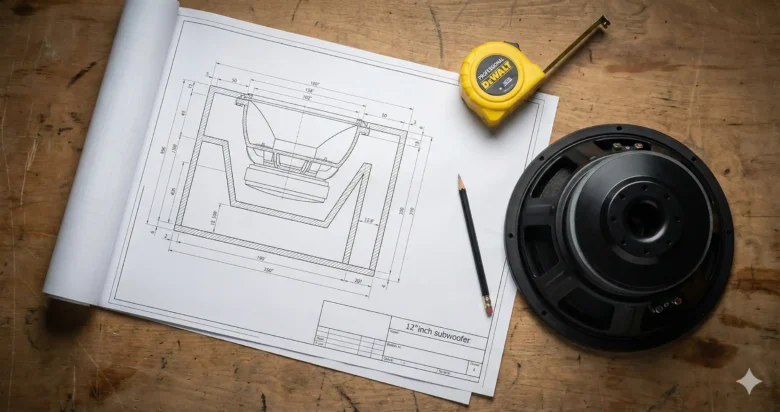
Have you ever spent hundreds of dollars on a high-end 12-inch subwoofer only to be disappointed by a “muddy” or “weak” bass response? It is a common frustration in the DIY car audio world. Most people blame the amplifier or the brand of the speaker, but the truth is usually hidden in the wood. The internal volume, or “litrage,” of your enclosure is the single most important factor in how your sub performs. If the box isn’t built to spec, you aren’t just losing sound quality; you are literally wasting money. (98 words)
In the United States car audio scene, we often talk about cubic feet, but the science of “liters” remains the global standard for precision. Think of your enclosure as a lung; if it is too small, the subwoofer can’t breathe and will overheat. If it is too large, the speaker loses its “spring” and can easily tear itself apart at high volumes. Mastering the calculation of internal volume allows you to unlock the deep, rib-shaking lows that your 12-inch sub was designed to produce in the first place. (95 words)
Stop guessing and start building with confidence by following a proven technical roadmap. Whether you are aiming for a tight, musical sealed box or a massive, window-rattling ported enclosure, the math remains the same. By the time you finish this guide, you will have the “secret sauce” used by professional installers to win sound competitions and create legendary builds right in their own garages. Your journey to perfect, distortion-free bass begins with a simple measurement and a bit of focus. Continue reading.
How to Calculate the Exact Internal Volume for 12-inch Subwoofers: The Professional DIY Guide
If you want your car to shake with precision rather than just rattle with noise, you need to understand that a 12-inch subwoofer is a demanding piece of hardware. It is the “goldilocks” size of the audio world—large enough to move serious air, but small enough to stay musical. However, that performance is entirely dependent on the air pressure inside the box. In this guide, we are going to break down the math, the physics, and the workshop hacks you need to calculate the exact internal volume for your next build.
Liters, Cubic Feet, and the Global DIY Standard
In the USA, most of us use Cubic Feet ($ft^3$) for box volume, but most high-end manuals (like those from JL Audio, Sundown, or Rockford Fosgate) provide specs in Liters (L). To be a successful DIYer, you need to speak both languages.
- The Magic Number: $1 ft^3 = 28.31$ Liters.
When you calculate your box, always work in inches first, then convert to cubic feet, and finally to liters if necessary. This ensures that you are following the manufacturer’s spec to the decimal point. Accuracy here isn’t just for nerds; it’s for anyone who doesn’t want to blow a voice coil on day one.
Understanding Your Subwoofer’s DNA: Thiele-Small Parameters
Before you buy a single sheet of MDF, you must look at the Thiele-Small (T/S) parameters provided with your 12-inch sub. These numbers aren’t just marketing fluff; they are the mechanical blueprints of the speaker.
- Vas (Equivalent Volume): This tells you how “stiff” the air in the box needs to be to match the sub’s suspension.
- Fs (Resonant Frequency): The lower this is, the better the sub is at playing those “low-lows.”
- Qts (Total Quality Factor): If your Qts is above 0.45, your sub will likely perform better in a Sealed Enclosure. If it is below 0.40, a Ported (Vented) Enclosure is usually the way to go.
Step 1: Gross Volume vs. Net Volume (The Most Common Mistake)
This is where 90% of DIYers fail. They calculate the size of the box and stop there. That is Gross Volume. But the air inside the box isn’t “empty.”
Net Volume is what matters. It is the actual amount of air left over after you subtract the physical objects taking up space inside. To get the perfect 12-inch sub performance, you must subtract:
- The Subwoofer Displacement: A typical 12-inch sub takes up about 0.10 to 0.15 cubic feet (approx. 3 to 4 liters) of space inside the box.
- The Port Displacement: If you are building a ported box, the PVC pipe or wood slot port takes up space too.
- Bracing Displacement: Those 2x2s or extra MDF strips you added for strength? They take up volume.
Step 2: The Math of the Enclosure
To find the Gross Internal Volume, you need the internal dimensions of your box. If you use 3/4″ MDF (the standard in the US), you must subtract 1.5 inches from your external width, height, and depth to find the internal measurements.
The Formula:
$$(Width \times Height \times Depth) / 1728 = Cubic Feet$$
Example:
If your internal measurements are $14″ \times 14″ \times 14″$, that is $2,744$ cubic inches. Divide that by $1,728$ (the number of cubic inches in a cubic foot), and you get 1.58 cubic feet.
Now, subtract your sub’s displacement (let’s say 0.12 $ft^3$). You are left with 1.46 $ft^3$ Net Volume. If your 12-inch sub calls for 1.5 $ft^3$, you are almost perfect!
Step 3: Port Tuning and the “Deep Bass” Secret
For a 12-inch sub, a ported box is king for output. But if the port isn’t tuned correctly, it will sound terrible. This is called the Tuning Frequency (Fb).
- For Daily Listening: Aim for 32Hz to 35Hz.
- For Competition (SPL): Aim for 40Hz to 45Hz.
A larger internal volume requires a shorter port to reach the same tuning, whereas a smaller box needs a longer port. This is why “pre-fab” boxes from big-box stores usually sound bad—they aren’t tuned to your specific 12-inch sub’s needs.
Material Choice: Why 3/4″ MDF is the DIY King
Don’t use plywood from a standard hardware store unless it is Baltic Birch. Standard plywood has air pockets that will rattle and hiss under the pressure of a 12-inch sub. Medium Density Fiberboard (MDF) is the standard because it is dense, non-resonant, and inexpensive.
- Pro Tip: Always use wood glue (like Titebond II) and screws. Glue is actually what holds the box together; screws just act as clamps while the glue dries.
The Finishing Touches: Gaskets and Sealant
Even a perfect calculation won’t save a leaky box. Air is like water; it will find the path of least resistance. Use a silicone sealant on every internal joint after the glue has dried. When mounting your 12-inch sub, use a foam gasket or weather stripping to ensure the seal between the metal frame and the wood is airtight.
Conclusion
Calculating the exact internal volume for your 12-inch subwoofer is the ultimate “level up” for any car audio enthusiast. By moving beyond “good enough” and using precise internal measurements, subtracting displacements, and choosing the right tuning, you transform a simple wooden box into a high-performance acoustic instrument. The difference isn’t just something you hear—it’s something you feel in your chest.
5 Unique FAQs
1. Can I use a 12-inch sub box for a 10-inch sub if I use an adapter?
Technically yes, but it’s not recommended. A 10-inch sub usually requires less volume. The oversized box might cause the 10-inch sub to “over-excursion” and damage the voice coil.
2. Does the shape of the box (wedge vs. cube) affect the litrage calculation?
The shape affects how you calculate the volume (wedges are harder!), but the sub doesn’t care about the shape as much as the total volume, as long as there is enough depth for the magnet to breathe.
3. Is it better to be slightly over or slightly under the recommended volume?
If you have to choose, slightly over is usually safer for sound quality. It makes the sub play deeper. However, if you go too far over, you reduce the power handling of the speaker.
4. Should I use poly-fill inside my 12-inch sub box?
Poly-fill slows down the airwaves, making the sub “think” it is in a box that is 10-15% larger. It’s a great “hack” if you accidentally built your box a little too small.
5. How much space should I leave behind the subwoofer magnet?
At least 1 to 2 inches. If the magnet’s pole vent is pressed against the back wall, the subwoofer cannot cool itself and will eventually burn out during long listening sessions.