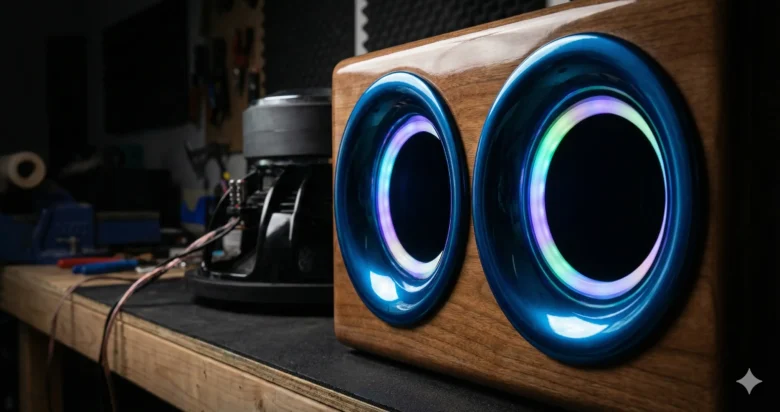
When you are designing a show-worthy trunk setup, every detail matters. You want those polished acrylic accents, the perfect LED glow, and a port that looks like it belongs in a high-end studio. But here is the nightmare scenario: you hit the play button at the car show, and instead of deep, thunderous bass, the crowd hears a loud, whistling “huff” every time the sub kicks. This “chuffing” is the sound of your air moving too fast, and it is the fastest way to turn a professional-looking build into an amateur mistake. (100 words)
In the world of custom builds, we often prioritize symmetry and clean lines. However, a port isn’t just a decorative hole; it is a breathing organ for your 12-inch subwoofer. If the diameter is too small, the air is forced through at extreme speeds, creating turbulence that acts like a physical choke on your bass output. To keep your show build sounding as good as it looks, you have to master the balance between the visual diameter and the internal air velocity. It is about making the air slide, not crash, through the enclosure. (100 words)
Choosing the right port diameter is the “secret sauce” that separates the winners from the runners-up. You don’t need a degree in fluid dynamics to get it right, but you do need to understand how your subwoofer’s excursion—its physical movement—forces air through that pipe. As your “brother” in the shop, I’m going to show you how to pick a diameter that fits your aesthetic while ensuring your bass remains crisp, clear, and absolutely terrifying. Let’s dive into the math and the style of high-performance port design. Check the details. (99 words)
How to Choose the Port Diameter to Avoid Subwoofer “Chuffing”
If you’re building a “Show Build,” you know that the port is the focal point of the enclosure. It’s where the power of the sub is visually represented. But if you pick a 3-inch pipe because it “fits the corner perfectly” for a high-power 12-inch sub, you are in for a world of disappointment. That whistling, huffing sound—technically called Port Noise or Chuffing—will haunt your music.
Let’s talk about how to keep your air velocity low and your “wow factor” high.
What Exactly is “Chuffing”?
Imagine trying to breathe through a tiny straw while running a marathon. You’d hear a loud “whoosh” sound with every breath. That is exactly what happens when your subwoofer (the runner) tries to push air through a port (the straw) that is too small.
As the air speed increases, it creates turbulence against the walls of the port. This doesn’t just make an annoying sound; it creates Port Compression, which means your sub actually gets quieter because the air can’t get out fast enough.
The Show Builder’s Golden Rule: The Mach Limit
In the professional car audio world, we measure air speed in Mach (the speed of sound).
- Target: Keep your air velocity below 0.10 Mach (roughly 34 meters per second).
- The Result: At 0.10 Mach or lower, the air moves smoothly and silently.
- The Danger Zone: Once you hit 0.15 Mach, the “chuffing” becomes audible. At 0.20 Mach, it sounds like a blow dryer.
[Internal Link: Use our free Air Velocity Calculator for Port Design]
Choosing the Diameter based on Subwoofer Size
For a “show” aesthetic, round PVC ports are king. But what size do you actually need for a 12-inch sub?
- Low Power (300W-500W RMS): A single 4-inch diameter port is usually enough. It looks clean and handles moderate airflow well.
- High Power (800W-1500W RMS): You should look at a 6-inch diameter port or dual 4-inch ports for that symmetrical “twin-pipe” look.
- Monster Builds (2000W+ RMS): You are entering 8-inch territory or massive custom slot ports.
Pro Tip: Always check your subwoofer’s Xmax (excursion). A sub that moves 30mm will need a much larger port than a sub that only moves 15mm, even if they have the same wattage.
Aesthetics: The “Aeroport” Advantage
If you want the ultimate show look, don’t just use a piece of raw PVC pipe. You want Aeroports—these are ports with flared ends that look like a trumpet or a jet intake.
- Visuals: They look incredibly aggressive and professional when painted or lit with LEDs.
- Performance: The flares “smooth out” the air as it enters and exits the port. This allows you to use a slightly smaller diameter without chuffing, which is a lifesaver when space is tight.
[Image: Comparison of raw PVC vs. Flared Aeroports in a custom trunk]
The “Price of Beauty”: Port Length
Here is the “Brotherly” warning you need to hear: The wider the port, the longer the pipe must be. If you decide that an 8-inch port looks “cooler” than a 4-inch port for your 12-inch sub, you might find that the pipe needs to be 40 inches long to stay in tune. Fitting 40 inches of pipe inside a 2-cubic-foot box is like playing a game of Tetris with no winners.
The Fix: If the pipe is too long to fit straight, you can use 90-degree elbows. Just remember that every bend increases the risk of turbulence, so use “long-sweep” elbows and sand the internal joints until they are smooth as glass.
Placement for Impact and Performance
In a show build, you might want to point the port up toward the glass or out through a trim panel.
- Clearance: The internal end of the port must be at least one “diameter” away from the back wall. If you have a 4-inch port, keep it at least 4 inches away from the wood inside, or you will create a “choke point” that causes chuffing.
- Loading: Pointing the port toward the rear bumper often yields more bass (loading), while pointing it up looks better for photos. Decide if you are building for “likes” or for “lows.”
Finishing Touches: Paint and LEDs
Since this is a show build, your port shouldn’t look like plumbing.
- Sanding: Sand the PVC with 400-grit sandpaper until the “printing” is gone.
- Painting: Use a high-quality “Plastic-Bond” spray paint. Chrome, metallic flake, or color-matching the car’s exterior are all top-tier choices.
- LEDs: Hide an LED ring just inside the flare. The light will catch the moving air (and the dust) to create a “pulsing” effect that looks incredible at night.
Conclusion
Don’t let your “Show Build” be ruined by the sound of rushing air. By choosing a port diameter that respects the Mach limit and using flares to smooth out the flow, you can have a system that looks like a masterpiece and sounds like a monster. Remember: beauty is in the details, but performance is in the air. Keep it wide, keep it smooth, and keep it loud.
FAQs
1. Can I use multiple small ports instead of one large one? Yes! Two 4-inch ports have nearly the same surface area as one 6-inch port. This is a great way to maintain a symmetrical aesthetic in your trunk.
2. Does the thickness of the PVC wall matter? For show builds, use “Schedule 40” PVC. It’s thicker and more rigid, which prevents the pipe itself from vibrating and creating its own noise.
3. What happens if I make the port too large? Aside from the pipe being impossible to fit in the box, a port that is too large can lead to a loss of cone control, making your sub sound “mushy” and increasing the risk of mechanical failure.
4. How do I paint the inside of a long port? The best way is to “swirl” the paint. Pour a little paint inside, rotate the pipe until it’s covered, and let the excess drain out. It creates a thick, mirror-like finish.
5. Will a flared port change my box tuning? Slightly. A flared port acts as if it’s a little bit longer than a straight pipe. Most builders calculate the length from the “halfway” point of the flare to get the most accurate tuning.