If you own a single 12-inch subwoofer, you are already ahead of the game. It is the most versatile size in car audio, capable of playing almost anything. But here is the problem: a box tuned for the “earthquake” bass of modern Rap often sounds sloppy and “muddy” when you switch to high-speed Rock or Country. You feel like you are stuck with one “sound signature” unless you spend another weekend in the garage building a whole new enclosure. But what if you could change the personality of your box in under ten minutes? (98 words)
As a fellow “single-sub” enthusiast, I know the struggle of wanting that tight, punchy kick drum during your morning commute and a window-shaking rumble for the weekend meet. You don’t need a collection of different boxes taking up your trunk space. By using a few reversible “hacks” like port plugging, volume displacement, and poly-fill, you can effectively “tune” your existing setup to match your mood. It’s about understanding how air behaves inside that wooden shell and giving you the power to manipulate it without breaking the bank or the wood. (99 words)
Converting your box for different musical styles is essentially an exercise in “Acoustic Shape-Shifting.” We are going to look at how to tighten up a ported enclosure for better “snap,” how to trick a small box into sounding deep and warm, and how to use your amplifier’s processing to bridge the gap between genres. You bought that 12-inch sub because it’s a powerhouse—now it’s time to make it work for every track in your playlist. Whether you’re a bass-head or a purist, these modifications will change how you listen to your music. Check the details. (99 words)
How to Convert a Speaker Box for Different Musical Styles
Most people think a subwoofer box is a static object—once it’s built, that’s how it sounds forever. But for those of us running a single 12-inch sub, versatility is the name of the game. You want your system to be an “all-rounder.”
Here is how you can physically and electronically convert your enclosure to handle different genres like a pro.
1. The “Rock & Metal” Conversion: Port Plugging
If you have a Ported (Vented) box, it’s likely great for Rap but can sound “boomy” or “slow” for the rapid-fire double bass drums in Metal or Rock.
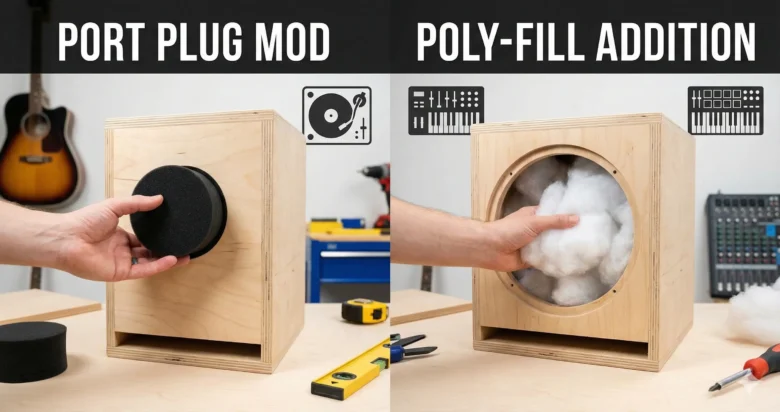
The Hack: Create a Port Plug.
By tightly sealing the port with a piece of dense foam or a custom-cut wood block wrapped in carpet, you turn your ported box into a Sealed Enclosure.
- The Result: The bass becomes significantly tighter, more accurate, and faster. You lose a few decibels of peak loudness, but you gain the “snap” needed for high-tempo music.
2. The “Deep Hip-Hop” Conversion: Port Extensions
Maybe your box is tuned to 40Hz (loud and punchy), but you’ve started listening to “rebassed” tracks that hit 28Hz.
The Hack: Add an external Port Extension.
If you use a round PVC port, you can temporarily attach an extra length of pipe to the outside.
- The Physics: A longer port equals a lower tuning frequency.
- The Result: Your sub will now play those ultra-low notes with authority. It might look a bit “mad scientist” in your trunk, but the low-end gain is real.
3. The “EDM & Pop” Conversion: Internal Displacers
Electronic Dance Music (EDM) often sounds best in a box that is slightly smaller than what you’d use for Rap. A smaller box increases the “Q” of the system, giving you a slight peak in the mid-bass that makes synth-stabs feel more aggressive.
The Hack: Use “Displacers.”
Open your box and drop in a couple of solid bricks or sealed containers of sand.
- The Physics: These objects take up air space, reducing the internal volume ($V_b$).
- The Result: The subwoofer’s response becomes more controlled and “punchy,” which is exactly what you want for 128 BPM dance tracks.
[Internal Link: How to calculate volume displacement for internal objects]
4. The “Jazz & Acoustic” Conversion: The Poly-fill Trick
If your 12-inch sub sounds a bit “dry” or “thin” when listening to acoustic instruments or soulful vocals, you might need more “virtual volume.”
The Hack: Add Poly-fill.
Loosely stuff the box with polyester fiberfill (about 1 pound per cubic foot).
- The Physics: The fibers slow down the air as it moves, making the box act like it is $15\%$-$20\%$ larger.
- The Result: The bass becomes “warmer,” smoother, and extends lower, providing a more natural foundation for non-electronic music.
5. The “Software” Conversion: DSP and Crossover
Sometimes the best conversion happens at the amplifier.
- For Rap: Set your Low-Pass Filter (LPF) to 80Hz and use a bit of “Bass Boost” at 45Hz.
- For Rock: Turn off the Bass Boost and drop your LPF to 60Hz. This prevents the sub from trying to play the same frequencies as your door speakers, which cleans up the “muddiness.”
6. The 2-Second Trick: Phase Inversion ($180^\circ$)
If you feel like the bass is “staying in the trunk” and not reaching your ears at the right time, try swapping the positive and negative wires on your sub (or hit the phase switch on your amp).
Depending on the genre and the box type, inverting the phase can make the bass “jump” to the front of the car, aligning perfectly with the kick drums in your dashboard speakers.
Conclusion
Your single 12-inch sub is a tool of infinite potential. You don’t have to be a victim of your box’s original design. By experimenting with port plugs, displacers, and fill, you can “re-tune” your system for any musical journey. Car audio is a hobby of experimentation—don’t be afraid to change the shape of your sound.
FAQs
1. Is it safe to plug a port that wasn’t designed to be closed?
Yes. However, the sub will handle power differently. In a sealed box (plugged port), the air acts as a spring, which can actually help protect the sub from over-excursion at very low frequencies.
2. What is the best material for a temporary port plug?
High-density upholstery foam is great because it can be compressed into the port for an airtight seal without scratching the finish.
3. Will adding bricks inside my box damage the subwoofer?
Not if they are secured! If a brick slides into your subwoofer’s cone during a sharp turn, it’s game over. Always wrap displacers in cloth and use Velcro or brackets to keep them away from the speaker.
4. Can I “convert” my box just by changing the EQ on my phone?
Digital EQ can help, but it can’t change the physical physics of the box. An EQ can’t stop a panel from flexing or a port from chuffing. Physical mods are always superior to digital “fixes.”
5. How much poly-fill is “too much”?
If you pack it too tight, it actually starts to decrease the virtual volume because it becomes a solid mass. It should always be “fluffy” and loose.