I’ll never forget a client named Steve who drove three hours to my shop in a pristine 2018 Audi. He had just spent a small fortune on a set of Focal Utopia components and installed them himself. On paper, it was a world-class system. But when he sat me in the driver’s seat and hit “Play,” I almost winced. The singer didn’t sound like she was on the dashboard; it sounded like she was trapped under the floorboards, and the high-hats were screaming directly into my left ear.
Steve looked at me, defeated, and asked, “Why does my $2,000 kit sound like a $20 Bluetooth speaker?”
The answer wasn’t the gear—it was the imaging. He had the components, but he didn’t have the stage. Over the next six hours, I didn’t change a single piece of equipment. I just moved the tweeters, sealed the doors, and flipped the phase on one speaker. When he got back in, he actually got emotional. “The singer is right there,” he pointed at the center of the dash. “She’s standing on my hood.”
That is the power of a properly installed 2-way component kit.
Understanding the Goal: What is “Soundstage”?
In the “Old School” pro world, we talk about three things: Width, Depth, and Height.
- Width: The sound should seem to extend beyond the A-pillars.
- Height: The music should be at eye level, not coming from your ankles.
- Depth: You should feel like the drummer is a few feet behind the vocalist.
In a car, the driver’s seat is the worst place to listen to music because you are sitting way too close to the left speaker. This creates a “Path-Length Difference” (PLD) that ruins the stereo image. To fix this, we have to use physical placement and electrical wizardry.
Step 1: The Door is an Enclosure (Treat it Like One)
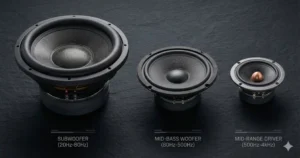
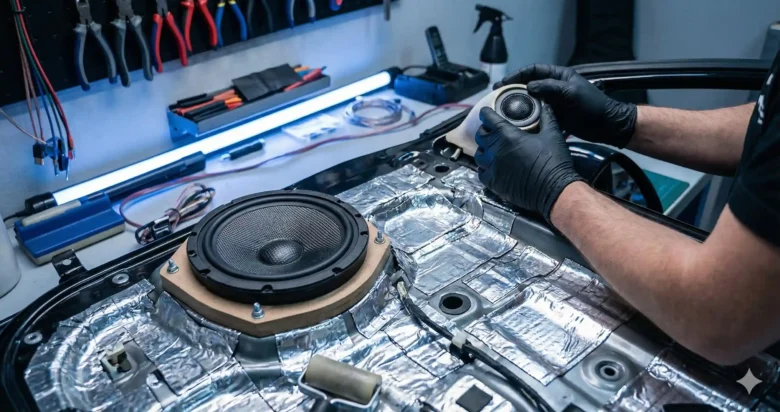
Most people just screw the 6.5-inch mid-bass driver into the factory plastic adapter and call it a day. That’s your first mistake. A speaker moves air; if the mounting surface is vibrating or if air is leaking behind the speaker into the door panel, you lose all your “snap” and mid-bass authority.
I always tell my guys: Seal the baffle. Use a high-quality butyl-based sound deadener (like Dynamat or SoundShield) on the inner and outer skin of the door.
F = 1 / (2 * π * √(M * C))
Where:
F = Resonant frequency of the door panel
M = Mass of the panel (Increasing this with deadener lowers F)
C = Compliance (Stiffness of the panel)
By adding mass to the door, you lower the resonant frequency of the metal, ensuring the door doesn’t “sing” along with your music.
Step 2: Tweeter Placement (The 2-Inch Rule)
Tweeters are highly directional. Because high-frequency wavelengths are so short, even moving a tweeter two inches can completely shift your soundstage.
- Sail Panels (Near the Mirrors): Great for width, but can sometimes feel too “separated” from the mid-bass.
- A-Pillars: My favorite. Aiming the tweeters at a point between the seats (cross-firing) usually creates the most stable center image.
- On-Axis vs. Off-Axis: Aiming them directly at your ears (on-axis) gives the most detail but can be “harsh.” Aiming them across the dash (off-axis) uses the glass reflections to widen the stage.
Pro Tip: Use double-sided tape to test tweeter locations before you cut any holes in your interior. Listen to a track with a strong center vocal and move the tweeters until the voice stays locked in the middle of the dashboard.
Step 3: The Phase Paradox
This is the secret that Steve didn’t know. Because the distance between your left ear and the left speaker is different from the distance to the right speaker, sound waves can arrive at different times and cancel each other out. This is destructive interference.
Sometimes, to get the “bass” to meet the “vocals” on the dashboard, you actually have to wire one speaker “wrong.”
If (Distance_Left – Distance_Right) = ½ Wavelength of Frequency (X),
Then Frequency (X) will be silent (Cancellation).
Solution: Flip the (+) and (-) wires on the passenger side tweeter or mid-bass to realign the waves at the listening position.
Step 4: Managing the Crossover Transition
A 2-way kit comes with a passive crossover box. Its job is to tell the mid-bass to stop playing high notes and the tweeter to stop playing low notes.
Most high-end kits have a “Tweeter Attenuation” switch (0dB, -3dB, -6dB). If your tweeters are mounted high on the A-pillar and are very close to your ears, set them to -3dB. This prevents the high frequencies from overpowering the mid-range, which keeps the soundstage “glued” together.
The “Shop Test” for a Perfect Stage
When I finish an install, I use a specific track—usually something acoustic like Rebecca Pidgeon’s “Spanish Harlem”. I close my eyes. If I can point to exactly where she is standing, and it feels like she is level with my eyes and dead-center on the dash, I’ve won. If the voice is “blurry” or sounds like it’s coming from the speakers themselves, I go back to the phase and placement.
Conclusion
Installing a 2-way component kit isn’t just about wiring; it’s about acoustics. You are building a concert hall inside a metal box. Focus on sealing your doors, experimenting with tweeter angles, and don’t be afraid to flip your phase. If you do it right, you won’t just hear your music—you’ll see it.
FAQs
1. Should I put my mid-bass in the kick panels or the doors? Old School pros love kick panels because it equalizes the path-length difference (the distance to your left and right feet is more similar than the distance to the doors). However, it requires custom fiberglass work. Doors are easier but require much more sound deadening and phase tuning.
2. Can I use the factory tweeter wires? I don’t recommend it. Most factory systems have hidden capacitors or weird EQ processing built into the head unit. For a 2-way kit, run fresh, high-quality OFC wire from your crossover to each driver to ensure a clean, full-bandwidth signal.
3. What is “Time Alignment” and do I need it? Time Alignment (found in DSPs) allows you to digitally delay the speaker closest to you so the sound hits your ears at the same time as the far speaker. If you have this, you can achieve a perfect stage even with bad speaker placement. If you don’t have it, placement is your only tool.
4. Why does my mid-bass disappear when I turn the volume up? This is usually caused by the “back wave” of the speaker meeting the “front wave.” If your door isn’t sealed, the two waves cancel each other out. This is why sound deadening and “fast rings” (foam rings around the speaker) are non-negotiable for a good stage.
5. My tweeters are too “bright.” How do I fix the stage? Try aiming them at the windshield. The glass will reflect the sound and naturally roll off some of the harsh high frequencies, often making the soundstage feel wider and “airier.”