Welcome to the club, brother. You’ve finally got your subs, your amp is wired up, and you’re ready to wake up the neighborhood. But before you go full tilt, we need to talk about the “smoke.” In the car audio world, we have a saying: “Gain is not a volume knob.” If you treat it like one, your brand-new speakers will be in the trash bin by next week.
As a beginner, you probably don’t have a $500 oscilloscope sitting in your garage. That’s okay. You don’t need one to get a professional, safe result. In this 1000-word deep dive, I’m going to show you how to use a simple $15 digital multimeter and a little bit of math to set your gains perfectly.
The Great Gain Myth: Why It’s Not a Volume Knob
Let’s clear this up right now. A volume knob increases the power output of a device. A Gain (or Sensitivity) knob tells the amplifier how much voltage is coming from the radio so it can match it.
Think of it like a pair of binoculars. If you are looking at something far away (a weak signal from a cheap radio), you need to turn the focus dial a lot. If you are looking at something close (a strong signal from a high-end radio), you barely touch it. If you “focus” too much on a strong signal, everything becomes a blur. In car audio, that “blur” is called Clipping, and it is the #1 killer of subwoofers.
Understanding the Enemy: What is Clipping?
Imagine a beautiful, smooth ocean wave. That is a clean audio signal (a Sine Wave). Now, imagine someone takes a giant pair of scissors and cuts the top and bottom off that wave, leaving a flat, square edge. That is a Clipped Wave.
When your amplifier clips, the speaker cone stops moving smoothly and “pauses” for a fraction of a second at the top and bottom of the stroke. During that pause, the energy has nowhere to go, so it turns into pure heat. The voice coil inside your sub starts to cook, the glue melts, and eventually, the speaker “freezes” or catches fire.
The goal of setting your gain is to find the exact point where your amplifier is putting out maximum power just before the wave starts to clip.
Why Beginners Should Avoid the “Ear Method”
A lot of old-school guys will tell you, “Just turn it up until it sounds bad, then back it off a bit.” Don’t do this.
As a beginner, your ears aren’t trained to hear “1% Total Harmonic Distortion.” By the time you actually hear the distortion in a heavy bass track, your amplifier has likely been clipping for several minutes. Heavy bass masks distortion very well. By the time it sounds “bad” to you, the damage is already being done. We need a more precise tool: the Digital Multimeter (DMM).
The Tool: Your New Best Friend, the Multimeter
A Digital Multimeter measures AC Voltage. Since music is an alternating current (AC) signal, we can use the multimeter to see exactly how much “pressure” the amplifier is putting out. This is much more accurate than guessing by ear.
The Formula: Ohm’s Law to the Rescue
To use this method, you need to know two things:
- The RMS Power of your amplifier (e.g., 500 Watts).
- The Impedance of your speakers (e.g., 2 Ohms).
The formula to find your Target AC Voltage is:
$$\text{Voltage} (V) = \sqrt{\text{Power} (P) \times \text{Resistance} (R)}$$
Example Calculation:
If you have a 500W RMS amplifier and your subwoofers are wired to 2 Ohms:
$500 \times 2 = 1000$
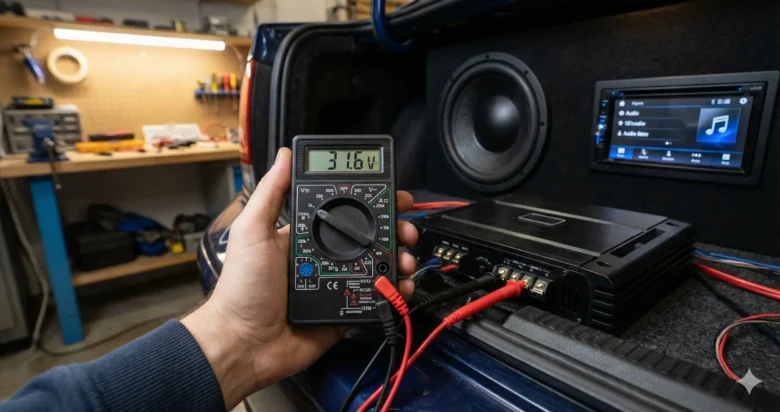
The square root of $1000$ is approximately 31.6 Volts.
This means when your radio is at max volume, your multimeter should read 31.6V at the amplifier terminals. Not a penny more!
Step 0: Preparation and Safety
Before we start, you need Test Tones. Do not use regular music to set your gain! Music is dynamic and constantly changing. You need a steady, pure sine wave.
- For Subwoofers: Download a 50Hz Sine Wave.
- For Door Speakers (Mids/Highs): Download a 1kHz Sine Wave.
Crucial Safety Note: Disconnect your speakers from the amplifier before you start. You are going to be playing loud, steady tones that can be annoying and, if the gain is wrong, can damage the speakers before you even finish the test. We want to measure the voltage at the amp terminals without the speakers connected.
The 7-Step Guide to Perfect Gain
Step 1: Reset the Amplifier
Turn the Gain knob all the way to the left (minimum). Turn off all “Bass Boost,” “Loudness,” and “EQ” settings on your radio and amplifier. We want a “Flat” signal. If you have a crossover (LPF), turn it to its highest setting for now so it doesn’t interfere with the 50Hz tone.
Step 2: Calibrate the Head Unit (The Source)
Most car radios start to distort their own signal at about $75\%$ to $80\%$ of their maximum volume.
- If your radio goes to 40, your “Max Clean Volume” is likely 30 or 32.
- Set your radio to this volume and leave it there for the rest of the test.
Step 3: Connect the Multimeter
Set your multimeter to AC Volts (usually denoted by a $V$ with a wavy line). Insert the probes into the amplifier’s speaker output terminals (Positive to Positive, Negative to Negative).
Step 4: Play the Test Tone
Play your 50Hz (for subs) or 1kHz (for mids) tone. Make sure your phone or source volume is also at max (if using Bluetooth or Aux), but ensure all EQ settings on the phone are off.
Step 5: The Math Check
Look at your multimeter. It will probably read a very low number, like 2V or 5V. Now, slowly—and I mean slowly—turn the Gain knob on the amplifier to the right.
Step 6: Reaching the Target
Watch the numbers climb. Stop immediately when you reach the Target Voltage you calculated earlier (in our example, 31.6V). If the number jumps past it, back it off. This is your “Ceiling.”
Step 7: Lock it Down
Turn off the music, turn down the radio, and turn off the car. Reconnect your speakers. You have now officially set your gains using science instead of guesswork.
Troubleshooting: What if the numbers are weird?
“I turned the gain all the way up and I still didn’t hit my target voltage.”
This usually means your radio has a “Low Voltage Pre-out” (like 2V). In this case, your amplifier just isn’t getting enough signal from the radio to reach its full potential. You might need a Line Output Converter (LOC) or a better head unit. Do not leave the gain at max; it can introduce “floor noise” or hiss.
“My target voltage is 40V, but the amp starts making a weird clicking sound at 30V.”
Some amplifiers have a “Clip Light.” If your amp has a light that flashes RED, trust the light over the multimeter. Every amplifier’s internal components are different; the light is the final authority.
The “Brotherly” Advice: The Daily Driver Reality
Listen, I know you want it loud. But remember: Ambient temperature matters. In the heat of summer, your amplifier and voice coils will get hotter much faster. If you set your gains to the absolute limit on a cold winter day, you might find yourself in trouble in July. I always recommend backing the gain off by about 5% to 10% from your target voltage. You won’t hear the difference in loudness, but your equipment will last twice as long.
Also, be careful with “Rebassed” YouTube music. These tracks are often recorded “Hot” (with extra digital gain). If you set your gain using a clean 0dB test tone and then play a +6dB rebassed track, you are clipping again. Always listen for the signs of stress: a “stinky” burning smell or the bass sounding “mushy” instead of sharp.
Conclusion
Setting your gain without an oscilloscope isn’t a dark art; it’s a simple process of matching voltages. By using a multimeter and Ohm’s Law, you’ve moved from being a “beginner who hopes it doesn’t break” to an “informed owner who knows it’s safe.”
You now have a system that is efficient, clean, and—most importantly—reliable. Go enjoy your music, knowing that you’ve done the work to keep the “smoke” inside the wires where it belongs.
FAQs
1. Is a 0dB or -3dB test tone better for setting gain?
For beginners, I recommend a -3dB tone. A 0dB tone is a “perfect” signal, but most real music is recorded at a lower level. Using a -3dB tone gives you a little bit of “overlap,” meaning your music will sound a bit louder without constant clipping.
2. Can I use a cheap $5 multimeter?
Yes. For measuring AC voltage at 50Hz, even a basic multimeter is quite accurate. Just make sure the battery in the multimeter is fresh; a low battery can give you false high readings.
3. Do I need to set gain again if I change my subwoofer?
If the new subwoofer has a different Impedance (Ohms), then YES. If you go from a 4-ohm sub to a 2-ohm sub, your target voltage changes completely. Always re-calculate!
4. Does the “Bass Boost” knob on the dash affect my gain?
Yes! If you use a remote bass knob, keep it at MAX while you set your gain. This ensures that even when you turn the knob all the way up later, you never exceed the safe limit you just set.
5. Why does my amp get hot even if the gain is set correctly?
Some heat is normal, especially for Class AB amplifiers. However, if it’s too hot to touch, you might have poor airflow or your power/ground wires might be too thin. Gain isn’t the only factor in heat management.