Have you ever spent an entire weekend building the “perfect” subwoofer enclosure only to watch it swell and crumble six months later because of trunk moisture? It is a heartbreaking experience for any DIYer. Choosing the right wood isn’t just about how it looks or sounds on day one; it is about making sure your hard work survives the extreme vibrations and the harsh environment of a car. Most people default to MDF, but is it really the safest bet for protecting your investment over the long haul? (97 words)
MDF and Marine Plywood are the heavyweights of car audio construction, but they serve very different purposes in terms of structural integrity. MDF is beloved for its acoustic neutrality and ease of use, while Marine Plywood offers incredible strength and superior weather resistance. For a builder working in a home garage with basic tools, this choice determines more than just your bass response—it dictates how many times you will have to rebuild the same project. Understanding the resilience of these materials is the only way to protect your speakers and your hard-earned money. (98 words)
You deserve a build that stands the test of time and delivers rock-solid performance every time you turn the key in the ignition. Avoiding the common pitfalls of wood rot and structural failure starts with making an informed, protective decision before you make your first cut. We have analyzed the density, the bonding agents, and the long-term resilience of these materials so you can build your next system with total peace of mind. Dive into our technical breakdown to ensure your enclosure is built to last for years. Check the details.
MDF or Marine Plywood: Which is the Best Wood for Speaker Boxes?
Building your own subwoofer box is a rite of passage for any car audio enthusiast. It is the foundation of your sound, the armor for your speakers, and the structural heart of your trunk. But the “MDF vs. Plywood” debate has raged for decades. If you want a box that doesn’t just sound great but actually lasts through humid summers, rainy winters, and thousands of hours of high-pressure vibrations, you need to know the truth about what you are buying at the lumber yard.
The Industry Standard: What Exactly is MDF?
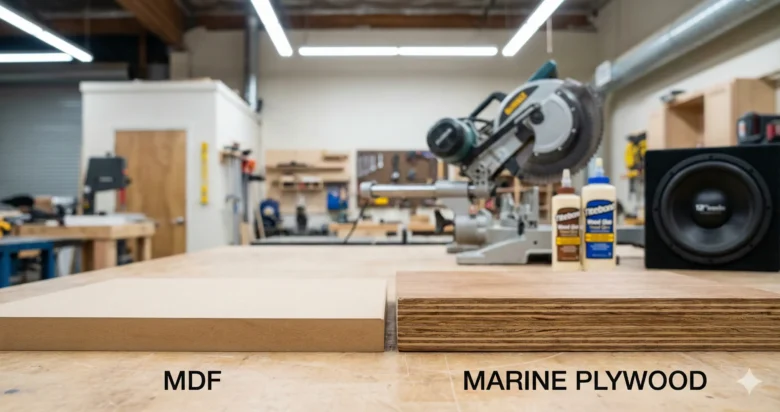
Medium Density Fiberboard (MDF) is the most common material used in professional and DIY car audio shops across the globe. It is made by breaking down hardwood or softwood residuals into wood fibers, combining them with wax and a resin binder, and forming panels by applying high temperature and pressure.
From a protective standpoint, MDF is a double-edged sword. Its greatest strength is its consistency. Because it has no grain and no voids, it is incredibly dense and acoustically “dead.” This means the wood won’t add its own ringing or vibrations to your music. However, MDF is essentially a giant sponge. If it gets wet, the fibers expand, the resin breaks down, and your box will literally fall apart. If you live in a high-humidity area, using unprotected MDF is a ticking time bomb for your sound system.
The Challenger: Understanding Marine Plywood (Birch)
When pros talk about plywood for speaker boxes, they aren’t talking about the cheap stuff used for roofing. They are talking about Marine-Grade Plywood or high-quality Baltic Birch.
Marine plywood is constructed with multiple thin layers of wood veneer glued together with waterproof phenolic resin. This cross-graining technique makes it significantly stronger than MDF. From a durability perspective, Marine Plywood is the king. It can handle moisture without swelling or delaminating, making it the ideal choice for builds in convertibles, boats, or cars that might have a leaky trunk seal. It is lighter than MDF, which protects your car’s suspension and fuel economy, but it is also much more expensive.
[Internal Link: See our guide on sealing wood for car audio]
Acoustic Performance: Which Delivers the Cleanest Bass?
In the quest for the perfect grave, density is your friend. You want a box that stays perfectly still while the subwoofer cone moves.
- MDF is denser and more uniform. It absorbs internal standing waves better, leading to a very “neutral” sound. Most audiophiles prefer MDF for high-fidelity (SQ) systems because it doesn’t “color” the sound.
- Marine Plywood is stiffer but less dense. This stiffness can sometimes lead to a “brighter” sound or slight resonance if the box isn’t properly braced. However, because it is so rigid, it can handle extreme SPL (Sound Pressure Level) better than MDF, which can flex under massive pressure.
If you are building a box for a high-excursion 12-inch sub, the stiffness of Marine Plywood might actually protect your sound quality by preventing the walls of the box from “ballooning” during heavy bass hits.
DIY Workability: Protecting Your Tools and Your Time
For the weekend warrior, workability is a major factor.
- Cutting MDF: It cuts like butter. You can get perfectly straight lines with a basic circular saw, and it routes beautifully for flush-mounting subs. The downside? The dust is toxic and gets everywhere. You must wear a mask to protect your lungs.
- Cutting Plywood: It is prone to splintering or “tear-out” if you don’t use a high-tooth-count blade. It is harder on your tools but produces much cleaner, larger wood chips rather than fine, invasive dust.
If you are a beginner, MDF is more forgiving. If you make a small mistake, it is easy to sand down or fill with wood filler. Plywood requires a bit more finesse to keep the finish looking professional.
The “Fastener” Test: Which Wood Holds the Sub Better?
This is a critical safety and performance issue. Over time, the vibrations of a 12-inch sub can loosen the screws holding it into the wood.
- MDF has poor screw-holding strength. If you take the sub out and put it back in a few times, the holes will “strip out,” leaving your sub loosely mounted. This causes air leaks and destroys performance.
- Marine Plywood grips screws like a vice. The layered construction prevents the wood from crumbling under the tension of the fasteners.
Protective Tip: If you use MDF, always use T-nuts and bolts instead of wood screws. This will protect the wood from stripping and ensure a permanent, airtight seal for the life of the enclosure.
The Moisture Threat: Protecting Your Build from the Elements
Since we are focusing on a durable and protective build, we have to address the “Sponge Factor.” If you use standard MDF in a vehicle that experiences temperature swings, condensation will form. Over a year, that moisture will settle into the bottom of the box.
- MDF will swell at the edges, the glue joints will fail, and mold can start to grow inside the fibers.
- Marine Plywood is treated to withstand these exact conditions. It remains structurally sound even if it gets damp.
If you choose MDF to save money, you must seal it. Painting the inside and outside with a water-resistant resin or a high-quality automotive primer is a mandatory step to protect your work.
Cost-Benefit Analysis: Is the Extra Cash Worth It?
In the US market, a 4×8 sheet of 3/4″ MDF usually costs between $45 and $60. A similar sheet of high-quality Marine Plywood or Baltic Birch can cost $120 to $180.
Is it worth triple the price?
- Choose MDF if: You are on a budget, you live in a dry climate, and you plan to finish the box with carpet or vinyl.
- Choose Marine Plywood if: You want a “lifetime” box, you are worried about weight, you live in a humid/rainy area, or you want to do a stained wood finish.
Step-by-Step Selection Guide for Your DIY Box
- Check Your Climate: If you are in Florida or the Pacific Northwest, lean toward Marine Plywood. If you are in Arizona, MDF is perfectly safe.
- Evaluate the Sub: Is it a monster sub (1500W+ RMS)? Go with Marine Plywood or double-layered MDF for the front baffle.
- Consider Your Tools: Do you have a shop vac and a good mask? MDF is fine. Working in an open driveway? Plywood is cleaner.
- Seal the Deal: Regardless of the wood, always use a high-quality wood glue like [Titebond II] to ensure the joints are stronger than the wood itself.
Conclusion
There is no “perfect” wood, but there is a “right” wood for your specific needs. MDF offers the best acoustic neutrality and price, making it a great entry point for DIYers. However, if your goal is to build a fortress for your sound—a box that resists moisture, holds its fasteners forever, and stands up to the rigors of the road—Marine Plywood is the superior investment. By choosing the right material and sealing it properly, you protect not just your subwoofer, but the hours of passion and effort you put into your car audio journey.
5 Unique FAQs
1. Can I mix MDF and Plywood in the same box? Yes! A common pro trick is to use a Marine Plywood or double-MDF “baffle” (the front plate where the sub mounts) for strength, and MDF for the rest of the walls to save money and maintain acoustic damping.
2. Does “Birch Plywood” from a big-box hardware store count as Marine Plywood? Usually no. Hardware store birch often has “voids” (empty air pockets) in the middle layers. These can vibrate and cause a buzzing sound. True Baltic Birch or Marine-grade has no voids.
3. Is there a way to make MDF waterproof? You can make it highly water-resistant by coating it in fiberglass resin or “Duratex” bedliner spray. However, once the seal is punctured, moisture will still find its way in.
4. Why is my MDF box smelling like chemicals? MDF uses urea-formaldehyde resins. When it’s new or gets warm in a car, it can “off-gas.” Painting or carpeting the box helps seal these smells in.
5. How thick should the wood be for a 12-inch sub? 3/4 inch (19mm) is the industry standard. For high-power applications, doubling the front baffle to 1.5 inches is the best way to protect against box flex and distortion.