Buying your first 12-inch subwoofer is an adrenaline rush, but it quickly turns into a headache when you realize the box matters just as much as the speaker itself. You see people at meets with bass so loud it shakes the ground, and you wonder: is it the gear or the enclosure? Most beginners get stuck choosing between a compact sealed box and a massive ported one, fearing they will make a choice that leaves their system sounding thin or quiet. It is time to clear the air and understand how pressure really works. (99 words)
The battle between Sealed and Ported enclosures isn’t just about size; it is about how you want to feel the music in your chest. A sealed box is the “safe” bet for many, offering tight control and a small footprint, but if your goal is to wake up the neighbors, you are looking for SPL (Sound Pressure Level). Understanding the physics of air displacement and port tuning is the secret weapon that professional installers use to dominate the streets. You don’t need a degree in acoustics, just a few practical tips to get it right. (100 words)
Imagine turning up the volume and feeling a wave of bass that doesn’t just sound loud but physically moves the air around you. Achieving that level of performance requires more than just a big amplifier; it requires the right acoustic environment for your subwoofer to thrive. We have broken down the science of sound pressure into a simple, brother-to-brother guide so you can stop guessing and start feeling the rumble. Don’t let your investment go to waste by putting a great sub in the wrong box. Check the details.
Sealed vs. Ported: Which One Generates More Sound Pressure (SPL)?
Listen, I’ve been where you are. You just unboxed a shiny new 12-inch sub, you’ve got the amp ready to go, and now you’re staring at two different box designs at the shop. One is small and fully closed, and the other has a big hole (the port) staring back at you. You want that “heart-stopping” bass, right? You want that SPL—Sound Pressure Level.
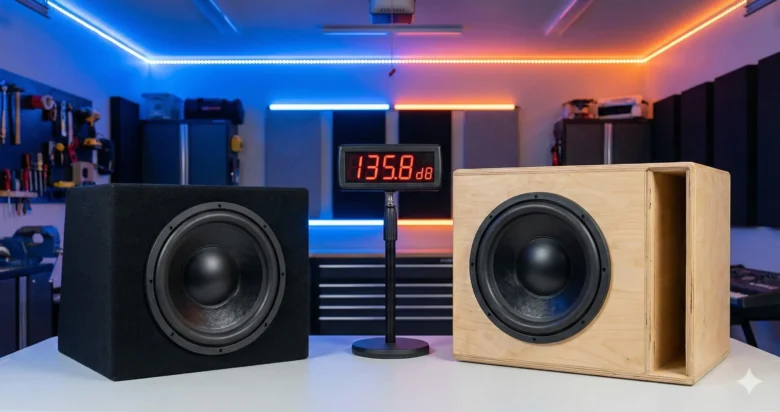
If you are looking for the short answer: The Ported box is the undisputed king of SPL. But hold on, “brother,” before you go rushing to buy one, you need to understand why and how it works so you don’t end up with a system that sounds like a muddy mess.
What Exactly is SPL? (Keep it Simple)
SPL stands for Sound Pressure Level. In the car audio world, we measure this in decibels (dB). It isn’t just about how “clear” the music is; it’s about how much pressure the sound waves create inside your car cabin.
Think of it like this: SPL is the physical force of the bass hitting your body. When people talk about “hair tricks” or shaking the windshield, they are talking about high SPL. To get high SPL, you need to move as much air as possible as efficiently as possible. This is where the box design changes everything.
The Sealed Enclosure: The Accurate Performer
A sealed box is exactly what it sounds like: an airtight wooden cube. When your 12-inch sub moves forward, it creates sound. When it moves backward, it compresses the air inside the box.
Why people love it:
- Accuracy: Because the air inside acts like a spring, it stops the subwoofer cone from oscillating too much. This results in very “tight” and “punchy” bass.
- Small Size: These boxes are perfect if you still want to fit groceries in your trunk.
- Safety: It is very hard to “bottom out” a sub in a sealed box because the air pressure protects the cone.
However, from an SPL perspective, the sealed box is inefficient. You are essentially “trapping” half of the sound (the back wave) inside the box where it just turns into heat. You need a lot of amplifier power to make a sealed box play as loud as a ported one.
The Ported Enclosure: The SPL Monster
Now, let’s talk about the Ported (or Vented) box. This design has a built-in tunnel or tube called a “port.” This isn’t just a hole to let air out; it is a precisely calculated acoustic instrument.
Why it wins for SPL: The port takes the sound wave coming off the back of the subwoofer—which is usually wasted in a sealed box—and flips it around so it comes out of the port in phase with the front wave. Now, instead of just the speaker cone moving air, you have the speaker and the port moving air together. It’s like having two subs for the price of one at certain frequencies.
[Internal Link: How to tune your port for deep bass]
The “Free Power” Effect
This is the part that usually blows beginners’ minds. A properly designed ported box can give you a 3dB to 6dB boost in output compared to a sealed box with the same subwoofer and the same amplifier.
In technical terms, a 3dB increase is like doubling your amplifier power. So, if you have a 500W amp, a ported box can make it feel like you have a 1000W system just by using a smarter box design. That is the definition of efficiency, brother!
The Trade-off: Quantity vs. Quality
Since I’m being a “brother” to you, I have to give you the catch. While the ported box is louder (more SPL), it isn’t always “cleaner.”
- Ported boxes tend to have a “peak” in their response. They play one specific frequency range (the tuning frequency) really, really loud, but they might not be as accurate across all types of music.
- Sealed boxes have a “flat” response. They play all notes (from low to high) with the same level of volume, which many people find more musical.
If you listen to Hip-Hop, Rap, or Dubstep, you want the Ported box. Those genres are designed for that heavy, low-end pressure. If you listen to Rock, Metal, or Jazz, you might prefer the speed and “snap” of a Sealed box.
[Image: Side-by-side frequency response graph of sealed vs ported boxes]
Space: The Final Frontier
Before you commit to the SPL King, check your trunk. A ported box for a 12-inch sub usually needs to be 1.5x to 2x larger than a sealed box. You are trading your trunk space for decibels. If you have a tiny hatchback, a massive ported box might take up the whole car.
Also, remember that the port itself takes up volume. If you build a ported box too small, the air velocity inside the port gets too high, causing a whistling sound called “port noise” or “chuffing.” It sounds like a blow dryer, and it will ruin your bass experience.
Tuning for the “Sweet Spot”
When building a ported box for maximum SPL, most guys tune it around 32Hz to 38Hz. This is the range where you get that deep, vibrating bass that you can feel in your seat. If you tune it too high (above 45Hz), the bass will sound “boomy” and “cheap,” like a bad PA system at a carnival.
Pro Tip: Always use a Subsonic Filter on your amp if you go ported. Below the tuning frequency, the sub has no “air spring” to hold it back, and it can easily fly apart if you play a super low note at high volume.
Common Myths Debunked
- “Sealed boxes are for SQ and Ported are for SPL”: Mostly true, but a well-designed ported box can actually sound very musical, and a massive sealed box can get surprisingly loud.
- “Ports make the bass slow”: Only if the box is poorly designed. A high-quality birch ported box can be very responsive.
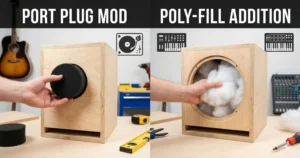
- “You can just cut a hole in a sealed box to make it ported”: NO! Do not do this. A port must be a specific length and diameter to work. A random hole will just destroy your subwoofer.
Conclusion
If your goal is to have the loudest 12-inch subwoofer system on the block and you want that “chest-thumping” pressure, go with a Ported enclosure. It utilizes the physics of the back-wave to give you “free” volume and a massive SPL boost that a sealed box simply can’t match. Just be prepared to give up some trunk space and spend a little more time (or money) getting the tuning exactly right. Bass is a science, but when it hits right, it feels like magic.
5 Unique FAQs
1. Can I get high SPL in a Sealed box? Yes, but you will need a lot more power and likely more subwoofers. For a single 12-inch sub, a ported box will always be the more efficient way to get loud.
2. Is a “Bandpass” box better than both? A 4th-order or 6th-order bandpass box can generate even more SPL than a standard ported box, but they are incredibly difficult to build and tune. One mistake in the math and you’ll burn your sub in minutes.
3. Does the direction of the port matter for SPL? Yes! In many cars, pointing the sub and the port toward the rear bumper creates a “loading” effect that increases SPL by using the hatch or trunk as a horn.
4. Why does my ported box sound quiet with the trunk open? Ported boxes rely on the “cabin gain” of the car to boost the low frequencies. When you open the trunk, you lose that pressure vessel, and the sound waves escape into the open air.
5. What is “Port Chuffing”? It is the sound of air turbulence. If the port is too small for the amount of air the 12-inch sub is moving, the air moves too fast and creates a huffing or whistling sound that covers up the music.