I remember a kid named Leo who walked into my shop in the late 90s, driving a beat-up Honda Civic that was literally rattling apart. He had a trunk full of eight 8-inch “subwoofers” he’d picked up at a flea market for next to nothing. He was proud of the install—he’d wired them all in a complex series-parallel mess to a massive old-school bridgeable amplifier. As he pulled up, the car was emitting a low, distorted hum that made the trunk lid look like it was made of liquid.
He hopped out, beaming with pride, but his face fell when he saw my expression. “I don’t get it,” he said, scratching his head. “It vibrates the whole car. The mirrors are useless. But I can’t hear the lyrics, and the drums sound like someone hitting a wet cardboard box. Why does it sound so… empty?”
I had to explain to him that he was trying to use a sledgehammer to do the work of a scalpel. He had plenty of displacement—those eight cones were moving a lot of air—but he had zero transient response. He was missing the entire middle of the musical spectrum. Leo had built a “one-note wonder.” That day, he learned the most important lesson in audio engineering: Frequency dictates form, and mass is the enemy of speed.
The Physics of Moving Air
At its core, every speaker is an air pump. To produce sound, the cone must move back and forth. The speed at which it moves determines the frequency (Hertz).
- To produce Low Frequencies (Bass), you need to move a large amount of air slowly.
- To produce High Frequencies (Treble), you need to move a small amount of air very quickly.
This is why a subwoofer looks nothing like a tweeter. It’s all about physics.
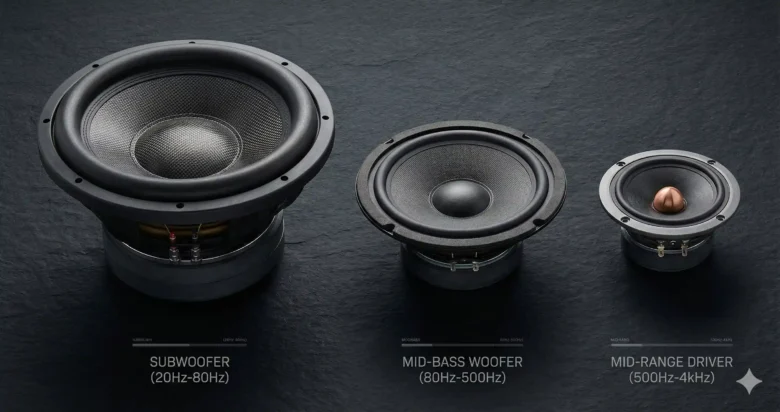
1. Subwoofers: The Heavy Hitters (20Hz – 80Hz)
A subwoofer’s job is to handle the bottom three octaves of human hearing. Because low-frequency waves are massive (a 40Hz wave is about 28 feet long), the driver needs a heavy cone and a huge “throw” (excursion).
Technically, we look at Vd (Displacement Volume).
Vd = Sd * Xmax
Where:
Vd = Total air volume displaced
Sd = Effective surface area of the cone
Xmax = Maximum linear excursion (one way)
Subwoofers have high mass (Mms) to lower their resonant frequency (Fs), allowing them to play the deep notes that you feel in your chest rather than hear with your ears.
2. Woofers / Mid-bass: The Bridge (80Hz – 500Hz)
This is where most “all-in-one” systems fail. The mid-bass driver is the hardest-working speaker in the car. It has to be heavy enough to play down to the subwoofer’s cutoff, but light enough to snap back instantly to reproduce the “kick” of a drum or the lower register of a male voice.
In a 3-way system, the woofer handles the “impact.” If your mid-bass is weak, your system will sound “thin” or “hollow,” no matter how much subwoofer power you have. We look for drivers with a balanced Qts (Total Quality Factor)—usually around 0.4 to 0.6—to ensure they don’t sound too boomy or too dry in a car door.
3. Mid-range: The Soul (500Hz – 5kHz)
The mid-range is where 80% of the musical information lives. Vocals, guitars, and pianos all live here. Because our ears are evolutionarily tuned to the human voice, we are incredibly sensitive to distortion in this range.
A dedicated mid-range driver is usually small (2.5 to 4 inches). Why? Because at 2,000Hz, a 6.5-inch woofer starts to “beam” (the sound becomes a narrow flashlight beam instead of a wide floodlight). A smaller mid-range driver ensures the sound spreads evenly across the dashboard.
The DNA: Thiele/Small Parameters
If you want to be a pro, stop looking at the “Max Power” rating on the box. It’s a useless number. Instead, look at the Fs (Resonant Frequency).
HPF (High Pass Filter) ≥ 2 * Fs
Example: If a mid-range driver has an Fs of 150Hz, you should never cross it over lower than 300Hz to prevent mechanical damage and distortion.
Why You Can’t “Force” It
I see people trying to make a 6.5-inch woofer act like a subwoofer by boosting the EQ at 30Hz. All you are doing is creating heat. The speaker doesn’t have the Xmax (physical travel) to move that much air. Conversely, trying to make a 12-inch subwoofer play vocals is impossible because the cone is too heavy to vibrate 1,000 times per second.
Conclusion
A great car audio system is an orchestra. The subwoofer is the tuba, the mid-bass is the cello, and the mid-range is the violin. When you understand the technical limits of each—the mass, the displacement, and the resonant frequency—you stop guessing and start engineering. Leo eventually fixed his car by adding a proper set of components, and the “Flat Sound” mystery was solved. Don’t be like young Leo; respect the physics of the driver.
FAQs
1. Can I use a “Full Range” speaker instead of dedicated drivers? You can, but it’s a compromise. Full-range speakers use a “whizzer cone” or a coaxial tweeter to try and cover everything. While convenient, they can’t match the clarity of a dedicated mid-range or the impact of a dedicated woofer because one motor is trying to do two jobs.
2. Why do some mid-range drivers have a “bullet” in the middle? That’s a phase plug. It prevents the sound waves from the different parts of the cone from crashing into each other at high frequencies. It also helps dissipate heat from the voice coil, improving reliability.
3. Is it better to have a 10-inch or 12-inch mid-bass for a “Pancadão” style? For the Brazilian “Pancadão” or US Pro-Audio style, 10-inch or even 12-inch woofers are common. They have massive Sd (surface area), which creates incredible “chest-kick” pressure, but they require very high crossover points for the compression drivers.
4. What happens if I set my subwoofer crossover too high? If you cross your sub at 150Hz or 200Hz, you will hear “localization.” The bass will sound like it’s coming from the trunk instead of being part of the music on the dash. Keep subs below 80Hz for the best integration.
5. Why are mid-range drivers often enclosed in their own small chamber? If a mid-range and a woofer share the same air space (like inside a door), the pressure from the woofer will push the smaller mid-range cone around, causing massive distortion. A dedicated enclosure “isolates” the mid-range so it can play cleanly.