Imagine standing in the silent sanctuary of a world-class recording studio. The air is still, the walls are treated with surgical precision, and the monitors are positioned to deliver every breath of the vocalist directly to your soul. In this space, the artist’s intent is sacred. There is no distortion, no vibration, and no compromise. This is the “Zero Point” of audio—where music lives in its purest, most untainted form before it reaches the world.
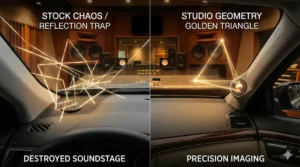
Now, step into your car. You are surrounded by reflective glass, vibrating plastic door panels, and sound-absorbing leather seats. You are sitting inches away from the left speaker while the right one is four feet away. The acoustics are a chaotic nightmare of reflections and cancellations. No matter how expensive your speakers are, they are fighting an uphill battle against the very physics of the cabin. Without a way to control this chaos, you aren’t hearing music; you are hearing a compromised echo.
The bridge between this acoustic disaster and the studio-grade experience you crave isn’t found in a bigger magnet or a silk dome tweeter. It is found in the “Brain” of the system—the Digital Signal Processor. If you truly value the integrity of the soundstage and the emotional weight of a high-resolution track, you cannot afford to ignore the processing power that restores order to the cabin. To discover how to finally unlock the hidden potential of your vehicle’s interior, continue reading below.
The Studio Paradox: Why Your Dashboard isn’t a Stage (Yet)
For the purist, music is more than just background noise; it is an immersive experience. When you listen to a high-quality recording on a home audiophile setup, you expect a “Center Image.” You want to close your eyes and feel exactly where the drummer is sitting, where the guitarist is standing, and where the singer’s voice is hovering in the air. This is the “Stage.”
In a car, this stage is naturally broken. Because you sit off-center, the sound from the driver-side tweeter reaches your ear significantly faster than the sound from the passenger side. This creates a “smeared” effect. Your brain can’t localize the sound, so the music feels like it’s coming from your feet or the bottom of the door. To a purist, this is an insult to the engineering that went into the original master of the song.
The “New Speaker” Trap: Throwing Money at a Broken Acoustic Environment
One of the most common mistakes beginners make is thinking that a $1,000 pair of component speakers will solve their problems. While high-end hardware like Focal or Morel offers incredible detail, they are still subject to the laws of physics. If you put a world-class violinist in a bathroom, they will still sound like they are playing in a bathroom.
Installing premium speakers without a DSP is like buying a 4K cinema projector and shining it onto a wrinkled, grey bedsheet. You have the resolution, but you lack the “screen” to display it properly. The cabin of your car is that wrinkled sheet. A DSP acts as the iron that flattens the environment, allowing those expensive speakers to actually do their job.
Meet the Conductor: What a Digital Signal Processor Actually Does
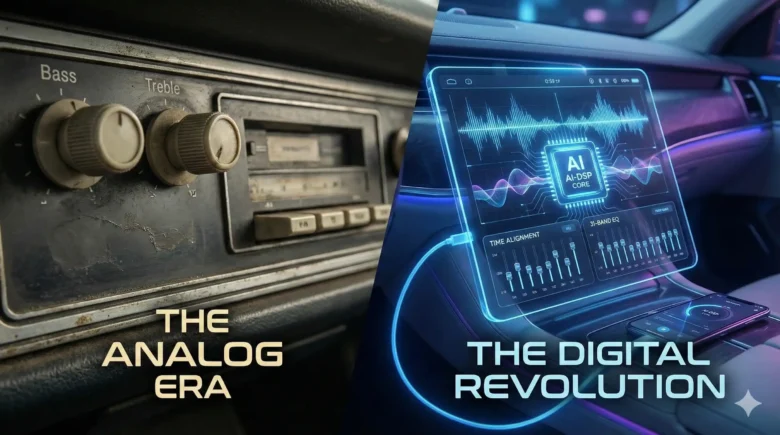
In the world of professional audio engineering, the Digital Signal Processor (DSP) is the conductor of the orchestra. It takes the raw, messy signal from your head unit and converts it into a high-resolution digital stream. Once the audio is in the digital domain, we can manipulate it with microscopic precision that was impossible in the analog era.
A DSP doesn’t just “change the sound.” It corrects the environment. It allows us to tell each individual speaker exactly when to play, how loud to play, and which frequencies to ignore. This level of control is what separates a “car stereo” from a “mobile high-fidelity system.”
The Science of the Phantom Center: Why Time Alignment is Non-Negotiable
The most magical feature of a DSP is Time Alignment. As we discussed, you sit closer to one side of the car. A DSP allows the tuner to delay the signal of the closer speakers by fractions of a millisecond.
When this is done correctly, the sound waves from every single speaker in the car—tweeters, mid-ranges, and subwoofers—hit your eardrums at the exact same moment. The effect is haunting. Suddenly, the dashboard “disappears,” and a rock-solid center image appears right above your steering wheel. The singer is no longer in the door; they are on the hood of the car, singing directly to you.
Surgical Equalization: Removing the Vehicle’s “Fingerprint” from the Art
Every car has a “sound signature.” Some cars have a nasty resonance at 400Hz because of the hollow space in the doors. Others have a sharp, painful peak at 8kHz because the tweeter is reflecting off the windshield glass. These peaks and dips color the music, moving it further away from the artist’s original vision.
A standard “Bass/Treble” knob is a blunt instrument. It’s like trying to perform surgery with a chainsaw. A DSP, however, provides a 31-band Parametric EQ for every single channel. We can find that specific 400Hz resonance and pull it down by exactly 3 decibels with a narrow “Q” factor. This leaves the rest of the music untouched while surgically removing the car’s acoustic flaws.
De-Equalization: Dealing with the Factory Radio’s Sabotage
In 2026, most modern vehicles come with integrated screens that control everything from your GPS to your climate control. You can’t just replace the radio anymore. The problem? Factory engineers bake “dirty” EQ into these radios to protect the cheap paper speakers they come with. They roll off the bass as you turn up the volume and boost the highs to make poor speakers sound “clearer.”
For a purist, this is the ultimate enemy. A high-quality DSP features De-Equalization and Summing. It analyzes the garbage signal coming out of your factory radio, flattens it, and restores the full-range high-fidelity signal. It gives you a “Clean Slate” to build your masterpiece upon.
The ROI of Pure Sound: Why a DSP is the Smartest Audio Asset You’ll Own
When we look at the Return on Investment (ROI) of an audio build, most people look at the resale value of the car. But for the audióphile, the ROI is measured in “Hours of Joy.” A DSP is a universal asset. Unlike custom speaker pods or heavy subwoofer boxes, a DSP is a small, powerful computer.
When you sell your car, you can simply unplug your DSP and move it to the next vehicle. It is a “forever” component. It makes a $200 set of speakers sound like $800, and it makes an $800 set sound like $3,000. It is the single most cost-effective way to achieve true high-end sound in a mobile environment.
The Purist’s Roadmap: How to Start Your DSP Journey Today
If you are ready to stop listening to a distorted version of your favorite tracks, your first step isn’t a catalog of speakers. It is a consultation with a specialist who understands Acoustic Tuning.
- Look for an Entry-Level DSP-Amp: Brands like Helix, Mosconi, and Match offer units that combine a powerful amplifier with a world-class DSP.
- Prioritize the Front Stage: Focus your processing power on the speakers in front of you. In the studio, the sound comes from the front—your car should be no different.
- Invest in a Tune: A DSP is only as good as the person tuning it. Whether you use AI-driven smartphone apps or a professional with an RTA microphone, the “Calibration” is where the magic happens.
Conclusion: Honoring the Artist’s Intent Behind the Wheel
At the end of the day, we don’t build these systems because we love wires and processors. We build them because we love music. We believe that when an artist pours their heart into a recording, we have an obligation to hear it exactly as they intended—even at 70 miles per hour on a busy highway.
The era of “guessing” with analog knobs is over. We now have the technology to turn a cramped, plastic-filled cabin into a mobile temple of sound. Don’t settle for the “standard” experience. Calibrate your life, process your signal, and finally hear the truth in your music.
Frequently Asked Questions (FAQ)
1. Can I install a DSP myself if I’m an amateur? While many modern DSP units offer “Plug & Play” harnesses for specific vehicles, the physical installation is only 20% of the job. The real value is in the tuning. If you are a beginner, look for units with “AI-Auto Tune” features that use your smartphone’s microphone to help set the initial levels. However, for a true purist experience, a professional calibration is always recommended.
2. Will a DSP work with my iPhone or Android device? Absolutely. In fact, many high-end DSPs allow you to bypass your car’s factory radio entirely. You can stream high-resolution audio (Lossless) directly from your phone into the DSP via Bluetooth HD, USB, or Optical inputs. This ensures the purest possible signal path from the source to your ears.
3. Does a DSP make my music louder? Not necessarily. A standalone DSP does not have power; it is a processor. However, most beginners opt for a “DSP-Amplifier,” which does both. The real benefit isn’t “loudness”—it is “Clarity.” By removing distortion and aligning the speakers, the music will feel more powerful and impactful even at lower volumes.
4. Is it worth getting a DSP if I keep my factory speakers? This is the “Secret Weapon” of car audio. Often, factory speakers aren’t as bad as they sound; they are just poorly controlled and improperly equalized by the factory radio. Adding a DSP to factory speakers can result in a 50% to 70% improvement in sound quality, often providing a better result than swapping speakers without a processor.
5. How much space does a DSP take up in my car? Modern engineering has made these units incredibly compact. Most entry-level DSPs are about the size of a small paperback book. They can easily be hidden under a seat, behind the dashboard, or in the glovebox, making them perfect for stealth installs that maintain the original look of your vehicle.