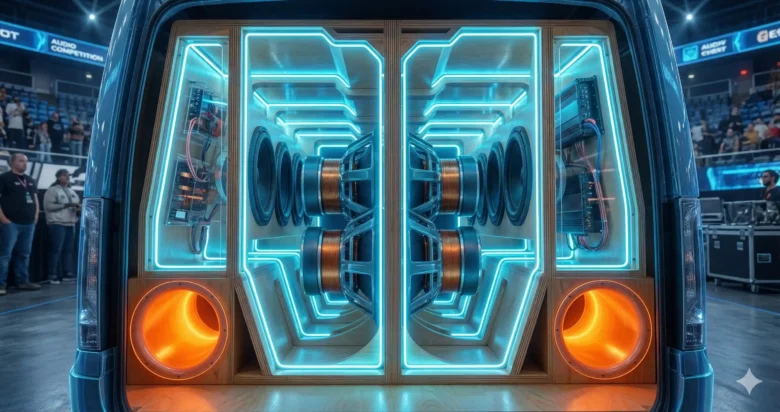
I’ll never forget a blacked-out Chevy Tahoe that pulled into a local show in 2015. It didn’t look like much from the outside, but when the owner hit “Play,” the windshield didn’t just vibrate—it flexed nearly two inches until a spiderweb crack raced across the glass. This wasn’t a standard ported box. Behind the B-pillar was a massive, floor-to-ceiling “Wall” engineered as a 6th Order Bandpass. The pressure was so intense it felt like someone was squeezing your lungs from the inside.
The 6th order is often called the “Forbidden Enclosure” because it is incredibly easy to get wrong and catastrophically difficult to build. If the ratios are off by even a fraction, you’ll end up with a “one-note wonder” that sounds like a wet cardboard box or, worse, a pile of shredded subwoofer cones. But when the math is perfect? It is the most efficient way to turn electrical energy into raw, violent Sound Pressure Level (SPL).
If you are ready to stop playing with “daily” boxes and start engineering for the 160dB club, you need to understand the physics of the chambers. This isn’t just wood and glue; it’s an acoustic pressure vessel. In this guide, I’m going to pull back the curtain on how the pros build the most feared enclosures in the lanes.
What Exactly is a 6th Order Bandpass?
Unlike a standard sealed or ported box, a 6th Order Bandpass enclosure has two chambers, and both are ported. The subwoofer is mounted in a wall between these two chambers, meaning you never actually see the cone—you only hear the air being moved by the ports.
The “Magic” happens because you have two different tuning frequencies. The rear chamber is usually tuned lower to catch the “low lows,” while the front chamber is tuned higher to provide that chest-thumping punch. When these two tunings overlap, they create a massive “bump” in efficiency that can be 3dB to 6dB louder than a standard ported box with the same power.
Parallel vs. Series: Choosing Your Weapon
In Extreme Audio Engineering, there are two ways to route the airflow:
- Parallel 6th Order: Both the front and rear chambers port directly into the vehicle’s cabin. This is easier to tune and offers a wider bandwidth, making it more “musical.”
- Series 6th Order: The rear chamber ports into the front chamber, and then the front chamber ports into the cabin. This design is much harder to build but offers insane cone control and maximum SPL at a specific frequency.
The Physics of Cone Loading and Power Handling
One of the biggest advantages of a bandpass wall is Cone Loading. In a standard box, subwoofers often reach their mechanical limit (bottoming out) before they reach their thermal limit. In a 6th order, the air pressure in the chambers acts like a “spring” on both sides of the cone.
This pressure limits the subwoofer’s movement, allowing you to throw 5,000 watts at a sub rated for 2,500 watts without it flying apart. This is how 160dB builds survive. However, because you can’t see the cone, you won’t know if it’s “clipping” until you smell the voice coil. Real-time Monitoring of your voltage and signal is mandatory here.
Tuning the Lows and Highs: The Frequency Trap
The goal of a 6th Order Bandpass is to create a flat “plateau” of bass. To do this, you have to choose your tuning frequencies (Fb) wisely.
- Rear Chamber: Typically tuned between 25Hz and 35Hz.
- Front Chamber: Typically tuned between 45Hz and 60Hz.
If the tunings are too far apart, you get a “dip” in the middle. If they are too close, you get a massive peak that sounds terrible but scores high on a term-lab meter.
Building the Wall: Survival of the Strongest
At 160dB, the pressure inside the box is enough to bend 3/4″ MDF like it’s paper. If the enclosure walls flex, you lose decibels. Every “flex” is energy that should have been sound but was wasted moving wood.
Pro-Build Specs:
- Material: Use at least triple-layered Baltic Birch plywood or 1-inch MDF.
- Bracing: Use 1-inch threaded steel rods or “window” bracing inside the chambers to lock the walls together.
- Fiberglassing: The internal corners should be rounded with “kerf” ports or fiberglass resin to minimize air turbulence.
Cabin Gain: The Vehicle is the Final Chamber
In Extreme Audio Engineering, we don’t just build a box; we treat the car as part of the enclosure. This is known as the Transfer Function. Every vehicle has a frequency where it naturally gets louder (usually between 40Hz and 50Hz for SUVs).
When you build a “Wall,” you are essentially turning the cabin into a pressurized room. By matching the enclosure’s front-chamber peak to the vehicle’s resonant frequency, you can gain an “easy” 3-5dB. This is the difference between a loud car and a legendary car.
The Danger Zone: Safety at 160dB
We have to be serious for a moment. 160dB is not a joke. This level of pressure can cause permanent hearing loss in seconds. It can also:
- Shatter windshields and side windows.
- Pop door seals.
- Tear the metal of the vehicle’s roof or B-pillars (metal fatigue).
Always use a remote control to play the system from outside the vehicle during full-tilt demos. Fire Safety is also critical; ensure your High-Output Alternator and battery bank are fused properly, as a vibration-induced short circuit at these power levels is catastrophic
Conclusion: Mastering the Pressure
The 6th Order Bandpass wall is the ultimate expression of acoustic engineering. It requires patience, multiple prototypes, and a deep understanding of the Physics of Sound. It’s not for the faint of heart, and it’s certainly not for a small budget.
But when you finally sit in that driver’s seat (with ear protection) and feel the air move with the force of a hurricane, you’ll understand why it’s the “Forbidden Enclosure.” It is the pinnacle of performance.
FAQ:
1. Can I build a 6th order for a trunk car? It is possible, but extremely difficult due to space constraints. Most 6th orders require 2 to 3 times the volume of a standard ported box. In a trunk, you usually run out of air for the ports to “breathe,” which leads to “chuffing.”
2. Why do people say 6th orders sound “muddy”? Because of “Group Delay.” Because the sound has to travel through ports and chambers, there is a slight delay between the electrical signal and the acoustic output. A poorly designed 6th order will have high group delay, making the bass feel “slow” or “behind” the music.
3. Do I need a specific subwoofer for a bandpass? Yes. You need a subwoofer with a strong motor (High BL) and a stiff suspension. A “soft” sub will lose control in the high-pressure environment of a 6th order and will likely fail mechanically.