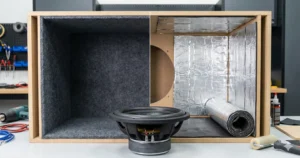
For the acoustic engineer, a subwoofer enclosure is not just a box; it is a pressurized vessel subject to extreme mechanical stress. When a high-power 12-inch driver pushes $2000W$ RMS, the internal pressure fluctuations are immense. Every millimeter of panel flex represents a failure in energy transfer. Instead of that energy moving air toward the listener, it is converted into heat and parasitic noise through the wood. To build the ultimate enclosure, one must move beyond carpentry and into the realm of structural engineering and material science. (98 words)
The objective of internal bracing is to manipulate the resonant frequency of the enclosure panels. Every flat surface has a natural frequency where it wants to vibrate. If that frequency falls within the subwoofer’s operating range (usually $20Hz$ to $80Hz$), the box “sings” along with the music, causing destructive interference and muddying the transient response. By strategically placing braces, we divide large panels into smaller segments, effectively raising their resonant frequency above the sub’s passband. It is a game of physics where stiffness and mass are your primary variables. (99 words)
In this technical guide, we will analyze the structural mechanics of high-pressure enclosures. We will explore why “over-bracing” is a common myth and how the geometry of your internal supports can either enhance or degrade your system’s total Q-factor. Whether you are using threaded steel rods for tension or CNC-machined matrix bracing for structural rigidity, the goal remains the same: a perfectly inert environment for your driver to perform. Prepare to dive deep into the math of rigidity and the science of silent wood. Check the details. (96 words)
The Science of Internal Bracing in High-Power Enclosures
In high-performance car audio, the “box” is the most overlooked component of the signal chain. To the casual observer, it is a simple MDF container. To the engineer, it is a mechanical filter that must remain perfectly rigid under extreme pressure. When we deal with high-excursion 12-inch subwoofers, the internal forces can reach hundreds of pounds of pressure against the enclosure walls.
The Physics of Pressure ($P$) and Force ($F$)
To understand why bracing is mandatory, we must first look at the force exerted by the air inside the box. As the subwoofer cone moves backward, it compresses the air. The pressure $(P)$ inside the enclosure acts equally in all directions.
The total force $(F)$ acting on a single panel is calculated by:
$$F = P \cdot A$$
Where:
- $P$ is the internal pressure (which increases with the subwoofer’s power and excursion).
- $A$ is the surface area of the panel.
On a standard $15″ \times 15″$ panel, even a small increase in $PSI$ can result in hundreds of pounds of force trying to “balloon” the wood. If the wood flexes, you lose SPL (Sound Pressure Level) and introduce Phase Distortion.
Resonant Frequencies and Modal Analysis
Every panel in your enclosure has a Fundamental Resonant Frequency ($f_0$). If this frequency coincides with a bass note being played, the panel will vibrate in sympathy, acting like a secondary (and very poor quality) speaker.
The Engineering Secret: Bracing does not “absorb” vibration; it shifts the resonant frequency. By placing a brace in the center of a panel, you effectively halve the unsupported span. This increases the stiffness of the panel and moves the resonant frequency higher—ideally well above $150Hz$, where the subwoofer is no longer playing.
Window Bracing vs. Threaded Steel Rods
There are two primary schools of thought in high-power structural design:
1. Window Bracing (The Matrix Method)
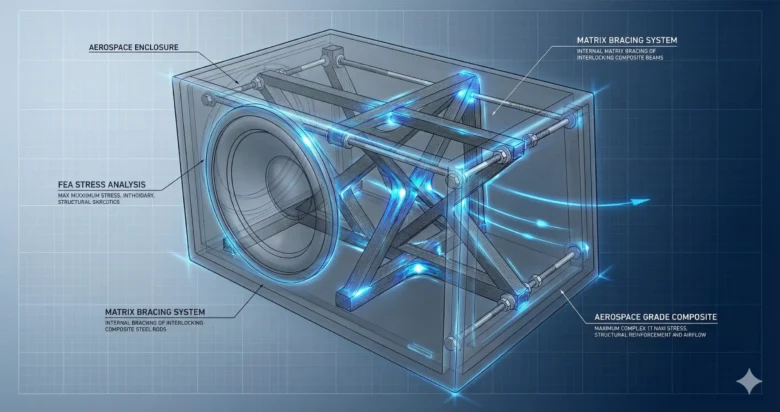
This involves a solid piece of MDF or Birch with “windows” cut out, effectively creating a skeleton inside the box.
- Pros: It provides uniform support to all four walls and adds significant structural mass.
- Cons: It takes up considerable internal volume (displacement), which must be accounted for in your tuning calculations.
2. Threaded Rods (The Tension Method)
Using $1/2″$ or $3/4″$ steel threaded rods with nuts and large washers to “clamp” the front baffle to the rear wall.
- Pros: Takes up almost zero air volume and provides incredible resistance to “ballooning.”
- Cons: It only provides support at the specific points where the rod is attached. It does not address the resonance of the rest of the panel.
[Internal Link: Comparing MDF vs. Birch Plywood for structural rigidity]
Matrix Bracing: The Aerospace Approach
In extreme competition builds (SPL), builders use a Matrix Bracing system. Instead of one thick brace, they use several thinner, strategically placed braces that intersect like a honeycomb. This uses the principle of triangulation to create an enclosure that is mathematically incapable of flexing. This ensures that $100\%$ of the energy from the voice coil is converted into acoustic pressure.
Displacement and the Net Volume Math
For the engineering nerd, precision is everything. You cannot simply ignore the volume of the braces. A complex window brace can occupy $0.10$ to $0.25$ cubic feet.
The Formula for Accuracy:
$$V_{net} = V_{gross} – (V_{sub} + V_{port} + V_{bracing})$$
If you fail to subtract the bracing volume, your Tuning Frequency ($F_b$) will be higher than intended, potentially leading to a “peaky” response and less low-end extension.
The 1.5″ Baffle: Mechanical Load Distribution
The front baffle is the only panel subject to both pneumatic pressure and mechanical vibration from the subwoofer’s frame. A high-excursion 12-inch sub can have a moving mass ($Mms$) of over $300$ grams. At $50Hz$, that mass is moving back and forth 50 times per second.
The Engineering Verdict: A double-layered ($1.5″$) baffle is required to act as a “mechanical ground.” The extra mass provides an inertia base that prevents the sub’s motor from moving the box instead of the cone.
Glue-Joint Chemistry
In a high-power enclosure, the joints are the primary failure points. Standard PVA glues (like Titebond) create a bond that is stronger than the wood fibers themselves—but only if the surfaces are perfectly flat. For engineers, we recommend a “Long-Clamp” time of at least 24 hours to allow the cross-linking of polymers in the glue to fully reach maximum tensile strength.
Conclusion
Building an enclosure for high-power subwoofers is an exercise in structural optimization. By applying the principles of panel resonance and force distribution, you move away from guesswork and toward acoustic perfection. A silent, rigid box is the only way to hear the true T/S parameters of your driver without the “coloration” of vibrating wood. In the world of elite car audio, stiffness is king.
FAQs
1. Does adding mass (weight) to the box stop it from flexing?
Mass and stiffness are different. Adding weight (mass) lowers the resonant frequency, which can actually make the box vibrate more at low bass frequencies. To stop flex, you need stiffness (bracing), not just weight.
2. Can I use carbon fiber for bracing?
Technically, yes. Carbon fiber has an incredibly high Young’s Modulus (stiffness-to-weight ratio). However, the cost and difficulty of bonding it to wood make it impractical for most DIY builds.
3. What is “Cross-Bracing”?
Cross-bracing is when you connect two opposite walls (e.g., left and right) with a single beam. This is the most efficient way to stop “ballooning” with the least amount of material.
4. Should braces be glued or screwed?
Both. Glue provides the structural bond, while screws act as a permanent clamp to ensure the glue joint never fails under the intense internal pressure.
5. How do I find the “nodes” of my panel to place the braces?
A simple DIY method is the “Rice Test.” Place the box flat, sprinkle rice on a panel, and play a sine wave. The rice will gather at the “nodes” (dead spots) and bounce away from the “antinodes” (vibrating spots). Place your braces where the rice bounces the most!