Have you ever sat in a car where the bass didn’t just play music but actually made it hard to breathe? That is the magic of frequencies below 40Hz. It is a visceral, bone-shaking experience that separates a standard car audio system from a true ground-pounder. However, reaching those “low-lows” is a dangerous game for your equipment. If you don’t know the secrets of port tuning, you are more likely to smell a burning voice coil than to feel a hair-trick. (98 words)
As your “brother in bass,” I’ve seen too many guys throw away thousands of dollars because they tuned their boxes for “loud” but played music that was “low.” Tuning a port below 40Hz requires a shift in mindset; you are no longer just building a box, you are designing a pressure vessel. When you hit that 30Hz sweet spot, the air in your cabin becomes heavy, your mirrors blur, and your seats become massage chairs. But without the right protective measures, that same pressure will destroy your subwoofer in seconds. (99 words)
Don’t let your passion for deep bass turn into a costly mistake. Mastering the physics of low-end tuning is the only way to get that legendary rumble while keeping your gear safe for years of daily pounding. We are going to dive deep into the math of port lengths, the life-saving necessity of subsonic filters, and the technical “hacks” that make the air move like a hurricane. If you want to own the low-end, you need to understand the science behind the shake. Check the details.
The Secret of Port Tuning for Frequencies Below 40Hz: Low-End Mastery
If you are reading this, you aren’t looking for “tight, punchy bass.” You are looking for the kind of sub-bass that moves hair, flexes windshields, and makes people wonder if an earthquake is happening. Tuning a subwoofer enclosure below 40Hz—typically into the 28Hz to 34Hz range—is where car audio becomes a physical experience. But listen to me, brother: the “Low-Low” is a double-edged sword.
The Sensory Shift: From Hearing to Feeling
When you tune a box to 45Hz, you hear the bass. It’s loud, it’s poppy, and it works great for rock music. But when you drop that tuning frequency (Fb) below 40Hz, something changes. You stop hearing the note with your ears and start feeling it in your lungs.
Below 40Hz, sound waves become incredibly long. A 30Hz wave is nearly 38 feet long! Inside a car, these waves create pressure. This is why your ears “pop” and your chest feels tight. To reach this level of performance, your port must be tuned to act as a massive air-moving piston that supports the subwoofer cone exactly where it wants to fail.
The Secret of Fb: How the Port Controls the Sub
The Tuning Frequency (Fb) is the point where the port does all the work and the subwoofer cone barely moves. This is the “sweet spot.”
- Above the tuning: The box acts like a normal enclosure.
- At the tuning: The air in the port resonates, creating massive output with minimal speaker effort.
- Below the tuning: This is the Danger Zone. Below the Fb, the subwoofer loses all “air spring” control. It starts to “unload,” meaning it flails around wildly.
If you tune your box to 32Hz but try to play a 20Hz “rebassed” track at full volume, your sub will likely bottom out and break. This is why the secret of low tuning isn’t just about the box—it’s about the Subsonic Filter.
The Protector’s Rule: Set Your Subsonic Filter
If you want to keep your gear alive, you must set your amplifier’s subsonic (or high-pass) filter. A good rule of thumb is to set it about 3Hz to 5Hz below your box tuning. If your box is tuned to 30Hz, set the filter to 25Hz. This protects the sub from those ultra-low frequencies that would otherwise cause it to over-exert and tear itself apart. Trust me, I’ve seen too many “Pro” builds die because they ignored this simple $0 fix.
[Internal Link: How to set your amplifier gains with a digital multimeter]
Port Length: The Physics of Deep Rumble
To get a 12-inch sub to play below 40Hz, your port usually needs to be long. The lower the frequency you want to reach, the longer the port must be. This often creates a challenge for DIY builders: “How do I fit a 30-inch port inside a 20-inch box?”
The Solution: You have to “fold” the port. Using a Slot Port that wraps around the internal walls of the box is the standard way to achieve low-end tuning.
- Pro Tip: When you fold a port, always “round” the internal corners. Sharp 90-degree turns create turbulence, which leads to “chuffing”—that annoying whistling sound that ruins your deep bass.
Air Velocity: Making the Hair Move
It’s not just about the length; it’s about the Port Area. If the port is too small, the air has to move through it too fast. When air velocity exceeds a certain point, the port “chokes,” and your output drops. For a 12-inch sub tuned to 32Hz, you generally want about 12 to 16 square inches of port area per cubic foot of box volume.
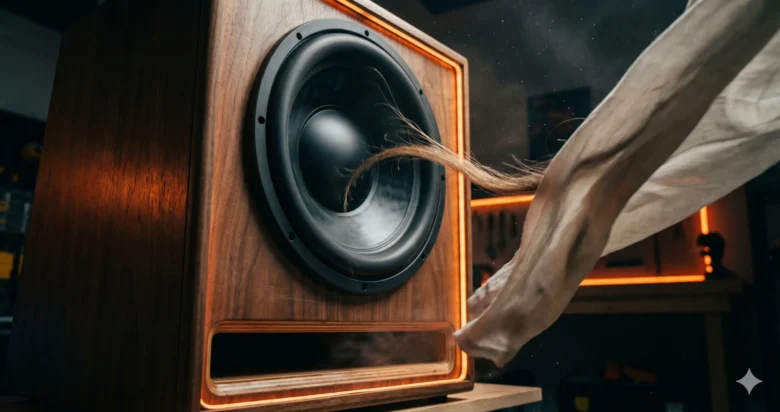
This is what creates “hair-tricks.” It’s the sheer volume of air being pushed in and out of that port at high speeds. If you want that physical wind, you need a large, smooth port tuned deep.
[Image: Diagram of a folded slot port with rounded corners]
Bracing for High Pressure
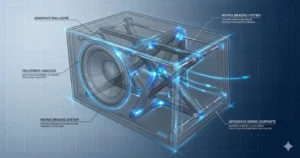
When you tune below 40Hz and start chasing SPL, the pressure inside the box is immense. I’ve seen boxes made of 3/4″ MDF literally “balloon” or flex. Flexing wood is wasted energy.
- Use internal bracing (dowels or 2×2 strips).
- Double the front baffle. The plate where the sub is mounted should be 1.5 inches thick. This ensures that 100% of the subwoofer’s energy is going into moving the air, not moving the wood.
The Vibe: Finding Your “Daily” Sweet Spot
Unless you are a pure competition guy, I don’t recommend tuning to 25Hz. While it’s cool to show off, most music doesn’t have much content that low. The “Sweet Spot” for most Bass Heads is 32Hz to 34Hz. This allows you to play almost any Rap or EDM track with authority, while still being able to hit the “low-lows” in specialized bass tracks. It is the perfect balance of safety, musicality, and “shaking the block.”
Conclusion
Mastering the low-end is about respecting the physics of sound. Tuning below 40Hz is the gateway to a truly immersive car audio experience, but it requires a “Protector’s” approach. Calculate your port length correctly, smooth out your corners, brace your box like a tank, and for the love of bass, set your subsonic filter. When you do it right, you won’t just hear the music—you will become part of it. Stay safe and keep pounding, brother.
5 Unique FAQs
1. Can I tune a small box to 30Hz? Yes, but the port will have to be extremely long to compensate for the small volume. This often leads to a port that takes up more space than the actual air chamber! It’s usually better to build a slightly larger box if you want deep tuning.
2. Why does my bass disappear when I open my car door? This is due to the “Cabin Gain” or “Transfer Function.” The interior of your car acts like a second box that boosts low frequencies. When you open the door, you “vent” that pressure, and the ultra-low notes lose their boost.
3. Will tuning to 30Hz make my Rock music sound bad? Not necessarily, but it might sound a bit “loose.” Rock drums usually hit around 50Hz-60Hz. A box tuned to 30Hz will play them, but it won’t have the same “snap” as a box tuned to 40Hz or a sealed enclosure.
4. What is the best software for calculating low-end port tuning? WinISD is the gold standard for free software. For a more modern, user-friendly interface, Subbox.pro is excellent for quick DIY calculations.
5. Is a round PVC port better for low tuning than a slot port? A round port is actually more efficient because air flows better through a circle. However, fitting a long enough PVC pipe into a box can be difficult, which is why most people use slot ports for low-end builds.