I’ll never forget a local guy who brought his competition truck to my shop on a trailer. He’d just bought four high-end Lithium LTO banks and tried to wire them up himself. He didn’t understand the difference between series and parallel, and in his confusion, he created a dead short across a 14-volt bank with zero fuse protection.
When he turned the key, the 0-gauge cables didn’t just melt—eles praticamente sublimaram. The sound was like a shotgun blast, and the smell of ozone and burnt copper was overwhelming. He was lucky the truck didn’t burn to the ground. He’d spent $4,000 on batteries and ruined $500 worth of wiring in half a second because he didn’t respect the physics of the circuit.
Wiring multiple batteries is the only way to support massive power, but it requires a “measure twice, cut once” mindset. Whether you are trying to extend your playtime or jump your system to a 24V or 48V rail, you need to understand how energy moves. In this guide, I’m going to show you how to wire like a pro and avoid the mistakes that kill gear.
Voltage vs. Capacity: Understanding the Basics
Before we pick up a wrench, we need to define our goals. In any Car Audio System, we are balancing two things:
- Voltage (Pressure): Higher voltage allows for more efficient power delivery.
- Capacity (Volume): Measured in Amp-Hours (Ah), this determines how long your system can run before the battery is empty.
If you want more “runtime,” you go parallel. If you want more “pressure” (to run specialized high-voltage amps), you go series.
Wiring in Parallel: The High-Current King
Wiring in parallel is the most common setup in the car audio world. This involves connecting the Positive (+) terminal of Battery A to the Positive (+) terminal of Battery B, and the Negative (-) to Negative (-).
The Result:
- Voltage stays the same: (e.g., two 12V batteries still produce 12V).
- Capacity (Ah) adds up: (e.g., two 100Ah batteries create a 200Ah bank).
- Discharge Rate (Amps) adds up: (e.g., if each battery can output 500A, the bank can output 1,000A).
The Engineering Advantage: By wiring in parallel, you are lowering the “Total Internal Resistance” of your power source. This means when the bass hits, the Voltage Drop is significantly less than if you were running a single battery.
Wiring in Series: Doubling the Pressure
Wiring in series is for advanced builds, usually seen in extreme SPL competition vehicles or marine setups. This involves connecting the Negative (-) terminal of Battery A to the Positive (+) terminal of Battery B. Your “Total Positive” comes from Battery A, and your “Total Negative” comes from Battery B.
The Result:
- Voltage adds up: (e.g., two 12V batteries produce 24V).
- Capacity (Ah) stays the same: (e.g., two 100Ah batteries still only provide 100Ah).
Why do this? High-voltage systems (24V, 48V, or the 16V lithium setups) allow amplifiers to produce massive power with much less amperage draw. Less amperage means less heat and thinner wire requirements for the same wattage.
The Danger of Mixed Chemistries and Ages
This is a rule I never break: Never mix batteries of different types, brands, or ages. If you put a brand-new Lithium Battery in parallel with an old AGM Battery, they will fight each other. The lithium battery sits at a higher resting voltage (typically 13.2V) than the AGM (12.6V). The lithium will constantly try to “charge” the AGM, leading to a parasitic drain that will eventually kill both batteries.
Always buy your batteries in “matched sets.” If one battery in a bank dies after two years, it is usually best to replace the whole bank, as the older batteries will have higher internal resistance and will “drag down” the performance of the new one.
Cable Symmetry: The Secret to Long Life
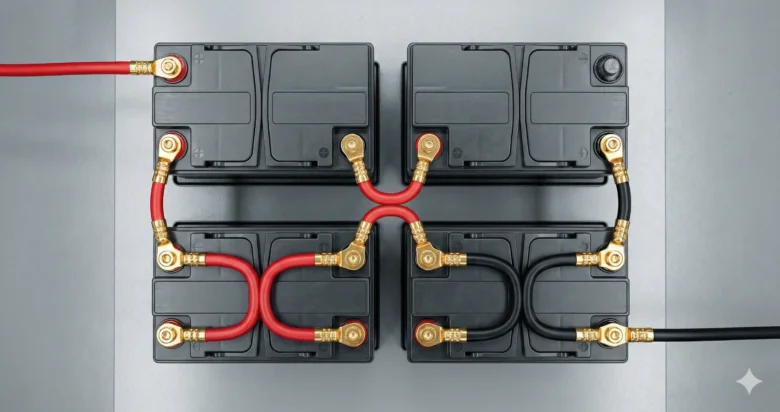
One of the most common mistakes is “Daisy-Chaining.” This is where you connect the main power and ground to the first battery, and then hop to the second, and then the third.
The first battery in the chain does 90% of the work because it is the “Path of Least Resistance.” It will fail first, followed by the second. To fix this, use Symmetrical Wiring.
- Connect the main Positive cable to Battery #1.
- Connect the main Negative cable to Battery #4 (the last battery in the bank).
- This forces the current to travel through the same amount of wire for every battery, ensuring they charge and discharge at exactly the same rate.
Using Copper Busbars for Large Banks
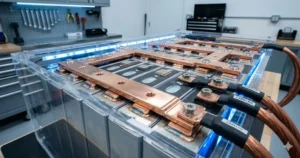
If you are wiring more than three batteries, stop using cables. Use Copper Busbars. A solid copper bar bolted across the terminals has almost zero resistance compared to a stack of ring terminals. It creates a “solid block” of power that allows for maximum current flow. In High Power Audio, every milliohm of resistance is an enemy, and busbars are the ultimate weapon for electrical efficiency.
Fusing a Multi-Battery System
Safety is non-negotiable. In a parallel bank, if one battery develops an internal short, the other batteries will dump all their energy into it. This can lead to a fire.
- Pro-Tip: Place a fuse between each battery in the parallel bank if they are physically separated by more than a few inches.
- Main Fuse: Always fuse your main power run within 12 inches of the battery bank using a high-quality ANL Fuse.
Conclusion: Build Your Foundation
Whether you go for a massive 12V parallel bank for daily demos or a high-voltage series setup for the competition lanes, your Car Battery wiring is the heart of your system.
By keeping your cable lengths equal, using only OFC Power Wire, and ensuring your chemistries match, you build a system that is “Old School Reliable.” Don’t be the guy with the $4,000 spark—be the guy with the rock-solid 14.4V rail that never moves.
FAQ:
1. Can I charge a 24V series bank with a 12V alternator? No. You either need a dedicated 24V alternator or a specialized DC-to-DC step-up charger. Trying to charge a 24V bank with 12V simply won’t work, as the charging voltage must always be higher than the battery’s resting voltage.
2. What is “Battery Balancing” and do I need it? Balancing is critical for Lithium Batteries in series. Because individual cells can have slightly different capacities, one might charge faster than the others. A BMS (Battery Management System) or an active balancer ensures all cells stay at the same voltage, preventing overcharge and fire risks.
3. Does wiring batteries in parallel increase the risk of a short? Mechanically, yes, because you have more exposed terminals and more cabling. This is why using insulated covers and proper mounting is essential. A loose battery in a parallel bank can slide and short against the chassis with enough force to weld the metal together.