I’ll never forget a job I saw back in 2012. A guy brought in a classic Cadillac Fleetwood. He was proud of his “DIY” install—two 15-inch subs and a massive Korean-made mono-block amp. But he had used 8-gauge wire he’d stripped out of an old jumper cable set.
As we were doing a demo, I smelled something sweet and acrid—the smell of melting PVC. I popped the hood, and the power wire near the battery was literally smoking. It was so hot it was bubbling the plastic insulation. He was trying to pull 200 Amps through a wire designed for 40. Five more minutes and that Cadillac would have been a bonfire.
He thought he was saving $50 on wire. He almost lost a $30,000 car. That day, I sat him down and taught him the math of the “Electrical Highway.” In car audio, your wire is the road. If you try to fit 10 lanes of traffic (Amps) onto a 1-lane dirt road (8-gauge), you’re going to have a crash.
The Physics of Current: Why Diameter Matters
In a 12V system, we are dealing with low voltage and high current. This is the opposite of your home wiring (120V/240V). Because the voltage is so low, any resistance in the wire has a massive impact on performance.
Resistance and Heat Generation
Every wire has a specific resistance per foot. As current (Amperage) flows through that resistance, it generates heat.
- Small Wire: High resistance = High heat = Potential fire.
- Large Wire: Low resistance = Low heat = Efficient power delivery.
The Joule Heating Calculation
The heat produced in a wire is proportional to the square of the current. This is why doubling your power (Amps) actually quadruples the heat generated in the cable.
P_heat = I² * R
Where:
I = Current in Amperes
R = Resistance of the wire in Ohms
Voltage Drop: The Silent Power Thief
This is what most people don’t realize: if you use a wire that is too small, you might only be getting 11V at your amp even if your battery is at 14V. This is called Voltage Drop.
How Voltage Drop Kills Performance
Most car audio amplifiers are designed to put out their rated power at 14.4V. If your wire is too thin, the resistance “steals” that voltage. If your voltage drops to 12V, your 1,000-watt amp might only put out 700 watts. You are literally throwing away the power you paid for.
The Voltage Drop Formula
In the shop, we use this to determine if a customer needs a “Big 3” upgrade or just a bigger power wire.
Vd = (I * L * 2 * ρ) / A
Where:
I = Current (Amps)
L = Length of the wire (one way, in meters)
ρ = Resistivity of Copper (0.0175 Ω·mm²/m)
A = Cross-sectional area of the wire (mm²)
Calculating Your Total System Draw
To pick the right wire, you first need to know how many Amps you are pulling. Don’t look at the “Max Power” on the box. Look at the total Fuse Rating on your amplifiers.
If you have a 4-channel amp with a 40A fuse and a mono-block with an 80A fuse, your total potential draw is 120 Amps.
The Efficiency Factor
Remember that amplifiers aren’t 100% efficient.
- Class AB: ~50% efficient.
- Class D: ~80% efficient.
If a Class D amp is putting out 1,000 watts, it’s actually pulling about 1,250 watts from the battery. At 13.8V, that’s roughly 90 Amps.
The Length Factor: Distance Dictates Diameter
A wire that can handle 100 Amps over 3 feet (like under the hood) cannot handle 100 Amps over 15 feet (from the battery to the trunk). Resistance is cumulative; the longer the wire, the higher the total resistance.
The 15-Foot Standard
In most cars, the run from the battery to the trunk is between 12 and 18 feet.
- 0 to 4 feet: You can get away with thinner wire (e.g., 4-gauge for 100A).
- 10 to 20 feet: You must go larger (e.g., 1/0-gauge for 100A to keep voltage drop under 0.5V).
AWG vs. Marketing “Gauges”
This is where the industry gets “dirty.” There is a big difference between American Wire Gauge (AWG) and “Gauge” or “mm²” labels on cheap kits.
The Circular Mil Lie
Standard AWG specifies the exact amount of copper in the wire. Some cheap brands use thick PVC insulation to make the wire look like 0-gauge, but the actual copper inside is only 4-gauge.
Spotting High-Quality Cable
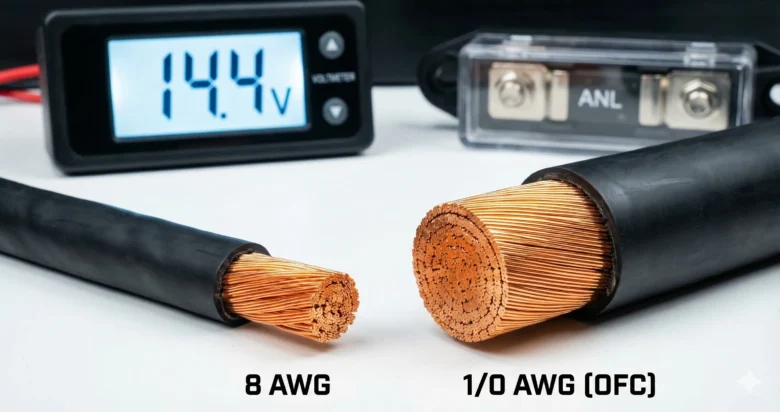
Always look for OFC (Oxygen Free Copper) and the AWG stamp. If the kit doesn’t say “AWG,” it’s likely “undersized” or “CCA” (Copper Clad Aluminum), which only has 60% of the conductivity of copper. If you use CCA, you must go one size larger than the chart recommends.
The Fuse-Wire Relationship
I tell my apprentices this on day one: The fuse is there to protect the wire, not the amplifier.
If you have a 1/0-gauge wire that can handle 250 Amps, you should have a 250A fuse near the battery. If that wire ever shorts against the car’s chassis, the fuse will blow before the wire turns into a white-hot heating element.
Professional Fusing Table
- 1/0 AWG OFC: Max Fuse 250A – 300A
- 4 AWG OFC: Max Fuse 100A – 125A
- 8 AWG OFC: Max Fuse 50A – 60A
Conclusion
That Cadillac owner ended up buying a true 0-gauge AWG OFC kit from me. We installed it with a proper ANL fuse holder, and not only did the smoke stop, but his subs actually hit significantly harder because the amp was finally getting the 14.4V it was designed for.
Don’t let your wire be the bottleneck of your system. Calculate your total Amperage, factor in the 15-foot distance, and always choose pure copper AWG spec cable. It’s the cheapest insurance policy you’ll ever buy for your car.
FAQs
1. Can I use building wire (THHN) from a hardware store? You can, but I don’t recommend it. Building wire has very few, stiff strands. Car audio wire has thousands of tiny strands. This makes it flexible enough to route through a car and, more importantly, gives it more surface area to resist vibration and stay connected in terminals.
2. Should I run a dedicated ground wire to the battery or just the chassis? For systems under 1,000W, a good chassis ground is fine. For high-power systems (over 2,000W), I always recommend running a dedicated negative 0-gauge wire back to the battery. This eliminates the resistance of the car’s steel frame, which is a much poorer conductor than copper.
3. What is the “Big 3” upgrade? It is replacing the three main factory wires: Battery (+) to Alternator, Battery (-) to Chassis, and Engine Block to Chassis. Factory wires are usually designed for the car’s basic needs, not a high-power audio system. Upgrading these to 1/0-gauge is the first step to a stable electrical system.
4. How do I know if my wire is “True AWG”? Check the strand count and the diameter of the copper core (not the insulation). A 1/0 AWG wire should have a copper diameter of about 0.325 inches (8.25mm). If it’s mostly plastic and very little copper, it’s not AWG.
5. Is it okay to use two 4-gauge wires instead of one 0-gauge? Mathematically, yes. Two 4-gauge wires have roughly the same cross-sectional area as one 0-gauge. However, it makes fusing more complicated (you need a fuse on both) and it’s harder to route. One high-quality 0-gauge is always the cleaner solution.