Let’s be honest, duck has a reputation for being intimidating. People hear “duck dinner party” and immediately picture sweating over a stove, googling “why is my duck rubbery” at 7pm while guests are already at the door. But here’s the truth: duck is one of the most rewarding proteins you can cook for company. It’s rich, flavourful, deeply satisfying, and when it comes out right, it generates the kind of table reaction that no chicken breast has ever inspired.
Duck has been a centrepiece of elegant cuisine for centuries — from the French bistros of Paris serving Duck Confit to the bright, citrusy grandeur of Duck a l’Orange, from the crispy Peking Duck of Beijing to the game-rich traditions of British country cooking. Every culture that encounters duck tends to fall in love with it. And that makes it the perfect anchor for a dinner party menu that feels genuinely special, globally inspired, and absolutely delicious.
Whether you’re planning an intimate dinner for four, a festive celebration for twelve, or you simply want to finally conquer that recipe you’ve been bookmarking for months — this guide is built for you. We’re talking a full elegant duck menu from starter to dessert, with wine pairings, hosting tips, and every technique you need to pull it off without losing your mind. Ready to make your guests absolutely speechless? Keep reading — your best dinner party yet starts right here.
Why Duck? The Case for the King of Dinner Party Proteins
Duck doesn’t get the everyday dinner rotation treatment the way chicken does — and honestly, that’s part of what makes it so perfect for hosting. There’s something inherently celebratory about a duck dinner. It signals to your guests: “I thought about this. I put in the effort. Tonight is special.”
But beyond the theatre of it, duck genuinely tastes extraordinary. The meat is darker, richer, and more flavourful than chicken or turkey. The fat — especially in the skin — renders down into something gloriously crispy when cooked correctly. And duck pairs beautifully with both savoury and sweet elements: cherries, oranges, figs, red wine, honey, five-spice — the flavour combinations are almost endlessly exciting.
From a culinary standpoint, duck is also incredibly versatile. You can confit the legs for a meltingly tender result. You can sear the breasts to a perfect medium-rare like a steak. You can slow-roast a whole bird until the skin is lacquered and crackling. One animal, three completely different techniques, all of them stunning. That’s a dinner party protein that works hard for you.
And here’s the practical upside: most duck preparations are actually very make-ahead friendly. Duck confit, the broth, the desserts — all can be prepared a day in advance, meaning you spend less time panicking in the kitchen and more time actually enjoying your guests.
Understanding Duck: Cuts, Types, and What to Buy
Whole Duck vs. Duck Breasts vs. Duck Legs
Before you start cooking, it helps to know what you’re working with. Here’s a quick breakdown of the most common duck options and when to use each:
Whole Duck: Best for roasting as a centrepiece. A standard whole duck weighs between 1.8kg and 2.5kg (4-5.5 lbs) and serves 4 people generously. It takes longer to cook but creates the most dramatic table presentation.
Duck Breasts (Magret): The premium option for a sleek, restaurant-style main course. Usually sold in pairs, they cook quickly (around 15-20 minutes) and should be served medium to medium-rare for best flavour and texture. Perfect for smaller, more intimate gatherings.
Duck Legs: Ideal for confit or slow-braising. They’re more forgiving than breasts, deeply flavourful, and become fall-off-the-bone tender with low-and-slow cooking. A great choice for larger groups.
Duck Liver: Rich, velvety, and perfect for an elegant pate starter. Milder than chicken liver and genuinely luxurious when prepared well.
Where to Buy Quality Duck
For the best results, source your duck from a butcher or specialty food shop rather than a standard supermarket. Ask specifically for free-range or Pekin/Aylesbury duck if you’re in the UK, or Pekin (Long Island) or Moulard duck if you’re in the US. In Australia, look for Luv-a-Duck or similar premium brands. In Canada, fresh duck is widely available from specialty grocery stores and butchers.
If buying online, many quality butchers now ship directly. Ordering a day or two in advance and keeping the duck refrigerated uncovered overnight actually helps dry out the skin, which leads to a much crispier result — a professional chef trick you should absolutely steal.
The Complete Elegant Duck Menu — Course by Course
Here is a full duck-forward dinner party menu designed to flow beautifully from first course to final bite. You don’t need to serve every course — pick and choose based on your guest count and how ambitious you’re feeling. But if you want to go all-in? This is your playbook.
Starter: Duck Liver Pate on Toasted Brioche
A silky, rich duck liver pate is the kind of starter that immediately tells your guests: “Yes, we’re doing this properly.” It’s smooth, deeply savoury, slightly boozy from a splash of cognac, and utterly irresistible spread thickly on warm toasted brioche. The best part? It’s made entirely ahead of time — in fact, it needs to be, as it requires at least 4 hours (ideally overnight) in the fridge to set properly.
Ingredients (serves 6-8):
• 400g (14 oz) duck livers, trimmed
• 1 shallot and 2 garlic cloves, finely chopped
• 3 tbsp unsalted butter (plus extra for sealing)
• 3 tbsp cognac or brandy
• 60ml (1/4 cup) heavy cream
• Fresh thyme, salt, and white pepper
• Brioche loaf, sliced and toasted
• Cornichons and a small green salad to serve
Method:
Melt butter in a pan over medium heat and gently cook the shallot and garlic until soft. Turn up the heat, add the duck livers, and cook for 3-4 minutes until just barely pink inside. Add the cognac carefully and let it bubble for 1 minute. Transfer everything to a food processor with the cream, season generously, and blend until completely smooth. Pass through a fine sieve for extra silkiness. Pour into ramekins, smooth the top, and seal with a thin layer of melted clarified butter. Refrigerate overnight. Serve with toasted brioche, cornichons, and a simple dressed salad. Watch your guests disappear into a state of quiet, happy concentration.
Starter: Duck Confit Crostini with Fig Jam and Microgreens
If you happen to be making duck confit for your main course (more on that shortly), set aside a little pulled confit meat for these crostini — they are outrageously good and take about 10 minutes to assemble.
Ingredients (serves 6-8):
• 1 baguette, sliced and toasted until golden
• 200g (7 oz) shredded duck confit meat
• 4 tbsp quality fig jam or fig preserve
• Small handful of microgreens or peppery rocket/arugula
• Flaky sea salt and cracked black pepper
• A drizzle of good balsamic glaze
Spread each crostini with fig jam, top with a generous pinch of shredded confit duck, a few microgreens, a drizzle of balsamic glaze, and a pinch of flaky salt. The combination of sweet fig, rich duck, peppery greens, and tangy balsamic is completely addictive. Serve immediately.
Soup Course: Roasted Duck Broth with Mushrooms and Thyme
If you’re roasting a whole duck, don’t throw away the carcass — it’s liquid gold. A slow-simmered duck broth is deeply savoury, warming, and feels extraordinarily elegant as a small soup course served in pretty cups or shallow bowls.
Ingredients (serves 6):
• Duck carcass and any roasting juices
• 1 onion, 2 carrots, 2 celery stalks (roughly chopped)
• 4 garlic cloves, 3 sprigs fresh thyme, 2 bay leaves
• 200g (7 oz) mixed mushrooms (shiitake, cremini), thinly sliced
• Splash of dry sherry or Madeira
• Salt and white pepper
• Fresh thyme leaves and a drizzle of truffle oil to finish
Roast the carcass at 200C/400F for 20 minutes to deepen the colour and flavour. Add to a large pot with the vegetables, herbs, and cold water to cover. Simmer for 2-3 hours. Strain, return to the pot, add the sliced mushrooms and sherry, and simmer another 15 minutes. Season well. Serve in warm cups or bowls with fresh thyme leaves and a tiny drizzle of truffle oil. It’s humble broth elevated to something genuinely beautiful.
Main Course: Classic Duck a l’Orange
Few dishes carry the romantic, old-school glamour of Duck a l’Orange. It’s the dinner party main course that says “I have good taste and I am not afraid to show it.” The sweet-sharp orange sauce against the rich, roasted duck is one of the great flavour pairings in classical French cuisine — and it’s far less complicated to execute at home than its reputation suggests.
Ingredients (serves 4):
• 1 whole duck (approx. 2kg / 4.4 lbs)
• 2 oranges (zest and juice) plus 1 for stuffing
• 3 tbsp sugar
• 3 tbsp red wine vinegar
• 250ml (1 cup) duck or chicken stock
• 3 tbsp Grand Marnier or Cointreau
• 2 tbsp unsalted butter
• Salt, white pepper, fresh thyme
Method:
Score the duck skin deeply in a crosshatch pattern without cutting into the meat. Season generously inside and out. Stuff the cavity with halved orange, thyme, and salt. Roast on a rack at 180C/350F for about 90 minutes, basting occasionally and draining the fat every 30 minutes. While the duck rests, make the sauce: dissolve the sugar in the red wine vinegar in a saucepan over medium heat until it forms a light caramel. Add the orange juice and zest, stock, and Grand Marnier. Simmer until reduced by half, then whisk in cold butter. Season to taste. Carve the duck, plate over the sauce, and garnish with fresh orange segments and thyme. It’s a showstopper — full stop.
Main Course: Seared Duck Breast with Cherry and Red Wine Reduction
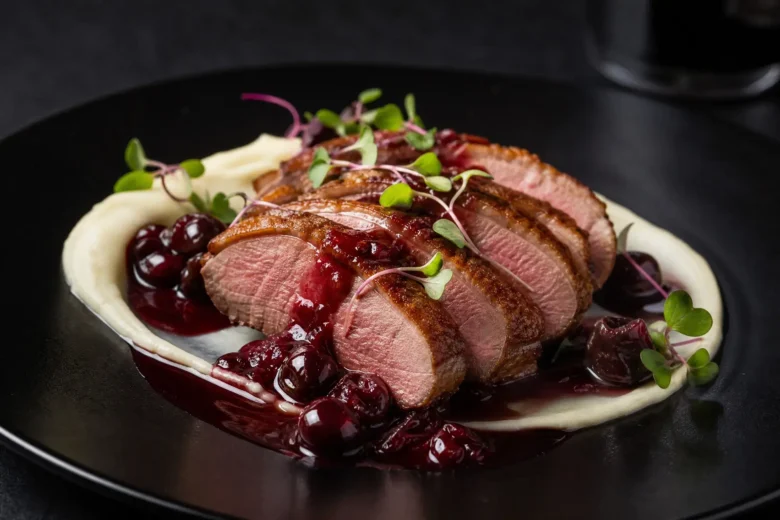
For a more modern, restaurant-style presentation, seared duck breast with a dark cherry and red wine reduction is perhaps the most elegant duck dish you can put on a plate. The crispy, golden skin. The perfectly pink, juicy interior. The deep, jewel-red sauce pooled underneath. This is the duck dish that makes people go quiet and reach for their phone to photograph the plate before eating.
Ingredients (serves 4):
• 4 duck breasts (magret), skin-on
• 300g (10 oz) fresh or frozen dark cherries, pitted
• 250ml (1 cup) good red wine (Pinot Noir works beautifully)
• 2 tbsp balsamic vinegar
• 2 tbsp honey
• 1 shallot, finely diced
• 2 sprigs fresh thyme
• 2 tbsp unsalted butter
• Salt and black pepper
Method:
Score the duck breast skin in a crosshatch pattern. Season well with salt and pepper. Place skin-side down in a cold pan (yes, cold — this helps render the fat slowly and evenly). Turn the heat to medium and cook for 8-10 minutes until the skin is deep golden and crispy, pouring off excess fat as needed. Flip and cook 3-4 more minutes for medium-rare. Rest for 8 minutes — this step is non-negotiable.
For the sauce: in the same pan, soften the shallot, add cherries, wine, balsamic, and honey. Simmer vigorously until reduced to a glossy sauce, about 10-12 minutes. Stir in cold butter and season to taste. Slice the duck breast on the diagonal, fan over the sauce, garnish with fresh thyme. Serve immediately with your chosen sides.
Main Course: Slow-Roasted Whole Duck with Herb Butter
Sometimes simplicity is the most elegant thing of all. A whole slow-roasted duck, perfumed with herbs, skin gloriously burnished and crackling, placed at the centre of the table for guests to admire before it’s carved — this is dinner party hosting at its most generous and most satisfying.
Ingredients (serves 4):
• 1 whole duck (approx. 2-2.5 kg / 4.5-5.5 lbs)
• 4 tbsp unsalted butter, softened
• 4 garlic cloves, minced
• Zest of 1 lemon, 2 tbsp fresh thyme leaves, 1 tbsp fresh rosemary, chopped
• 1 tsp smoked paprika
• Salt and cracked black pepper
• 1 onion and 1 lemon, halved, for the cavity
Method:
Mix the softened butter with garlic, lemon zest, thyme, rosemary, paprika, salt, and pepper. Carefully loosen the skin over the duck breast with your fingers and push half the herb butter underneath. Rub the rest all over the outside. Stuff the cavity with the halved onion and lemon. Score the skin deeply. Roast on a rack at 160C/320F for 2.5-3 hours, draining the fat every 45 minutes. In the last 20 minutes, turn up the heat to 220C/425F for a final blast of crackling skin. Rest for 15-20 minutes before carving. The smell alone will make everyone want to sit down immediately.
Side Dishes That Complement Duck Beautifully
Duck is rich, so your sides should provide contrast and balance. Here are the best accompaniments for an elegant duck menu:
Dauphinoise Potatoes: Thinly sliced potatoes layered with cream, garlic, and Gruyere cheese, baked until golden and bubbling. The creamy richness is indulgent but it somehow balances duck’s intensity beautifully. Make it ahead and reheat — it gets better.
Roasted Root Vegetables with Honey and Thyme: Carrots, parsnips, and beetroot roasted with olive oil, honey, and fresh thyme until caramelised and sweet. They echo the fruit-forward flavours that pair so naturally with duck.
Wilted Spinach with Garlic and Nutmeg: Quick to prepare, vibrant green, and the slight bitterness of the spinach cuts beautifully through the richness of the duck.
Braised Red Cabbage with Apple and Cloves: A classic European accompaniment to duck. Slow-braised until silky and sweet-sharp, with warming spice from cloves and allspice. Can be made days ahead and reheated — it only gets better.
Wild Mushroom Pilaf: Fragrant basmati rice cooked with sauteed wild mushrooms, shallots, stock, and fresh herbs. Elegant, earthy, and a perfect base for the duck and its sauce.
Desserts: Ending the Duck Dinner on a High Note
After a rich, indulgent main course, your dessert should feel special but not overwhelming. These two options are make-ahead, elegant, and provide just the right note to finish the evening.
Lavender Creme Brulee
The theatrical crack of a creme brulee is one of the great joys of the dinner table — and lavender-infused custard adds a floral, sophisticated twist that feels completely at home in an elegant duck menu. Make the custards the day before; all you need on the night is a kitchen torch and a few seconds.
Ingredients (serves 6):
• 500ml (2 cups) heavy cream
• 1 tsp dried culinary lavender (or vanilla bean as alternative)
• 5 egg yolks
• 100g (1/2 cup) caster/superfine sugar plus extra for the brulee topping
Warm the cream with lavender until barely simmering. Steep 20 minutes, then strain. Whisk egg yolks with sugar until pale, then slowly pour in the warm cream, whisking constantly. Pour into ramekins, place in a bain-marie (roasting tin with hot water halfway up the sides), and bake at 150C/300F for 35-40 minutes until just set with a slight wobble. Refrigerate overnight. Before serving, sprinkle each with a thin, even layer of sugar and brulee with a torch until amber and crackling. The sound of that crack at the table is half the dessert experience.
Dark Chocolate Tart with Sea Salt and Orange Zest
Rich, glossy, and deeply chocolatey with a sharp note of orange zest that echoes the duck a l’orange theme of the menu — this tart is a stunning way to close the evening. It can be made completely the day before and kept refrigerated.
Ingredients (serves 8):
• 1 pre-baked shortcrust pastry shell (25cm / 10 inch)
• 300g (10 oz) good dark chocolate (70% cacao), finely chopped
• 300ml (1 1/4 cups) heavy cream
• 60g (4 tbsp) unsalted butter
• Zest of 2 large oranges
• Flaky sea salt to finish
Bring the cream to a gentle simmer. Pour over the chopped chocolate and let stand 2 minutes, then stir until completely smooth. Add butter and orange zest, stir until glossy. Pour into the pre-baked tart shell and refrigerate for at least 4 hours. Before serving, finish with a generous scattering of flaky sea salt. Slice cleanly with a hot knife. Serve with a small scoop of creme fraiche or vanilla ice cream. The orange-chocolate-salt combination will have people asking for seconds before they’ve finished their first slice.
Wine and Drink Pairings for a Duck Menu
Duck is one of the most wine-friendly proteins out there. Its richness and depth can handle bold reds, but its natural affinity with fruit means it also sings alongside lighter, fruit-driven wines. Here’s how to pair drinks throughout your elegant duck dinner:
With the Pate Starter: A glass of chilled Sauternes or a late-harvest Riesling is the classic pairing — the sweet, honeyed wine against the rich, savoury pate is one of the great food-and-wine marriages. Alternatively, a bone-dry Champagne or Cremant d’Alsace works beautifully.
With Duck Confit or Whole Roasted Duck: Pinot Noir is the textbook answer — and for good reason. A Burgundy, an Oregon Pinot, or a New Zealand Central Otago Pinot Noir all have the earthy depth and red fruit character to complement duck perfectly without overpowering it.
With Duck a l’Orange: The citrus in the sauce calls for a wine with some fruit-forward brightness. A Viognier or a white Rhone blend can be surprising and wonderful. For reds, a Grenache-based wine from the Southern Rhone Valley (Cotes du Rhone) echoes the fruity notes elegantly.
With Seared Duck Breast and Cherry Sauce: This is perhaps the most versatile pairing opportunity. A Syrah/Shiraz with its dark berry and pepper notes is exceptional. So is a Malbec from Argentina or a GSM blend (Grenache-Syrah-Mourvedre) from Australia or the Southern Rhone.
With Dessert: A small glass of Pedro Ximenez sherry with the chocolate tart is unexpectedly sublime. With the creme brulee, a Muscat de Beaumes de Venise or a light Moscato provides just enough sweetness without being cloying.
Non-Alcoholic Option: A sparkling elderflower and cranberry drink (elderflower cordial, cranberry juice, sparkling water) has the right fruit-forward character to pair with duck and feels genuinely celebratory.
ro Tips for Cooking Duck Without Panic
Duck has an undeserved reputation for being difficult. It’s not difficult. It just requires a few key pieces of knowledge that most people aren’t told. Here they are:
Tip 1 — Score the skin deeply: The layer of fat under duck skin is thick, and you need to score it deeply (without cutting into the meat) in a crosshatch pattern to allow it to render out properly. This is what gives you crispy skin instead of a flabby, chewy layer.
Tip 2 — Start duck breast in a cold pan: Unlike most proteins, duck breast goes into a cold pan. The low-and-slow start allows the thick fat layer to render gradually, resulting in even crispiness across the entire surface.
Tip 3 — Drain the fat when roasting whole duck: A whole duck releases an extraordinary amount of fat during roasting. Drain it every 30-45 minutes. The collected duck fat is liquid gold for roasting potatoes — save every drop.
Tip 4 — Rest your duck properly: Duck breast needs at least 8 minutes rest. A whole roasted duck needs 15-20 minutes. Resting allows the juices to redistribute and the meat to relax, making it infinitely juicier and more tender.
Tip 5 — Don’t overcook it: Duck breast is best served medium to medium-rare (internal temperature 57-60C / 135-140F). Overcooked duck becomes dry and livery. Trust your thermometer, not your eyes.
Tip 6 — Make ahead wherever possible: Confit, pate, braised cabbage, dauphinoise, and all the desserts in this guide can be made 1-2 days in advance. The more you prep ahead, the more you enjoy the evening.
osting Timeline: How to Plan the Perfect Duck Dinner Party
The secret to a stress-free dinner party isn’t talent — it’s a solid timeline. Here’s how to spread the work over 48 hours:
2 Days Before: Make the duck liver pate and refrigerate. Make the chocolate tart. Make the braised red cabbage. Buy all ingredients and check your equipment (roasting rack, thermometer, torch for the brulee).
1 Day Before: Make the duck confit if using. Make the creme brulee custards. Prepare the dauphinoise potatoes. Set the table completely — cloth, candles, flowers, place cards. Chill the wines.
Day of Dinner — 3 Hours Before: Prep the duck main course: score the skin, season, and leave uncovered in the fridge to dry out further. Prep all vegetables. Make the cherry or orange sauce base.
Day of Dinner — 1.5 Hours Before: Begin roasting the whole duck (if applicable). Prepare the crostini toppings. Set out the pate with brioche and cornichons for an easy arrival starter.
30 Minutes Before Guests Arrive: Light candles, start the music, pour yourself a glass of something. You’ve done the hard work. The kitchen is organised. You’re ready.
During the Dinner: Cook duck breasts to order (they take 15-20 minutes total) while guests enjoy the starter. Finish the sauce, plate confidently, carry to the table like the host you are.
onclusion
Here’s the thing about cooking duck for your friends: it’s not just about the food. It’s about the gesture. It’s about choosing an ingredient that’s a little more ambitious, putting in the time to understand it, and delivering something on the plate that makes the people you care about feel genuinely celebrated.
Duck rewards curiosity and patience in equal measure. It’s the kind of cooking that builds confidence — once you’ve nailed a seared duck breast with cherry sauce or pulled off a gleaming whole roasted duck with crispy skin, you’ll never look at a dinner party the same way again. You’ll be the friend who does the duck dinner. And trust us: that friend is everyone’s favourite dinner guest to invite back.
So pick your menu, source your duck, prep your sides ahead, chill the Pinot Noir, and get ready to create the kind of evening your guests talk about for months. You’ve got everything you need. Now go cook something magnificent.
Frequently Asked Questions
1. Can I prepare the duck main course entirely in advance for a dinner party? Duck confit (legs) can absolutely be made 1-2 days ahead and gently reheated in a low oven or pan. Whole roasted duck and duck breasts are best cooked on the day, though all the prep work — scoring, seasoning, sauce bases — can be done in advance. Duck breast is quick enough (about 20 minutes from pan to plate) to be cooked while guests enjoy a starter.
2. How do I know when duck breast is cooked to the right temperature? Use an instant-read meat thermometer. For medium-rare — which is the recommended doneness for duck breast — you’re looking for an internal temperature of 57-60C (135-140F) after resting. The meat will appear rosy-pink inside, which is completely safe and ideal. Overcooked duck breast loses its tenderness and becomes dry.
3. What’s the best way to get really crispy duck skin? Three things: score it deeply in a crosshatch pattern, dry the skin thoroughly (ideally by leaving it uncovered in the fridge for several hours or overnight), and start duck breast in a cold pan to render the fat slowly. For whole duck, drain the fat regularly during roasting and blast with high heat at the end.
4. What are the best wine alternatives if guests don’t drink alcohol? For a sophisticated non-alcoholic pairing, try a sparkling elderflower and cranberry drink, or a non-alcoholic Pinot Noir (several excellent alcohol-removed wines are now available from brands like Leitz and Thomson & Scott). A spiced apple and rosehip mocktail also pairs beautifully with duck’s fruity sauce profiles.
5. How much duck should I buy per person? For whole duck, allow approximately 500g (1.1 lbs) per person — a 2kg duck serves 4 comfortably. For duck breasts, one 200-250g breast per person is standard. For duck legs (confit), one leg per person is the right portion. When in doubt, slightly overestimate — leftover duck confit makes exceptional sandwiches and salads the next day.