Ask anyone who has ever carved a perfectly roasted rack of lamb at the head of a dinner table, the moment when that herb-crusted, rosé-pink meat is revealed, and they will tell you the same thing: there is no more satisfying sound in home entertaining than the collective intake of breath from your guests. Lamb has this quality, unique among dinner party proteins, of being simultaneously ancient and deeply civilised. It has been the centrepiece of celebratory feasts across the Mediterranean, the Middle East, and the British Isles for thousands of years. And yet every time it appears at a modern dinner table, prepared with care and intelligence, it feels completely, brilliantly new.
The range of what lamb can do is genuinely remarkable. A rack of lamb with a pistachio and herb crust, roasted to a perfect medium-rare, plated with a glossy jus and scattered with fresh herbs — this is haute cuisine at its most elegant. A slow-braised lamb shoulder, falling apart at the touch of a fork, fragrant with pomegranate and preserved lemon, spooned over silky couscous — this is comfort food elevated to something extraordinary. A whole leg of lamb, crusted with garlic and rosemary and roasted until gloriously golden, carved at the table for twelve guests — this is theatre, this is generosity, this is hospitality in its most primal and beautiful form.
This guide is your complete playbook for building an elegant lamb dinner party from cocktail hour through to dessert. You’ll find three outstanding main course options to suit different occasions and group sizes, a full supporting cast of starters, sides, and sweets, expert wine pairings, a 48-hour hosting timeline, and every technique you need to handle lamb with total confidence. Whether you’re cooking for four or fourteen, whether this is your first time working with lamb or your fiftieth — everything you need is right here. Let’s build something truly memorable.
Why Lamb Is the Centrepiece of an Elegant Dinner Party
Lamb occupies a very particular place in the world of dinner party cooking — and it’s worth understanding why, because it explains so much about how to use it well.
It signals occasion: Unlike chicken or beef, which appear in everyday meals throughout the week, lamb has retained a sense of specialness in most cultures. Serving lamb tells your guests, without a single word, that this evening matters. It’s a gesture of generosity and intention that people notice and appreciate.
The flavour is extraordinary: Lamb has a depth, richness, and distinctive character that no other red meat quite replicates. The slight gaminess that some people nervously describe is, in a quality piece of well-cooked lamb, actually a beautiful complexity — like the difference between a flat, simple wine and one with genuine character and terroir.
It partners magnificently with bold flavours: Rosemary, garlic, mint, pomegranate, preserved lemon, harissa, red wine, anchovies, cumin, yoghurt — the list of ingredients that pair brilliantly with lamb is long and globally diverse. This gives you enormous creative freedom as a host to build a menu that reflects your personal style, the season, or the occasion.
Multiple cuts, multiple cooking techniques: From quick-seared chops to slow-braised shoulders to whole roasted legs, lamb offers a range of textures and cooking approaches that allow you to tailor the menu to your timeline, your skill level, and your group size. Some preparations take 15 minutes. Others transform over 8 hours in a low oven. All of them are extraordinary.
Outstanding make-ahead potential: Braised lamb shoulder, lamb kofta, lamb broth, and all the side dishes in this guide can be made partially or entirely in advance — meaning you can prepare most of the meal before guests arrive and spend the evening being a host rather than a short-order cook.
Understanding Lamb: Cuts, Quality, and What to Buy
The Most Popular Lamb Cuts for Elegant Entertaining
Knowing your lamb cuts is the foundation of confident cooking. Here’s a guide to the cuts most relevant to elegant dinner party menus:
Rack of Lamb: The crown jewel of lamb cuts. A rack consists of 7–8 rib chops still attached, with the bones frenched (cleaned) for elegant presentation. It’s lean, tender, and cooks quickly (about 25 minutes for medium-rare). Visually, it’s one of the most dramatic presentations in all of cooking. Perfect for intimate dinners of 2–4 guests.
Lamb Shoulder: The working muscle of the animal, full of connective tissue, fat, and extraordinary flavour. Requires long, slow cooking (3–5 hours) to break down the collagen into silky, sticky, melting tenderness. The payoff is one of the most deeply satisfying textures and flavours in cooking. Excellent for larger groups and completely make-ahead friendly.
Leg of Lamb: The classic whole-roast centrepiece. A bone-in leg weighs 2–2.5kg (4.5–5.5 lbs) and serves 6–8 people. It has more personality than a shoulder in terms of different muscle textures — some parts more tender, some more robust — which makes carving at the table interactive and interesting. The star of Easter Sunday tables around the world.
Lamb Chops (Loin or Rib): The most approachable and fastest-cooking cut. Individual chops sear beautifully in a hot pan in 3–4 minutes per side and make elegant individual servings. Loin chops are larger and meatier; rib chops are smaller and more delicate. Perfect for dinner parties where you want to plate individually rather than carve at the table.
Lamb Mince/Ground Lamb: Used for kofta, kebabs, meatballs, and stuffed preparations. Rich, well-seasoned lamb mince is one of the most flavourful ground meats available and the foundation of the cocktail hour kofta recipe in this guide.
Grass-Fed vs. Grain-Fed: Does It Matter?
For lamb, the answer is: absolutely yes. Grass-fed lamb — raised on pasture, grazing on grass, clover, and wildflowers — has a more complex, distinctive flavour with the characteristic gentle gaminess that makes lamb so interesting. The fat is also more nutritionally rich and has a deeper, more golden colour than grain-fed alternatives.
New Zealand and Australian lamb are two of the world’s most celebrated grass-fed lamb sources, widely available internationally and consistently excellent in quality. British lamb, particularly Welsh and Scottish hill breeds, is considered among the finest in the world, with a flavour deeply influenced by the mineral-rich pastures and cool climate. In the US, domestic American lamb tends to be larger and milder; many butchers and specialty suppliers also stock New Zealand lamb.
For an elegant dinner party menu, always choose the best quality lamb you can source. The flavour difference between a supermarket rack of lamb and one from a quality butcher or specialty supplier is genuinely significant — and since lamb is already the most impressive thing on the table, giving it the best foundation is simply good sense.
Where to Source Quality Lamb
Your best options, in order of preference: a dedicated butcher who knows their suppliers and can advise on provenance and ageing; a farmers’ market where you can buy directly from the producer; a quality grocery chain with a proper butcher counter; and finally, online specialty meat suppliers who deliver directly from farm to door — increasingly excellent and convenient.
When buying, look for meat that is a bright, deep red (not grey or brown), with firm white fat (not yellow, which can indicate poor quality or improper storage). Ask your butcher to french the rack for you — this saves significant preparation time and they do it far more neatly than most home cooks.
The Complete Elegant Lamb Menu — Course by Course
Here is a full lamb-forward dinner party menu designed to build beautifully from cocktail hour through to a memorable dessert. Select what suits your occasion — every element is designed to stand alone or as part of the complete menu.
Cocktail Hour: Lamb Kofta Skewers with Tzatziki and Warm Flatbread
Before anyone sits down, before the candles are lit and the first course is poured, set the tone with these extraordinary lamb kofta skewers. Fragrant with cumin, coriander, cinnamon, and fresh herbs, charred at the edges from a screaming-hot grill pan or barbecue, served alongside a bowl of cool, garlicky tzatziki and warm torn flatbread — this is the cocktail hour bite that makes your guests’ eyes widen and their glasses rise for a toast. And nothing announces a lamb dinner party quite like the smell of spiced lamb cooking as your guests arrive.
| Recipe at a Glance | |
| Serves | 8–10 guests as cocktail bites |
| Prep Time | 20 minutes + 30 minutes chilling |
| Cook Time | 10 minutes |
| Make Ahead | Shaped kofta up to 24 hours ahead; cook to order |
| Difficulty | Easy |
Ingredients:
• 700g (1.5 lbs) lamb mince (20% fat content for best flavour and moisture)
• 1 small onion, grated and squeezed dry in a clean cloth
• 4 garlic cloves, very finely minced
• 2 tsp ground cumin, 1 tsp ground coriander, 1/2 tsp cinnamon
• 1/2 tsp smoked paprika, 1/4 tsp cayenne
• 3 tbsp fresh flat-leaf parsley, very finely chopped
• 2 tbsp fresh mint, very finely chopped
• 1 tsp sea salt, 1/2 tsp cracked black pepper
• Olive oil for brushing
• Metal or pre-soaked wooden skewers
For the Tzatziki:
• 300g (1 1/4 cups) thick Greek yoghurt
• 1/2 cucumber, grated and squeezed very dry
• 2 garlic cloves, minced
• 2 tbsp extra-virgin olive oil
• 1 tbsp fresh dill or mint, chopped
• 1 tbsp fresh lemon juice
• Salt and white pepper to taste
Method:
Combine all kofta ingredients in a large bowl and mix thoroughly — use your hands for the best result, squeezing and kneading the mixture until it’s well combined and slightly sticky. This develops the myosin proteins in the meat, which helps the kofta hold its shape on the skewer. Refrigerate for at least 30 minutes — this is crucial for a firm, well-shaped kofta that doesn’t fall apart during cooking.
Divide the mixture into golf ball-sized portions. With wet hands, mould each portion around a skewer in an elongated oval shape, squeezing firmly. Heat a grill pan, cast iron skillet, or outdoor barbecue to very high heat. Brush the kofta lightly with olive oil and cook, turning every 2 minutes, for about 8–10 minutes total until charred on the outside and just cooked through with a slight rosy interior. For the tzatziki: simply combine all ingredients, taste for seasoning, and refrigerate until needed. Serve the kofta on a platter with warm flatbreads torn into pieces, the tzatziki, and a scatter of fresh pomegranate seeds and chopped mint.
Pro tip: The kofta mixture actually benefits from being made the night before — the spices bloom and develop overnight and the flavour is noticeably more complex. Shape, skewer, and refrigerate covered until ready to cook.
Starter: Lamb Carpaccio with Capers, Lemon Oil, and Fresh Mint
This is the starter that makes people sit up straighter and reach for the wine list in their mind. Lamb carpaccio — paper-thin slices of raw, briefly frozen lamb fillet, draped across a cold plate and dressed with fragrant lemon oil, salty capers, shaved Pecorino, and torn fresh mint — is a dish of genuine restaurant-level sophistication that is, once you understand the technique, remarkably straightforward to produce. The key is using an impeccably fresh, quality lamb fillet and slicing it properly after a brief spell in the freezer to firm the meat.
| Recipe at a Glance | |
| Serves | 6–8 guests |
| Prep Time | 20 minutes + 1 hour freezing |
| Cook Time | None |
| Make Ahead | Slice and plate up to 2 hours ahead; dress just before serving |
| Difficulty | Medium |
Ingredients:
• 400g (14 oz) lamb fillet or loin (the finest, freshest available)
• 3 tbsp best quality extra-virgin olive oil
• Zest and juice of 1 large lemon
• 2 tbsp small capers (nonpareil), rinsed and drained
• 40g (1.5 oz) Pecorino Romano or Parmesan, shaved with a vegetable peeler
• A generous handful of fresh mint leaves, torn
• Flaky sea salt and very generously cracked black pepper
• A handful of watercress or peppery rocket/arugula (optional)
Method:
Wrap the lamb fillet tightly in cling film, forming it into a tight cylinder. Place in the freezer for 45–60 minutes until firm but not frozen solid — you want the texture of very firm cheese. This makes it possible to slice the meat paper-thin with a very sharp knife. Using your sharpest knife (or a meat slicer if you have one), slice the lamb as thinly as humanly possible — aim for translucency. Arrange the slices overlapping slightly across chilled plates. If making ahead, cover with cling film and refrigerate for up to 2 hours.
To dress: whisk together the olive oil, lemon juice, and zest, and season with salt and pepper. Drizzle generously over the lamb slices. Scatter capers across the plate. Add the shaved Pecorino in loose, irregular pieces. Finish with torn mint leaves and a small handful of watercress if using. One final crack of black pepper and a pinch of flaky sea salt. Serve immediately with warm toast points or thin grissini alongside.
Pro tip: If raw lamb makes you or your guests uncertain, this dish can be made with very briefly seared lamb fillet — sear for 30 seconds per side on a screaming-hot pan, then rest, freeze briefly, and slice. The exterior gains a beautiful colour while the interior remains almost entirely raw.
Soup Course: Slow-Roasted Lamb Broth with Orzo and Fresh Herbs
If you are roasting a whole leg or shoulder for your main course, do not under any circumstances discard the bones and roasting juices — they are the foundation of a broth of extraordinary depth and richness. This slow-roasted lamb broth, finished with tiny orzo pasta, a squeeze of lemon, and a shower of fresh herbs, is one of the most warming, comforting, and quietly spectacular soup courses you can serve. It’s the course that makes people think: “This person really knows how to cook.”
| Recipe at a Glance | |
| Serves | 6–8 guests |
| Prep Time | 15 minutes |
| Cook Time | 3–4 hours (mostly unattended) |
| Make Ahead | Up to 3 days ahead; reheat and finish with orzo just before serving |
| Difficulty | Easy |
Ingredients:
• Lamb bones and/or carcass from roasting (or ask your butcher for lamb bones)
• 1 large onion, 3 carrots, 3 celery stalks — all roughly chopped
• 6 garlic cloves, smashed
• 3 sprigs fresh rosemary, 4 sprigs fresh thyme, 3 bay leaves
• 2 tbsp tomato paste
• 250ml (1 cup) dry red wine
• 3 litres (12 cups) cold water
• 150g (3/4 cup) orzo pasta
• Juice of 1 lemon
• Fresh flat-leaf parsley and fresh mint for finishing
• Salt and freshly cracked black pepper
• A drizzle of good extra-virgin olive oil to finish each bowl
Method:
Roast the lamb bones at 220C/425F for 20–25 minutes until deeply browned and caramelised — this is the single most important step for flavour depth. Transfer to a large stockpot with the vegetables, garlic, tomato paste, herbs, and wine. Add cold water to cover. Bring to a boil, skim off any foam that rises to the surface, then reduce to the lowest possible simmer and cook uncovered for 3–4 hours.
Strain through a fine-mesh sieve. Return to the pot and bring back to a simmer. Season assertively with salt and pepper — a well-seasoned lamb broth should taste deeply savoury and satisfying even without the pasta. Add the orzo and cook for 8–9 minutes until al dente. Finish with lemon juice, which brightens the whole dish dramatically. Ladle into warm bowls, finish with a generous handful of fresh parsley and torn mint leaves, and a drizzle of excellent olive oil. Serve with warm crusty bread.
Pro tip: Make the broth up to 3 days in advance and refrigerate. The fat will solidify on the surface and can be easily lifted off, leaving a beautifully clear, intensely flavoured broth underneath. Reheat and add the orzo just before serving.
Main Course: Rack of Lamb with Herb and Pistachio Crust
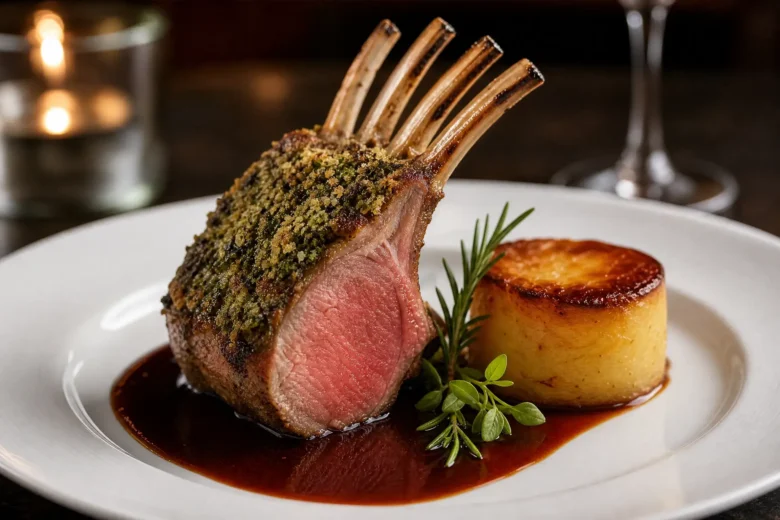
This is the lamb dish that belongs on every serious home cook’s repertoire — the rack of lamb with a vibrant, fragrant herb and pistachio crust. It is visually one of the most dramatic main courses in all of home entertaining: the elegant frenched rib bones standing upright, the golden-green crust shimmering under the light, the interior a perfect, blushing medium-rare. It takes about 35 minutes total from preparation to plate. The work-to-impact ratio is almost embarrassingly good.
| Recipe at a Glance | |
| Serves | 4 guests (2 racks) |
| Prep Time | 20 minutes |
| Cook Time | 25 minutes + 10 minutes resting |
| Make Ahead | Crust mixture up to 2 days ahead; sear and crust same day |
| Difficulty | Medium |
Ingredients:
• 2 frenched racks of lamb (7–8 ribs each), fat cap scored
• 2 tbsp olive oil for searing
• 2 tbsp Dijon mustard (for binding the crust)
• Salt and cracked black pepper
For the Herb and Pistachio Crust:
• 80g (3/4 cup) shelled unsalted pistachios, finely chopped (not ground — you want texture)
• 60g (1 cup) fresh breadcrumbs (from day-old bread)
• 4 tbsp fresh flat-leaf parsley, very finely chopped
• 2 tbsp fresh mint, very finely chopped
• 2 tbsp fresh rosemary, very finely chopped
• 3 garlic cloves, minced
• Zest of 1 lemon
• 3 tbsp extra-virgin olive oil
• Salt and pepper to taste
For the Red Wine Jus:
• 1 shallot, finely diced
• 250ml (1 cup) good red wine
• 250ml (1 cup) lamb or beef stock
• 1 sprig fresh rosemary
• 2 tbsp cold unsalted butter
• Salt and pepper
Method:
Preheat oven to 200C/400F. Remove the lamb from the fridge 30 minutes before cooking — room temperature meat cooks more evenly. Mix all crust ingredients together in a bowl; it should hold together loosely when pressed. Season the racks generously with salt and pepper.
Heat olive oil in a heavy oven-safe skillet over very high heat. Sear the racks fat-side down first for 2–3 minutes until deeply golden and caramelised. Sear all other sides briefly — 30 seconds each. Remove from heat and allow to cool slightly. Brush the fat side generously with Dijon mustard, then press the crust mixture firmly and evenly onto the mustard-coated surface — the mustard acts as both a flavour addition and a glue.
Place the racks crust-side up in the skillet or on a roasting rack and roast for 18–22 minutes for medium-rare (internal temperature 57–60C / 135–140F). Rest for a minimum of 10 minutes — do not skip this. While resting, make the jus: in the same pan (deglaze with the red wine), add the shallot, stock, and rosemary. Reduce by half until glossy and syrupy. Strain and whisk in cold butter. Season.
Carve into individual chops between the bones. Arrange 2 chops per plate, standing upright, leaning elegantly against each other. Spoon the jus around the base. Garnish with fresh mint and a scatter of extra crushed pistachio. The moment you place this plate in front of a guest, the evening is already a success.
Pro tip: For a dinner party of 6–8, use 4 racks and cook in two batches or two roasting pans simultaneously. The crust mixture scales perfectly — simply double the quantities.
Main Course: Slow-Braised Lamb Shoulder with Pomegranate and Preserved Lemon
If rack of lamb is the sprinter — fast, brilliant, dramatic — then slow-braised lamb shoulder is the marathon runner: patient, deeply rewarding, and ultimately extraordinary in a way that speed simply cannot replicate. After 4–5 hours in a low oven, the shoulder collagen melts into the braising liquid, the meat becomes impossibly tender and falls apart at the gentlest pressure, and the pomegranate-and-preserved-lemon braising sauce reduces to a sticky, jewel-dark, intensely fragrant glaze that is among the most beautiful things you will ever put on a dinner plate. And here is the magnificent part: you can make this entire dish two days before your dinner party.
| Recipe at a Glance | |
| Serves | 6–8 guests |
| Prep Time | 25 minutes |
| Cook Time | 4.5–5 hours (low and slow) |
| Make Ahead | Entire dish up to 2 days ahead — improves overnight |
| Difficulty | Easy (time does the work) |
Ingredients:
• 1 whole bone-in lamb shoulder (approx. 2–2.5 kg / 4.5–5.5 lbs)
• 3 tbsp olive oil
• 2 onions, roughly chopped
• 6 garlic cloves, smashed
• 2 tbsp tomato paste
• 250ml (1 cup) pomegranate juice (unsweetened)
• 500ml (2 cups) lamb or chicken stock
• 2 preserved lemon quarters, flesh removed, rind finely chopped
• 2 tbsp honey
• 1 tsp ground cumin, 1 tsp ground coriander, 1/2 tsp cinnamon
• 3 sprigs fresh rosemary, 3 sprigs fresh thyme
• Salt and cracked black pepper
To Finish:
• Seeds from 1 large pomegranate
• Large handful of fresh mint and flat-leaf parsley
• 2 tbsp pomegranate molasses (for extra gloss and depth)
Method:
Preheat oven to 160C/320F. Season the lamb shoulder very generously all over with salt and pepper. Heat olive oil in a large, heavy Dutch oven or casserole over high heat and sear the shoulder on all sides until deeply browned — 3–4 minutes per side. This browning creates the flavour foundation for everything that follows. Remove and set aside. In the same pot, soften the onions and garlic, add tomato paste and cook 2 minutes. Add the cumin, coriander, and cinnamon and cook 1 minute until fragrant.
Pour in the pomegranate juice and stock, scraping up all the brown bits from the bottom of the pot. Add the preserved lemon, honey, and herbs. Nestle the lamb shoulder back in, cover with a tight-fitting lid, and transfer to the oven. Braise for 4.5–5 hours until the meat falls away from the bone at the slightest pressure. Remove the lamb carefully (it will want to fall apart — this is correct). Strain the braising liquid into a saucepan and reduce over high heat for 10–15 minutes until glossy and sauce-like. Add the pomegranate molasses and taste for seasoning.
To serve: place the pulled lamb on a large, warm platter. Pour the reduced pomegranate sauce generously over everything. Scatter with pomegranate seeds, torn mint, and flat-leaf parsley. Serve with couscous, flatbread, or creamy polenta to soak up the extraordinary sauce. This is one of those dishes that stops conversation. Temporarily.
Pro tip: Make this two full days before your dinner party. Refrigerate the lamb in its braising liquid overnight — the fat solidifies and can be removed the next day, leaving a beautifully clean, intensely flavoured sauce. Reheat gently in a low oven (150C/300F) for 45 minutes before serving.
Main Course: Roasted Leg of Lamb with Garlic, Rosemary, and Red Wine Jus
There are few more generous, more joyful, more quintessentially celebratory acts in home cooking than bringing a whole roasted leg of lamb to the table. The smell that fills the house as it cooks — garlic, rosemary, lamb fat, caramelising juices — is one of the great sensory experiences of domestic life. And carving it at the table, with guests leaning in and glasses raised, is the kind of dinner party moment that people describe years later when they talk about the best meals they’ve ever eaten in someone’s home.
| Recipe at a Glance | |
| Serves | 8–10 guests |
| Prep Time | 20 minutes |
| Cook Time | 2 hours (for medium) + 20 minutes resting |
| Make Ahead | Stud and marinate 24 hours ahead; roast on the day |
| Difficulty | Easy |
Ingredients:
• 1 bone-in leg of lamb (approx. 2.5 kg / 5.5 lbs)
• 8 garlic cloves — 4 thinly sliced for studding, 4 left whole for the pan
• 4 sprigs fresh rosemary, leaves stripped and roughly chopped (plus whole sprigs for the pan)
• 3 tbsp extra-virgin olive oil
• Juice and zest of 1 lemon
• 1 tsp dried oregano
• Flaky sea salt and generously cracked black pepper
For the Red Wine Jus:
• 1 shallot, finely diced
• 300ml (1 1/4 cups) full-bodied red wine
• 400ml (1 2/3 cups) good quality lamb or beef stock
• 2 tbsp cold unsalted butter
• Fresh rosemary sprig
• Salt and pepper to taste
Method:
The day before (or morning of): use a small sharp knife to make approximately 20–25 deep incisions all over the leg, pushing into the meat about 3cm (1 inch) deep. Push a sliver of garlic and a pinch of chopped rosemary into each incision — this perfumes the meat from the inside and creates little pockets of intense flavour throughout every slice. Mix the olive oil, lemon juice and zest, dried oregano, and a generous amount of salt and pepper. Rub this marinade all over the leg, getting into every crevice. Cover and refrigerate.
Remove the lamb from the fridge 1 hour before roasting — room temperature meat cooks more evenly. Preheat oven to 220C/425F. Place the lamb on a rack in a roasting tin with the whole garlic cloves and rosemary sprigs beneath. Roast at high heat for 20 minutes for a beautiful crust, then reduce temperature to 180C/350F and continue roasting for approximately 1 hour 20 minutes for medium (internal temperature 63–65C / 145–150F), or 1 hour for medium-rare (57–60C / 135–140F). Rest for a minimum of 20 minutes, covered loosely with foil.
For the jus: pour off excess fat from the roasting tin. Place the tin over medium heat on the stovetop. Add the shallot and cook 1 minute. Add the wine and let it bubble, scraping up all the roasting residue. Add stock and rosemary. Reduce by half until glossy and deeply flavoured. Strain into a clean saucepan and whisk in cold butter. Season. Carve the lamb at the table for maximum drama, serving slices with the jus spooned generously over the top.
Pro tip: For the most beautiful carved slices, cut the meat against the grain — running perpendicular to the muscle fibres. This shortens the fibres and makes every slice more tender. Use a long, thin carving knife and don’t rush — steady, confident strokes produce far better results than anxious, aggressive cutting.
Side Dishes That Elevate the Lamb Experience
Lamb’s bold, rich character calls for sides that either complement its depth or provide refreshing contrast. Here are the finest accompaniments for an elegant lamb menu:
Creamy Saffron Mashed Potatoes: Steep a generous pinch of saffron in 2 tablespoons of warm cream for 10 minutes until the cream turns golden. Fold into a classic buttery mash. The saffron adds a haunting floral fragrance and a beautiful gold colour that looks magnificent beside the deep red-brown of lamb. Make ahead and keep warm in a double boiler.
Roasted Aubergine/Eggplant with Tahini and Pomegranate: Halve aubergines, score the flesh in a crosshatch, brush with olive oil and roast at 220C/425F until completely soft and caramelised, about 35–40 minutes. Dress with tahini thinned with lemon juice and water, scatter with pomegranate seeds, chopped parsley, and a drizzle of pomegranate molasses. This side dish has Middle Eastern warmth that pairs magnificently with both the braised shoulder and the roasted leg.
Warm Fattoush Salad with Sumac and Crispy Pita: Tomatoes, cucumber, radishes, and fresh herbs dressed with a bright sumac-lemon vinaigrette and topped with shards of crispy fried or baked pita. The crunch, freshness, and acidity of fattoush is the perfect foil for rich, fatty lamb.
Butter-Braised Peas with Mint and Pancetta: Cook pancetta until crispy, remove, and gently warm fresh or high-quality frozen peas in the pan with butter and a splash of stock. Toss with fresh mint and the crispy pancetta. Simple, vibrant, and a classic partner for lamb in the British and French traditions.
Jewelled Couscous with Dried Apricots, Pistachios, and Preserved Lemon: Couscous steamed in lamb or chicken stock, tossed with chopped dried apricots, slivered toasted almonds, crushed pistachios, preserved lemon zest, fresh herbs, and a drizzle of olive oil. Warm, fragrant, and the ideal base for the braised lamb shoulder and its pomegranate sauce.
Roasted Carrots with Harissa Butter and Honey: Toss whole baby carrots or large carrots cut into batons with harissa paste, melted butter, and honey. Roast at 200C/400F for 25–30 minutes until tender, caramelised, and slightly charred at the tips. Bold, sweet, and spiced in exactly the right way alongside lamb.
Desserts to Close the Lamb Dinner in Style
After a rich, generously spiced lamb dinner, your dessert should feel like a reward — something that provides either delicate, aromatic contrast or deep, comforting indulgence. These two options are made for a lamb dinner party menu.
Rose Water Panna Cotta with Pistachio, Honey, and Dried Rose Petals
This panna cotta is the dessert for a lamb menu with Middle Eastern or Mediterranean influences — and it is genuinely one of the most beautiful things you can put in front of a guest. The panna cotta itself is silky and delicate, faintly perfumed with rose water, wobbling seductively when you carry it to the table. The toppings — crushed pistachios, a drizzle of honey, scattered dried rose petals — make it look like edible jewellery. It’s completely make-ahead, requires no baking, and never fails to draw a collective breath of admiration.
| Recipe at a Glance | |
| Serves | 6–8 guests |
| Prep Time | 15 minutes |
| Chilling Time | Minimum 4 hours (overnight preferred) |
| Make Ahead | Up to 2 days ahead |
| Difficulty | Easy |
Ingredients:
• 500ml (2 cups) heavy cream
• 250ml (1 cup) whole milk
• 80g (6 tbsp) caster/superfine sugar
• 1.5 tsp rose water (start with 1 tsp and adjust — it should be present but not overwhelming)
• 2.25 tsp (1 packet) unflavoured powdered gelatin
• 2 tbsp cold water (for blooming the gelatin)
To Serve:
• 50g (1/3 cup) shelled pistachios, roughly crushed
• 3 tbsp good quality honey
• 1 tbsp dried edible rose petals
• Fresh raspberries or pomegranate seeds (optional)
Method:
Bloom the gelatin in 2 tablespoons of cold water for 5 minutes. Warm the cream, milk, and sugar over medium heat, stirring until the sugar dissolves and the mixture just begins to steam — do not boil. Remove from heat, add the bloomed gelatin and stir until completely dissolved. Add the rose water, stir to combine, and taste — the flavour should be delicate and floral. Pour into lightly oiled ramekins or glasses. Refrigerate for at least 4 hours or overnight. To serve unmoulded: run a thin knife around the edge, place a plate on top, and flip with confidence. Or serve in the glasses for a simpler, equally beautiful presentation. Top each with crushed pistachios, a generous drizzle of honey, scattered rose petals, and fresh pomegranate seeds.
Pro tip: Rose water varies significantly in strength between brands. Always start with less than you think you need and add more to taste — an overpowering rose water panna cotta tastes like soap, while a subtly perfumed one tastes like a dream.
Sticky Toffee Pudding with Salted Caramel Sauce
For the lamb dinner party with a more British or hearty character — think roasted leg of lamb, butter-braised peas, and red wine — sticky toffee pudding is the dessert that brings the evening to the most satisfying possible close. Warm, dense, deeply molasses-sweet, drowning in glossy salted caramel sauce, served with a scoop of clotted cream or good vanilla ice cream — this is the dessert that makes grown adults look briefly, blissfully, six years old again. And it is almost entirely made ahead.
| Recipe at a Glance | |
| Serves | 8–10 guests |
| Prep Time | 20 minutes |
| Cook Time | 35 minutes |
| Make Ahead | Bake up to 2 days ahead; sauce keeps 1 week refrigerated |
| Difficulty | Easy–Medium |
Ingredients:
• 200g (7 oz) pitted Medjool dates, roughly chopped
• 250ml (1 cup) boiling water
• 1 tsp bicarbonate of soda / baking soda
• 175g (3/4 cup + 2 tbsp) dark muscovado or dark brown sugar
• 75g (5 tbsp) unsalted butter, softened
• 2 large eggs
• 175g (1 1/3 cups) self-raising flour (or plain flour + 1.5 tsp baking powder)
• 1 tsp vanilla extract
For the Salted Caramel Sauce:
• 200g (1 cup) dark brown sugar
• 120ml (1/2 cup) heavy cream
• 60g (4 tbsp) unsalted butter
• 1 tsp flaky sea salt (or to taste)
• 1 tsp vanilla extract
Method:
Pour the boiling water over the dates and bicarbonate of soda. Let soak for 15 minutes until very soft, then blend or mash to a rough paste. Beat the butter and sugar until light and fluffy. Add eggs one at a time, beating well. Fold in the flour, then the date paste and vanilla. Pour into a buttered baking dish or individual ramekins. Bake at 180C/350F for 30–35 minutes (20–25 for individual portions) until a skewer comes out clean. For the sauce: melt sugar and butter together over medium heat, add cream, stir until smooth, and simmer 3 minutes. Remove from heat, add salt and vanilla. Taste — it should be deeply caramel, buttery, and just salty enough to make your eyes close. To serve: poke holes in the warm pudding and pour a third of the sauce directly into the cake. Serve portions with the remaining sauce poured generously over the top, and clotted cream, creme fraiche, or vanilla ice cream alongside.
Wine and Drink Pairings for a Lamb Menu
Lamb is one of the most wine-friendly proteins in the culinary world — its richness, depth, and slight gaminess create a perfect canvas for bold, structured red wines. Here is how to pair drinks throughout the complete lamb dinner:
With the Lamb Kofta Cocktail Bites: A glass of chilled dry rose — specifically a Provence-style rose or a Spanish Garnacha rosado — is magnificent with the spiced lamb kofta and cool tzatziki. The wine’s fruit-forward freshness and delicate tannins complement the spice beautifully without overpowering the tzatziki’s herbaceous cooling notes. Alternatively, a light Lebanese red wine (Chateau Ksara, Massaya) adds a beautiful regional authenticity to a Middle Eastern-inspired spread.
With the Lamb Carpaccio: Raw lamb wants a wine with enough acidity to complement the lemon oil dressing and cut through the richness of the meat. A Barbera d’Asti from Piedmont, Italy — with its bright cherry fruit, low tannins, and high natural acidity — is an outstanding match. A young, unoaked Chianti Classico also works beautifully.
With the Lamb Broth Soup Course: A light, earthy Pinot Noir — from Burgundy, New Zealand’s Central Otago, or Oregon’s Willamette Valley — echoes the herbaceous depth of the broth while providing enough fruit to be genuinely pleasurable. Pour a small glass and let it evolve in the glass as the soup warms the table.
With Rack of Lamb and the Herb-Pistachio Crust: This is perhaps the definitive food and wine pairing in French cuisine: rack of lamb with a classified Bordeaux. The structure, tannins, dark fruit, and cedar-oak character of a Cabernet Sauvignon-dominant Bordeaux (or a quality Napa Valley Cab) are tailor-made for the richness and herb-fragrant crust of rack of lamb. A Rioja Reserva or Gran Reserva (Spain) is an equally brilliant, slightly more affordable alternative.
With the Braised Lamb Shoulder with Pomegranate: The sticky, fruit-laced, spiced depth of this dish calls for a wine with similar warmth and generosity. A Shiraz/Syrah from the Barossa Valley (Australia) or the Northern Rhone (France) — think Crozes-Hermitage or St-Joseph — has exactly the dark fruit, pepper, and spiced quality to match this dish. A rich Grenache blend (GSM) from the Southern Rhone or McLaren Vale is equally magnificent.
With the Roasted Leg of Lamb: The classic British Sunday roast lamb partner is Claret — a Bordeaux-style blend. But don’t overlook the extraordinary match with a full-bodied Malbec from Mendoza, Argentina — the dark plum fruit, velvety texture, and gentle tannins of a premium Argentine Malbec are absolutely brilliant alongside a garlic and rosemary roasted leg of lamb.
With Dessert: A small pour of Pedro Ximenez sherry alongside the sticky toffee pudding is one of the great underrated dessert pairings — the fig and molasses notes of the sherry and the date-toffee richness of the pudding are symbiotic. With the rose panna cotta, a glass of chilled Muscat de Beaumes de Venise (French dessert wine) or a lightly sweet Moscato d’Asti provides floral sweetness without cloying heaviness.
Non-Alcoholic Option: A sparkling pomegranate and rose water drink (pomegranate juice, rose water, sparkling water, honey syrup, squeeze of lime) is beautiful in colour, festive in feel, and echoes the flavours of the lamb dinner perfectly.
Pro Tips for Cooking Lamb Without Fear
Lamb has an undeserved reputation for being difficult or overpowering. It’s neither — it just requires understanding a few fundamental principles:
Tip 1 — Temperature is everything: Use a good instant-read meat thermometer and take the guesswork out of doneness. For rack of lamb and lamb chops, aim for 57–60C (135–140F) for medium-rare — rosy pink throughout, juicy, tender. For leg of lamb, 63–65C (145–150F) gives you medium, with some rosy pink remaining. For braised cuts like shoulder, temperature becomes irrelevant — you’re cooking until the collagen melts, which means 3–5 hours in a low oven regardless of internal temperature.
Tip 2 — Always rest the meat: Lamb, like all red meats, needs proper resting after cooking to allow the juices to redistribute. A rack needs at least 10 minutes. A whole leg needs 20 minutes minimum. Cover loosely with foil and resist all temptation to cut early. The difference in juiciness between a properly rested and immediately carved piece of lamb is dramatic.
Tip 3 — Don’t be afraid of fat: Lamb fat is flavourful and beautiful when rendered properly. Score it before roasting to allow it to render efficiently and crisp up. Leave some fat on — it bastes the meat as it cooks and contributes enormously to the final flavour. Removing all fat from lamb before cooking produces dry, less flavourful meat.
Tip 4 — Build flavour from the outside in: Studding a leg with garlic and herbs, marinating overnight, applying a crust to a rack, browning a shoulder deeply before braising — all of these techniques build layers of flavour that permeate the meat as it cooks. Lamb rewards preparation and patience.
Tip 5 — Season more than you think: Lamb is a bold protein and can absorb significantly more salt and seasoning than more delicate meats. Season generously at every stage — before searing, during cooking, and again just before serving. An underseasoned lamb dish is a missed opportunity; a well-seasoned one is a revelation.
Tip 6 — Mint is your friend, but use it with intention: The lamb-and-mint pairing is a classic for good reason — the fresh, slightly sweet herbaceous quality of mint cuts brilliantly through lamb’s richness. But mint sauce or jelly should be a considered choice, not a reflex. Fresh mint scattered over a finished dish, or used in a herb crust or marinade, is almost always better than bottled mint sauce.
Hosting Timeline: 48 Hours to a Perfect Lamb Dinner Party
The secret to a relaxed, elegant lamb dinner party is a well-executed timeline that spreads the preparation across two days and leaves you composed and enjoying the evening rather than frantically finishing dishes as guests arrive.
2 Days Before: If serving the braised lamb shoulder, cook it completely and refrigerate in its braising liquid — it genuinely improves over two days. Make the lamb broth base (without the orzo). Make the sticky toffee pudding sponge and salted caramel sauce. Make the rose water panna cotta. Caramelise the walnuts if using. Purchase all ingredients and check all equipment.
1 Day Before: Make the kofta mixture and shape onto skewers; refrigerate covered. Stud and marinate the rack or leg of lamb; refrigerate uncovered (the air drying helps create a better crust and crispier skin). Prepare all vegetable sides up to the point of cooking — peel, chop, and store. Set the table completely including candles, flowers, and place settings. Chill wines.
Day of — 3 Hours Before: Remove the lamb from the fridge to reach room temperature. Make the herb-pistachio crust mixture. Prepare the tzatziki and refrigerate. Slice melon and portion all cocktail hour components. Make the jewelled couscous (serves at room temperature) or begin the saffron mash base.
Day of — 1.5 Hours Before: Begin roasting the leg of lamb or rack. If serving braised shoulder, put it back in the oven at 150C to reheat gently. Begin the soup course broth reheat and add orzo 10 minutes before serving.
30 Minutes Before Guests Arrive: Grill the kofta skewers. Set out the cocktail hour spread. Light the candles. Start the music. Pour yourself a glass of something good. The hard work is done.
During the Dinner: The rack of lamb takes 25 minutes from the oven — put it in as guests sit down for the soup course. Rest while serving the starter. Carve or plate during a natural conversation break. All desserts are ready and waiting in the fridge.
Conclusion
There is a reason lamb has occupied the centrepiece of celebratory feasts across so many cultures, so many centuries, and so many different culinary traditions. It is a protein of genuine nobility — rich in flavour, generous in character, and capable of being treated with equal brilliance by the quick fire of a grill and the patient hours of a braising pot. It rewards the cook who takes time with it. It rewards the guests who encounter it at a table set with care.
The complete lamb menu in this guide is designed to be both achievable and genuinely impressive — a full evening’s journey from spiced kofta at cocktail hour to silky panna cotta as the last course, with three extraordinary main course options to suit any group size, any skill level, and any occasion. Master one element and you have a signature dish. Master the full menu and you have an evening that your guests will describe to their own friends when they talk about the best dinner they’ve ever been invited to.
So source the best lamb you can find, stock the pantry with good wine and aromatic herbs, and start building. The table is set. The guests are coming. It’s time to cook something magnificent.
Frequently Asked Questions
1. How do I reduce the gamey flavour in lamb if some of my guests find it too strong? The characteristic flavour of lamb that some people describe as ‘gamey’ is actually a sign of quality and comes from branched-chain fatty acids in the meat — and it’s far more pronounced in older animals (mutton) than in young lamb. For more cautious guests, choose younger lamb (spring lamb or milk-fed lamb where available), soak the meat briefly in a yoghurt or buttermilk marinade before cooking (the lactic acid tempers the stronger flavours), trim most exterior fat (which holds the strongest flavour compounds), and use fresh herbs and acid (lemon, pomegranate, mint) throughout the cooking process. Well-seasoned, properly cooked young lamb rarely provokes the ‘too gamey’ response.
2. What is the ideal internal temperature for different lamb preparations? For rack of lamb and lamb chops, medium-rare is 57–60C (135–140F) after resting — the meat will be rosy pink and juicy. Medium is 63–65C (145–150F) — still slightly pink in the centre. Well-done is 71C (160F) and above — the meat will be grey throughout and significantly drier. For leg of lamb, most guests prefer medium (63–65C) for the best balance of tenderness and flavour. For braised cuts like shoulder, internal temperature is irrelevant — you are cooking until the collagen breaks down, which occurs after several hours regardless of temperature reading.
3. Can I prepare the rack of lamb entirely in advance for a dinner party? You can do most of the prep ahead: the herb-pistachio crust mixture keeps for 2 days in the fridge; the rack can be seared (the first browning step) several hours ahead and kept at room temperature; the red wine jus base can be made ahead and finished at serving. The actual oven roasting (18–22 minutes) and resting (10 minutes) must happen on the day — but since these take about 35 minutes total, they fit very comfortably while guests enjoy a starter course.
4. How much lamb should I buy per person for different cuts? For rack of lamb (as a main course), allow 2–3 chops per person — one frenched rack of 7–8 ribs serves 3–4 people as a generous main. For leg of lamb, allow 250–300g (9–10 oz) bone-in weight per person — a 2.5 kg leg serves 8–10. For lamb shoulder, allow 300g (10 oz) bone-in weight per person — a 2–2.5 kg shoulder serves 6–8. For lamb mince (kofta), allow 75–85g (2.5–3 oz) per person as a cocktail bite, or double that for a starter portion.
5. What are the best alternatives if fresh lamb is unavailable or outside the budget? Quality frozen New Zealand or Australian lamb is an excellent alternative to fresh domestic lamb in most markets — it’s widely available and consistently high quality. If budget is a concern, lamb shoulder is significantly less expensive than rack or leg while delivering extraordinary flavour in braised preparations. Bone-in lamb neck chops are another underrated, very affordable cut that braises beautifully. For the kofta, lamb mince is inexpensive everywhere and a bag of good spices transforms it into something that genuinely tastes luxurious.